

Ground state energy estimation, a fundamental challenge in both chemistry and condensed matter physics, requires increasingly efficient algorithms to model complex systems, and a new benchmarking framework addresses this need. Nicole Bellonzi from Apollo Quantum LLC, Joshua Cantin and Linjun Wang from the University of Toronto, and their colleagues, have developed a rigorous method for evaluating the performance of classical and quantum solvers on a diverse set of problems. Their work assesses three prominent approaches, Semistochastic Heat-Bath Configuration Interaction, Density Matrix Renormalization Group, and Double-Factorized Phase Estimation, revealing that while optimised classical methods currently demonstrate broad solvability, quantum algorithms face limitations in both hardware and algorithmic development. Importantly, the researchers identified a bias within existing benchmark datasets favouring classical solvers, and propose expanding the suite to include more challenging, strongly correlated systems to provide a fairer evaluation of future progress, ultimately accelerating innovation in computational and quantum computing.
This calculation is essential for predicting molecular properties, understanding chemical reactions, and designing new materials, but becomes increasingly difficult as systems grow in complexity. Current computational methods struggle with the exponential increase in computational demand as system size increases, limiting their application to realistic materials. This work introduces a new, structured benchmarking framework designed to systematically evaluate and compare the performance of various ground state energy estimation algorithms across a diverse range of challenging molecular and material systems, ultimately enabling more reliable and efficient simulations of complex chemical and physical phenomena.
Quantum Simulation of Molecular Properties
A significant body of research focuses on leveraging quantum computing to improve the simulation of molecular properties and chemical reactions. This field is computationally demanding for traditional computers, and quantum computers offer the potential for substantial speedups. Key techniques under investigation include the Variational Quantum Eigensolver (VQE) and Linear Combination of Unitaries (LCU), methods for simplifying complex quantum calculations. Double Factorization and sparse random Hamiltonians offer alternative approaches to simplifying quantum simulations. Current research focuses on improving Hamiltonian decomposition, reducing the number of quantum gates in circuits, mitigating errors in quantum hardware, and developing methods that can handle larger, more complex molecules. Software frameworks like Block2, and access to high-performance computing infrastructure such as Niagara and SciNet, are supporting these efforts. Machine learning techniques, including SHAP and XGBoost, are being integrated to optimize quantum simulations and predict molecular properties. This collection of work demonstrates a rapidly evolving field actively exploring a wide range of techniques to overcome the challenges of using quantum computers for chemistry and materials science.
SHCI Outperforms Quantum Algorithms Currently
Researchers have developed a new benchmarking framework to rigorously evaluate algorithms used for estimating ground state energy, a crucial calculation in both chemistry and physics. This framework addresses the need for standardised testing of both classical and emerging quantum methods, enabling a clear comparison of their strengths and weaknesses. The team recognised that existing benchmarks often lack comprehensive data or focus on simplified problems, hindering progress in the field. However, the researchers also found that many existing benchmarks unintentionally favour this and similar classical approaches, creating a biased evaluation. To address this, they propose expanding the benchmark suite to include more challenging, strongly correlated systems, pushing the limits of all solvers. By integrating hardness metrics and machine learning-driven analyses, the benchmark offers deeper insights into solver behaviour, scalability, and generality, ultimately accelerating innovation in computational chemistry and quantum computing. The open-source repository, freely available to the research community, aims to establish a common standard for evaluating and comparing ground state energy estimation algorithms.
Benchmarking Ground State Energy Estimation Methods
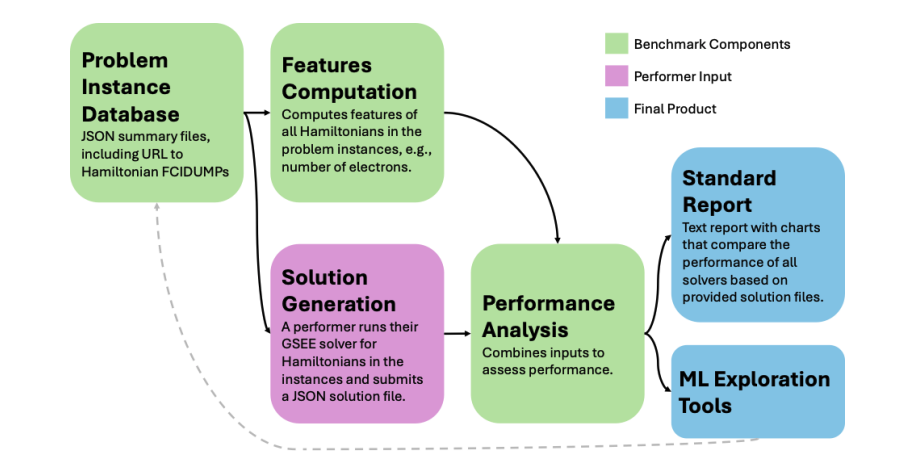
This work introduces a benchmarking framework, QB-GSEE, designed to evaluate the performance of both classical and quantum solvers for estimating ground state energy, a crucial task in condensed matter physics and chemistry. The researchers also analyzed a range of Hamiltonian features, identifying correlations between them and suggesting that reducing redundant features could refine the benchmarking process. The resulting database includes benchmark instances with known solutions and “guidestar” instances representing complex, unsolved problems, offering a comprehensive resource for evaluating solver capabilities. The authors acknowledge a bias within the current benchmark set, as many Hamiltonians are tailored to perform well with SHCI and related classical methods, and propose expanding the suite to include more strongly correlated systems for a more balanced evaluation. Future work will focus on refining the feature set and broadening the scope of the benchmark to better assess the potential of quantum solvers as hardware and algorithms advance.
🗞 QB Ground State Energy Estimation Benchmark
🧠 ArXiv: https://arxiv.org/abs/2508.10873


