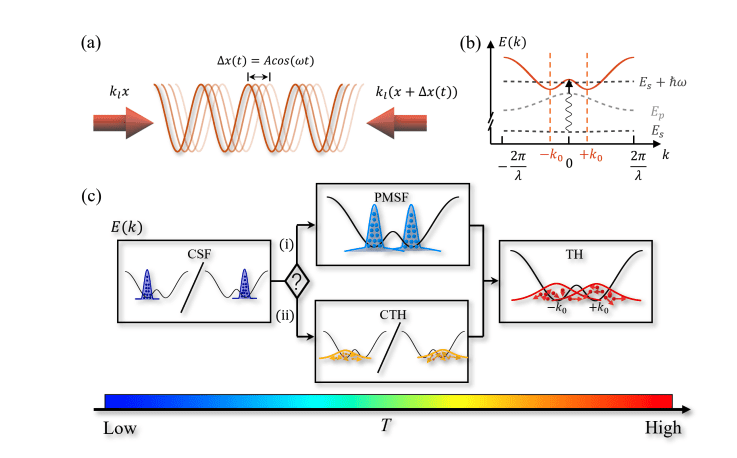
The behaviour of superfluids, materials exhibiting zero viscosity, continues to fascinate physicists seeking to understand complex quantum phenomena. Recent research focuses on ‘vestigial orders’ – subtle, residual patterns of organisation within these systems – and their implications for high-temperature superconductivity. Zhongcheng Yu, Chengyang Wu, et al. from Peking University and Fudan University now report experimental observation of the thermal melting of a chiral superfluid – a superfluid exhibiting a preferred ‘handedness’ – created using ultracold bosonic atoms trapped in a specifically engineered optical lattice. This lattice, created by shining lasers, possesses a ‘double-valley’ bandstructure, meaning the atoms can occupy two distinct energy minima. The team demonstrates how increasing temperature causes the chiral order to progressively degrade, first into a paramagnetic superfluid lacking the chiral preference, and ultimately into a normal, non-superfluid state. Their measurements of the transition temperatures between these phases reveal a complex interplay between superfluidity and the Ising model, a mathematical framework describing magnetic behaviour, under the influence of periodic driving – the ‘shaking’ of the optical lattice.
Recent investigations into multi-orbital superfluids garner attention due to their potential to illuminate the mechanisms underlying high-temperature superconductivity. Researchers now experimentally investigate thermal phase transitions in a chirally ordered superfluid created using ultracold bosonic atoms trapped in a shaken one-dimensional optical lattice. This system, engineered to possess a double-valley bandstructure via ‘Floquet engineering’—a technique employing periodic driving—exhibits both U(1) and time-reversal Z2 symmetries.
The experiment demonstrates a clear vestigial order melting process as temperature increases. Initially, the chiral superfluid undergoes a transition into a paramagnetic superfluid state, where time-reversal symmetry is lost but superfluidity persists. Further heating ultimately leads to a normal phase, devoid of both chiral order and superfluidity. Measurements of the critical temperatures for both the superfluid and Ising transitions reveal that the superfluid transition consistently occurs at a higher temperature than the Ising transition across the range of driving frequencies studied.
Notably, as the driving frequency approaches resonance, the temperature at which the Ising transition occurs decreases, while the superfluid transition temperature remains relatively stable. At significantly detuned driving frequencies, these two transitions converge into a single transition. These findings suggest a complex interplay between quantum and thermal fluctuations in periodically driven quantum systems, providing insights into the behaviour of multi-orbital superfluids and potentially informing the study of unconventional superconductivity. The researchers achieved this by creating a double-valley dispersion through lattice shaking, enabling the preparation of a Bose-Einstein condensate and precise temperature control via evaporative cooling.
Future work could focus on exploring the parameter space beyond the current frequency range to determine if the observed trends persist. Investigating the impact of varying interaction strengths and lattice geometries could further elucidate the mechanisms governing these phase transitions. Furthermore, extending these experiments to explore the dynamics of the vestigial order melting process—for example, by employing time-resolved measurements—would provide a more complete understanding of the underlying physics and potentially reveal novel quantum phenomena.
More information
Vestigial Order Melting of a Chiral Atomic Superfluid in a Double-Valley Optical Lattice
DOI: https://doi.org/10.48550/arXiv.2507.07494