Controlling heat flow is crucial for improving the efficiency of electronic devices and managing thermal radiation, yet achieving precise, remote thermal control remains a significant challenge. Sebastiano Battisti, Matteo Pioldi, Alessandro Paghi, and colleagues at NEST, Istituto Nanoscienze-CNR and Scuola Normale Superiore, now demonstrate a novel approach to thermal modulation using a semiconductor-superconductor hybrid device. Their work establishes a system capable of remotely controlling heat transfer via radiative effects, achieving temperature modulation exceeding previous efforts by more than tenfold and demonstrating a substantial thermal transimpedance. This breakthrough paves the way for advanced heat management in integrated circuits and innovative solutions for controlling thermal radiation, offering the potential to direct heat flow with unprecedented precision to distant, electrically isolated components.
Josephson Thermometer Calibration and Characterisation
This supplementary information provides detailed supporting data and explanations for the main paper’s findings, focusing on calibration and characterisation of materials and devices used in the experiments. It validates the methods employed and allows other researchers to understand how the results were obtained and assess their reliability. The document details the calibration of Josephson thermometers, essential for accurate temperature measurement, and provides data on their operating ranges, spanning from 30 to 730 millikelvin. Researchers characterised a twin Josephson Field-Effect Transistor (JoFET) architecture, verifying its functionality and ruling out unwanted parasitic effects.
The team confirmed that the switching current of the JoFET decreases with increasing temperature and exhibits behaviour similar to a Superconducting Quantum Interference Device (SQUID) in the presence of a magnetic field, validating the fabrication process and ruling out magnetic interference for tuning heat transfer. Detailed measurements of electron-phonon coupling within the InAs on Oxide heterostructure were also performed. By fitting experimental data, scientists extracted key coupling parameters that remained relatively constant at low temperatures, simplifying analysis and increasing confidence in the thermal model. However, the coupling became less reliable at higher temperatures, indicating a limit to the model’s validity.
Radiative Heat Transfer in Semiconductor Hybrids
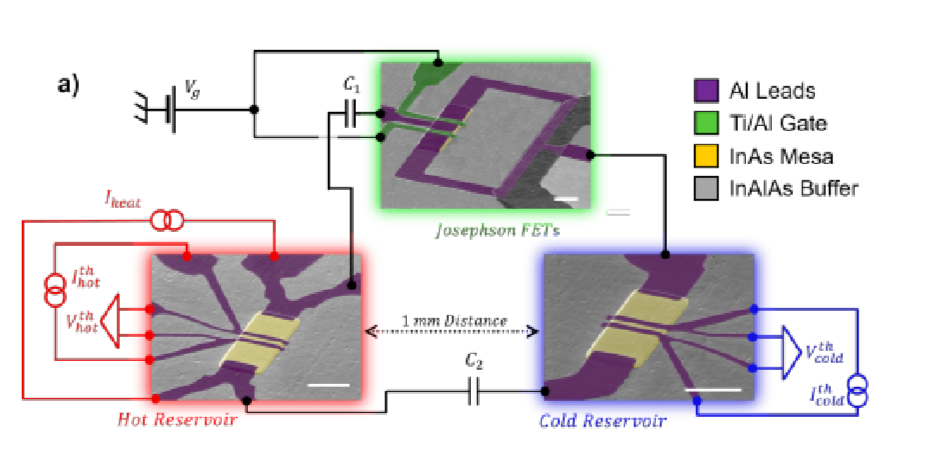
Scientists engineered a novel platform for investigating thermal modulation using a semiconductor-superconductor hybrid structure, demonstrating radiative heat transfer between spatially separated reservoirs. The architecture features two InAs mesas, macroscopically spaced 1 millimeter apart on a chip, functioning as hot and cold thermal reservoirs, and interconnected via non-galvanic electrical circuits. Researchers fabricated the devices using established techniques, including e-beam evaporation and atomic layer deposition, creating a meticulously controlled system for heat transfer studies. The InAs layer interfaces effectively with superconductors, enabling the creation of superconducting single-flux-quantum (SSmS) Josephson junctions and Josephson field-effect transistors (JoFETs).
The study pioneered a method for precise, nonlocal control of heat flow by employing a gate-tunable JoFET as a thermal current modulator, connected in parallel with the reservoirs. This device, fabricated with a thin hafnium oxide insulating layer, allows for voltage control of the InAs channel’s electron density, thereby influencing photonic heat transfer. Each reservoir, equipped with SSmS Josephson junctions functioning as thermometers, allows for monitoring of electronic temperature. Researchers performed temperature measurements sequentially to minimize thermal disturbances, driving current through each junction and measuring the resulting voltage drop to determine electron temperature. External control of the hot reservoir’s temperature is achieved by injecting a heating current, and capacitors provide galvanic isolation between the heating circuit, the cold reservoir, and the JoFET. This innovative approach achieves a temperature modulation of up to millikelvin, exceeding prior findings by more than an order of magnitude, and demonstrates a thermal transimpedance of millikelvin per volt at a bath temperature of millikelvin.
Radiative Heat Control Via Field-Effect Transistor
This work demonstrates a groundbreaking advance in thermal management through the development of a field-effect-controllable semiconductor-superconductor hybrid structure capable of modulating heat transfer via radiative mechanisms. The device utilizes a superconducting Josephson field-effect transistor to regulate heat currents without requiring magnetic fields, achieving a temperature modulation of up to millikelvin, exceeding previous results by more than tenfold. Experiments reveal a thermal transimpedance of 5. 5x 10⁻³ mK/V at a bath temperature of 30 millikelvin, demonstrating precise control over heat flow.
The research team injected heat into a hot reservoir and measured the resulting temperature change in a cold reservoir, separated by millimeters and connected only through radiative heat transfer. By varying the gate voltage applied to the Josephson field-effect transistor, scientists manipulated the photonic transport between the reservoirs, transitioning between transmissive and reflective states. Results show that for gate voltages less than -2. 5V, the temperature of the cold reservoir decreases for all tested hot reservoir temperatures, except the highest at 470 millikelvin, indicating a reduction in heat transfer.
Detailed analysis reveals that the observed modulation arises from impedance matching within the circuit, enhanced by the inductive properties of the superconducting transistor. Numerical simulations, validated by experimental data, confirm the ability to precisely control the temperature of the cold reservoir through gate voltage adjustments. The team determined key parameters for InAs materials used in the device, including an electron-phonon coupling constant of 5. 5x 10⁸ Wm-3/K and a power law exponent of 6. 7, crucial for optimizing device performance and simulations. This innovative approach offers a pathway towards advanced heat management in microchips and radiation shielding, enabling precise, nonlocal control of heat flow even when the heat source and destination are distant and electrically isolated.
Wireless Thermal Control Via Radiative Transfer
This research demonstrates a significant advance in controlling heat flow through a novel hybrid semiconductor-superconductor circuit. Scientists successfully fabricated a device capable of modulating temperature by utilizing radiative heat transfer between two reservoirs separated by a millimeter, achieved without any direct electrical connection. The core of this achievement lies in the use of a Josephson field-effect transistor to regulate heat currents, enabling a temperature modulation exceeding previous results by more than tenfold, reaching up to 45 microkelvins. This precise control is facilitated by manipulating black-body radiation, offering a completely wireless and non-galvanic method for thermal management.
The team’s device exhibits a thermal transimpedance of microkelvins per volt, demonstrating efficient conversion of electrical signals into thermal control. Importantly, the InAsOI platform used in the fabrication proves suitable for these experiments due to its minimal electron-phonon coupling and compatibility with sensitive thermometers. While the current device operates at bath temperatures up to 170 millikelvins, this work establishes a new benchmark in electrostatic manipulation of radiative heat transfer and paves the way for practical on-chip heat management systems. The authors acknowledge that further research is needed to optimize the device for higher operating temperatures and explore its potential in diverse applications, including radiation detection, quantum computing, and thermal logic. This work represents a crucial step towards developing advanced thermal routing and management solutions for future technologies.
🗞 Giant thermal modulation via a semiconductor-superconductor photonic field-effect heat transistor
🧠 ArXiv: https://arxiv.org/abs/2510.17683