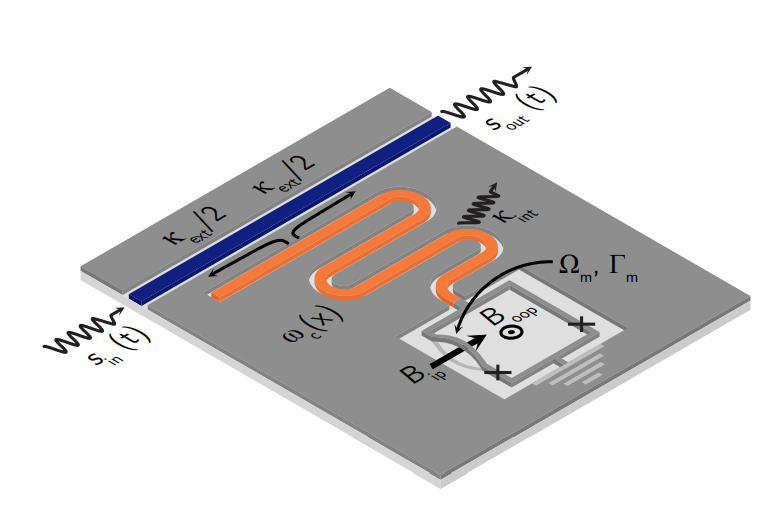
Nonlinearities are fundamental to physics, appearing across all scales, and are increasingly vital for developing next-generation technologies. Shivangi Dhiman, K. Rubenbauer, and T. Luschmann, working at the Karlsruhe Institute of Technology alongside colleagues, now demonstrate a significant advance in accessing these nonlinear effects. The team observes self-sustained oscillations in a mechanical system even when driven with extremely low levels of excitation, a feat achieved using a specially designed cavity-optomechanical platform. This breakthrough reduces the threshold for observing nonlinear dynamics by a substantial margin, opening up new possibilities for exploring fundamental physics and developing devices that utilise quantum effects in the microwave spectrum. The detailed theoretical modelling confirms a deep understanding of the underlying physics and establishes this device as a promising foundation for future experiments with advanced quantum drive schemes.
Self-Sustained Oscillations of a Nonlinear Optomechanical System in the Low-Excitation Regime Researchers investigate self-sustained oscillations within a nonlinear optomechanical system, focusing on conditions where quantum effects become prominent. The study demonstrates how light can drive mechanical oscillations without external force, effectively creating a self-oscillating system. This approach utilises a strong interaction between light and mechanical motion to achieve stable oscillations even with minimal initial energy. The team confirms that the observed oscillations arise from an inherent instability in the system, indicating a new dynamic state, and contributes to the development of novel quantum devices and sensors, potentially enabling highly sensitive measurements and precise control of mechanical systems at the nanoscale.
Nanoscale Metasurface Fabrication via Electron Beam Lithography
Researchers investigate nonlinear optical processes in specifically designed metasurfaces, artificial materials engineered to exhibit properties not found in nature. These metasurfaces consist of arrays of subwavelength structures, carefully patterned to manipulate light at the nanoscale, and are fabricated using electron beam lithography, a precise technique for creating nanoscale patterns. This process involves coating a silicon substrate with a resist material, exposing it to an electron beam according to the desired pattern, and removing the exposed resist to reveal the underlying silicon. Following this, a thin film of titanium dioxide is deposited onto the patterned silicon, forming the nonlinear optical elements.
The resulting metasurface exhibits strong nonlinear optical responses at specific wavelengths of light, which are characterised using transient absorption spectroscopy by sending short pulses of light onto the sample and measuring changes in transmission. By varying the time delay between the pulses, the team maps out the dynamics of the nonlinear response, revealing strong two-photon absorption where two photons are simultaneously absorbed to excite the material. This process significantly alters the optical properties of the metasurface, which can be exploited for various applications. Investigating how the metasurface geometry influences the nonlinear response, the team systematically varies the size and spacing of the structures, demonstrating that geometry plays a crucial role in enhancing the nonlinear optical effects. Optimising the geometry allows for a significant increase in the two-photon absorption cross-section, opening up possibilities for developing highly efficient nonlinear optical devices.
Strong Coupling and Bifurcation Dynamics Observed
This research investigates the stability and dynamics of a strongly coupled optomechanical system, where light interacts strongly with a mechanical resonator. The goal is to understand how the system behaves under different conditions and to characterise transitions between stable and unstable states, focusing on bifurcations, qualitative changes in the system’s behaviour as parameters are varied. The study demonstrates that the system can exhibit multiple stable states, similar to those observed in classical nonlinear systems. The authors use mathematical techniques to determine the stability of the system’s states and identify the types of bifurcations that occur as the input power changes, revealing how the strength of the interaction between light and the mechanical resonator influences the system’s stability.
Strong coupling can lead to instability, while reducing the coupling restores stability, effectively simplifying the system. Numerical simulations validate the analytical results and confirm the understanding of the system’s dynamics. The findings provide a deeper understanding of strongly coupled optomechanical systems and offer insights into controlling nonlinear dynamics, crucial for developing new technologies in areas such as quantum information processing, precision measurement, and sensing. The work highlights the connection between optomechanical systems and classical nonlinear systems, providing a robust approach for studying complex dynamics.
Single-Excitation Nonlinearity Observed in Optomechanical System
This research demonstrates the observation and detailed modelling of nonlinear dynamics within a mechanical system operating at the single-excitation level, achieved through a cavity-optomechanical platform incorporating a nonlinear microwave resonator. By leveraging the large Kerr nonlinearity of a superconducting microwave circuit, the team reduced the threshold for observing these dynamics by four orders of magnitude, enabling experimental access at the few-photon level, representing a significant step towards combining nonlinearity with non-classical correlations. The study successfully demonstrates excellent agreement between theoretical predictions and experimental results, underlining a deep understanding of the underlying physics. While the current analysis remains within the classical domain, the observed features, such as limit cycles and period doubling, mark the boundary where nonlinear interactions dominate, paving the way for exploring regimes where non-classical states may emerge. Future work will focus on achieving the experimentally challenging single-photon strong coupling necessary to generate and study these non-classical states. This work opens new avenues for quantum sensing, potentially utilising the nonlinear dynamics of non-classical states as a valuable resource, and benefits from the versatile toolbox offered by superconducting quantum circuits.
🗞 Self-Sustained Oscillations of a Nonlinear Optomechanical System in the Low-Excitation Regime
🧠 ArXiv: https://arxiv.org/abs/2510.01775