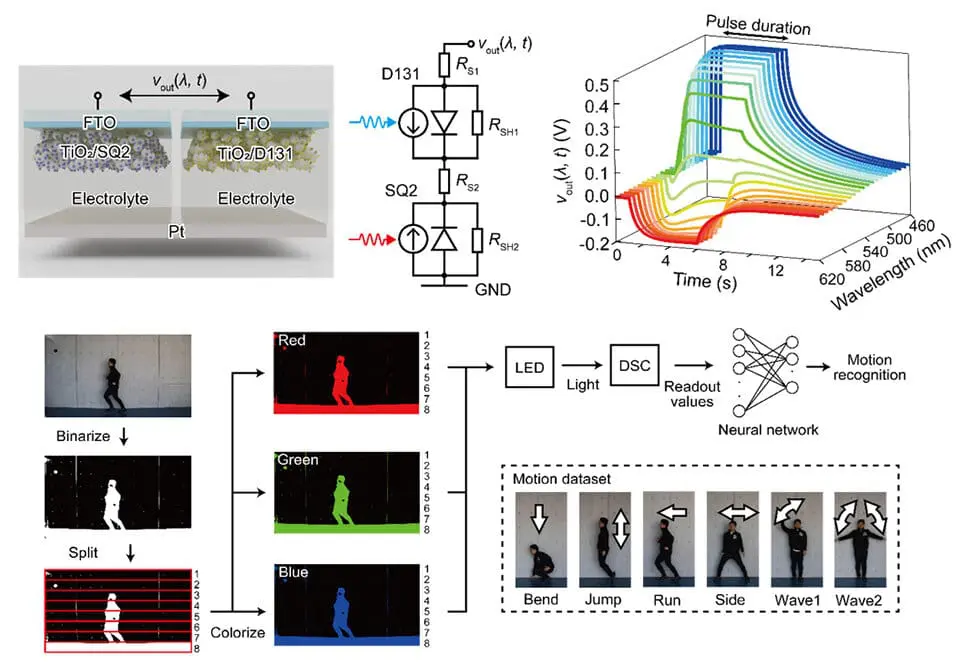
Researchers at Tokyo University of Science have developed a self-powered artificial synapse capable of colour discrimination approaching human visual acuity. Published on 12 May 2025 in Scientific Reports, the device, led by Associate Professor Takashi Ikuno with co-authors Hiroaki Komatsu and Norika Hosoda, utilises two dye-sensitized solar cells to generate electricity from light and distinguish colours across a 10-nanometre resolution of the visible spectrum. Unlike conventional optoelectronic systems requiring external power, this synapse exhibits bipolar responses to different wavelengths – positive voltage for blue light and negative for red – enabling complex logic operations and demonstrating potential for low-power machine vision in applications such as autonomous vehicles, wearable healthcare devices, and portable recognition systems. The system achieved 82% accuracy classifying 18 colour and movement combinations using a single device in a reservoir computing framework.
Neuromorphic vision systems are rapidly advancing, and researchers are developing innovative approaches to create energy-efficient and compact devices. The compact design and self-powered operation offer advantages for integration into various devices. The system’s ability to process information with minimal energy consumption is a key feature.
A team led by Ikuno developed a novel artificial synaptic operation that moves beyond reliance on conventional power sources, achieving self-powered operation. This system utilises dye-sensitised solar cells to harvest light and power the device, and colour discrimination is achieved through this self-powered operation.
Reservoir computing is employed to process temporal information, enabling the system to recognise gestures. Reservoir computing is a computational framework that uses a fixed, randomly connected recurrent neural network – the ‘reservoir’ – to map input signals into higher-dimensional spaces, simplifying the task of processing time-varying data.
The device demonstrates the potential for low-power vision applications, including wearable sensors and robotics. This capability expands the possibilities for deployment in resource-constrained environments and portable devices.
More information
External Link: Click Here For More