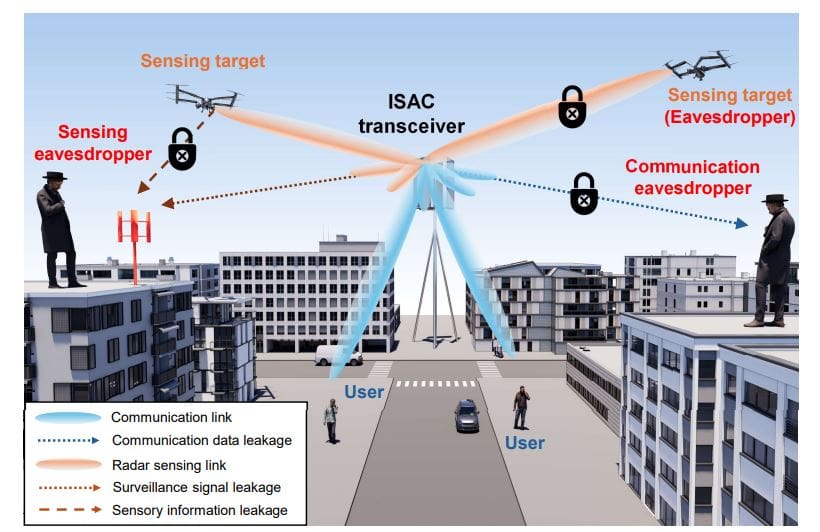
The convergence of communication and radar sensing, a key technology for future sixth-generation (6G) networks, presents both exciting opportunities and previously unaddressed security challenges. Kawon Han, Christos Masouros, and colleagues from University College London, alongside Taneli Riihonen from Tampere University and Moeness G. Amin from Villanova University, investigate vulnerabilities arising from this tight integration of functions in multiple-input multiple-output (MIMO) systems. Their work reveals that the high-power signals used for sensing, and the echoes they generate, create new avenues for eavesdropping and information leakage, extending beyond traditional security concerns. This research explores these unique threats and proposes countermeasures, including innovative signalling designs and transceiver optimisation, to build secure integrated sensing and communication systems for next-generation wireless networks.
Waveform Design for Sensing and Communication
Scientists are extensively researching integrated sensing and communication (ISAC), exploring methods to simultaneously perform sensing and communication without requiring signal remodulation. Researchers are investigating waveforms like Orthogonal Frequency Division Multiplexing (OFDM) and Orthogonal Time Frequency Space (OTFS), leveraging their flexibility for both radar and communication applications. Exploiting millimeter-wave frequencies and massive MIMO architectures is also prominent, aiming to enhance resolution and capacity in ISAC systems. This work addresses security threats, including spoofing, jamming, replay attacks, and target obfuscation, alongside privacy concerns related to channel state information.
Consequently, research focuses on low probability of intercept (LPI) signals, which are difficult for adversaries to detect. Researchers are developing countermeasures to these threats, including artificial noise to confuse eavesdroppers and jammers, and sensing-resistance-oriented waveform designs. Passive radar, which utilizes existing signals of opportunity like DVB-T transmissions, offers stealth and reduced interference. Crucially, scientists are building and validating ISAC concepts using testbeds like ARESTOR and BEEMER, alongside massive MIMO platforms, to move beyond theoretical research towards practical implementation.
Emerging areas include securing sensing in near-field scenarios and using reconfigurable intelligent surfaces (RIS) to deceive radar systems, alongside exploiting environmental scatterers to mislead eavesdroppers. Overall, research demonstrates a growing focus on security and privacy in ISAC systems, alongside a move towards practical implementation and validation through testbeds. This interdisciplinary field requires expertise in signal processing, communication theory, radar systems, and security, providing a comprehensive overview of the current state of research.
Radar-centric Transceiver Designs for Secure ISAC
Scientists are pioneering integrated sensing and communication (ISAC) as a cornerstone of sixth-generation (6G) wireless networks, enabling simultaneous data transmission and radar sensing. Multiple-input multiple-output (MIMO) technology provides the necessary flexibility for these dual functions. Researchers developed innovative methods to address unique security challenges inherent in ISAC systems, where high-power transmissions and intercepted echoes could reveal sensitive information. The study focuses on transceiver designs, examining both transmitter and receiver architectures, including full-duplex implementations, to mitigate these vulnerabilities.
To achieve this dual functionality, scientists are exploring radar-centric designs, directly modulating radar pulses with communication data. These systems preserve traditional radar waveforms, such as linear frequency modulation, frequency-modulated continuous wave, and phase-modulated continuous wave, while embedding data through techniques like slow-time coding and fast-time coding. Researchers are investigating index modulation (IM) as a means to expand the available degrees of freedom for both sensing and communication. In this approach, communication symbols are represented not by traditional in-phase and quadrature components, but by variations in radar parameters.
Scientists demonstrated that by altering parameters like array weights, pulse waveform shapes, central frequencies, signal bandwidth, and array configuration, they can effectively encode and transmit data. For example, one implementation utilizes the real and complex levels of radar beam sidelobes to index and represent different communication symbols, allowing for efficient data transmission without compromising sensing performance. This innovative method allows the communication receiver to decipher the transmitted signal by utilizing a dictionary mapping between radar parameter values and corresponding symbols.
ISAC Security and Performance Limits Demonstrated
Recent research demonstrates the potential of integrated sensing and communications (ISAC) as a key technology for sixth-generation (6G) wireless networks, enabling simultaneous data transmission and accurate radar sensing. Scientists achieved breakthroughs in transceiver design, focusing on multiple-input multiple-output (MIMO) systems, and explored methods to enhance security against potential eavesdropping and information interception. The work highlights the importance of addressing unique security vulnerabilities inherent in ISAC systems, extending beyond conventional physical-layer security approaches. Researchers investigated performance metrics for ISAC systems, including the Cramer-Rao Lower Bound (CRLB), a theoretical limit on estimation accuracy.
Experiments revealed that a joint design approach extends the achievable trade-off region between CRLB and signal-to-interference-plus-noise ratio (SINR), yielding improved performance compared to conventional beamforming techniques. Further analysis incorporated Bayesian CRLB, relaxing the requirement for precise knowledge of target parameters, and explored metrics such as sensing SINR, mutual information, and Kullback-Leibler divergence to evaluate system performance. A significant breakthrough came with the concept of constructive interference (CI), where interference is intentionally shaped to enhance communication reliability and improve instantaneous sensing performance. Scientists demonstrated that CI pushes received signals away from decision boundaries in modulated symbol constellations, effectively increasing useful signal power.
This led to the development of symbol-level precoding (SLP), a technique that operates on a symbol-by-symbol basis, exploiting both channel state information and data symbol knowledge to control interference direction at communication users. In a multi-user system, experiments showed that SLP can satisfy communication constraints while simultaneously shaping favorable radar characteristics. The optimization problem for SLP-based joint signaling ISAC design was formulated to maximize a weighted combination of communication and sensing objectives, subject to constraints on power budget and constant-modulus conditions. Results demonstrate that SLP guarantees simultaneous contributions to both communication and sensing objectives on an instantaneous basis, unlike block-level designs that optimize signals statistically over multiple snapshots. This approach ensures consistent sensing performance metrics, such as beampattern matching and sidelobe suppression, even in highly dynamic environments.
Secure Sensing, Communication and Vulnerability Analysis
MIMO transceiver technologies underpin integrated sensing and communication systems, offering the flexibility to simultaneously perform radar sensing and wireless communication. This work examined recent advances in MIMO transceiver design for these systems, establishing fundamental approaches for dual-functionality and highlighting emerging physical-layer security vulnerabilities unique to this integrated approach. Researchers also summarized recent solutions that jointly address sensing, communication, and security concerns, demonstrating the potential of secure waveform designs to protect data confidentiality.
👉 More information
🗞 Next-Generation MIMO Transceivers for Integrated Sensing and Communications: Unique Security Vulnerabilities and Solutions
🧠 ArXiv: https://arxiv.org/abs/2511.20309