

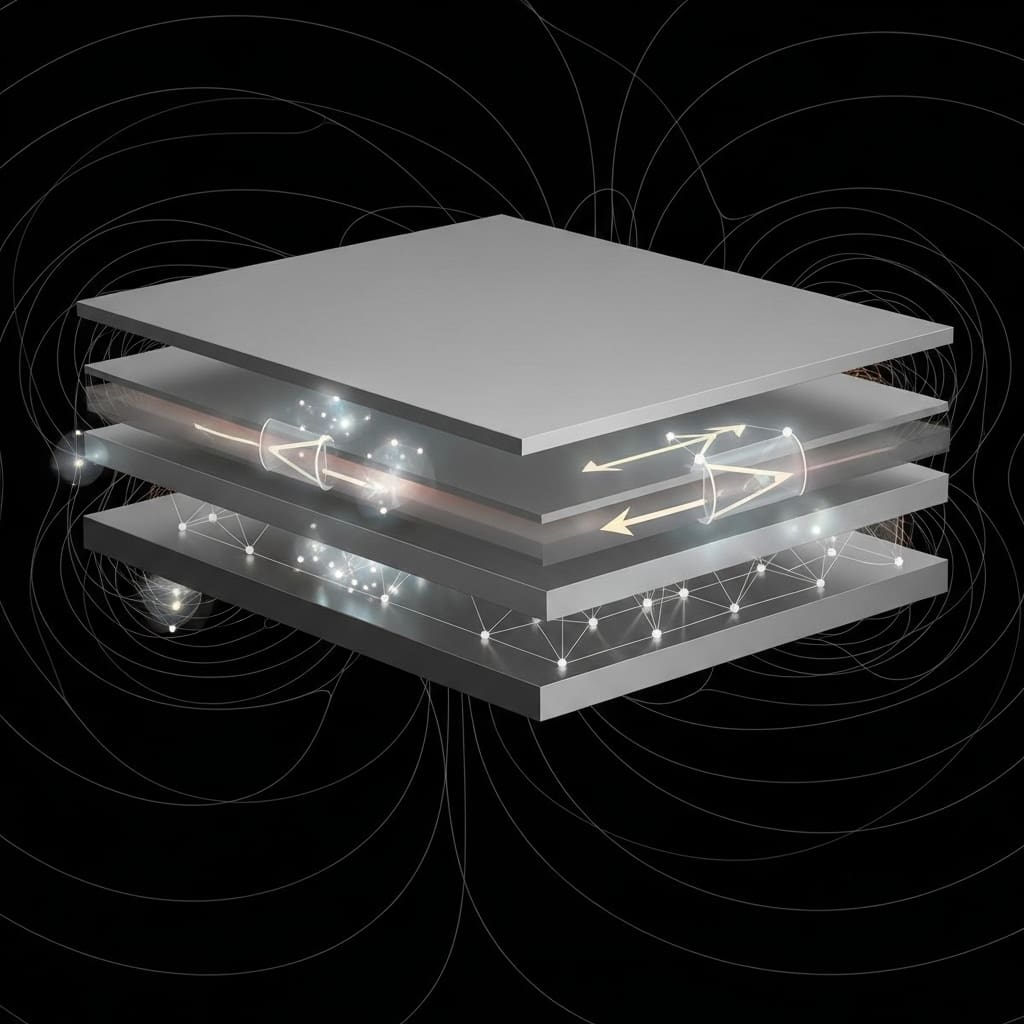
The unusual orbital alignments of Neptune-sized exoplanets continue to challenge established theories of planetary formation. Luke Handley and Konstantin Batygin, both from the California Institute of Technology, alongside colleagues, demonstrate a novel mechanism for tilting these planets into highly inclined, polar orbits. Their research reveals how photo-evaporation within the protoplanetary disk itself can drive these orbital changes, eliminating the need for previously proposed external planetary companions. This process relies on the shrinking and precession of the inner disk, resonantly exciting the planet’s orbit and explaining the observed distribution of planetary obliquities. The findings offer a significant step forward in understanding the dynamics of planetary systems and the factors shaping their architecture.
The observed dichotomy of aligned and perpendicular orbital configurations suggests obliquity excitation through secular resonance, a process whereby the precession of a hot Neptune becomes locked onto a forcing frequency, slowly guiding it into a perpendicular state. Previous models of resonant capture have often invoked the presence of companion perturbers within the star-planet-disc system, however, such companions are not consistently confirmed. This work presents a mechanism for exciting Neptunes to polar orbits in systems lacking giant perturbers, proposing photo-evaporation as the self-contained driving force. Photo-evaporation opens a gap in the protoplanetary disc, initiating a chain of events that ultimately leads to significant orbital tilting. The research focuses on understanding how this process can account for the observed population of highly inclined exoplanets and their formation epoch.
Photoevaporation-Driven Resonance Excites Planetary Obliquity The observed alignment
The study addresses the puzzling prevalence of aligned and perpendicular stellar spin-angles observed in Neptune-sized exoplanets, proposing a novel mechanism for exciting planetary obliquity without requiring giant planetary perturbers. Researchers developed a model centered on photo-evaporation within the protoplanetary disk, initiating the process at approximately 1 astronomical unit. This photo-evaporation creates a gap in the disk, allowing the inner disk to viscously accrete onto the host star while simultaneously precessing rapidly due to perturbation from the outer disk. Crucially, the team demonstrated that as the inner disk shrinks, its precession slows, eventually encountering a resonance with the J2 precession of the Neptune.
This resonance rapidly excites the planet into a polar configuration, effectively tilting its orbit perpendicular to the star’s rotational axis. The research employed detailed modelling of disk dynamics, focusing on the interplay between viscous accretion and precession rates to accurately simulate the resonant capture process. This approach enables the reproduction of observed obliquities for smaller planets, distinguishing it from scenarios where massive planets induce back-reactions onto the disk. Scientists harnessed existing observational data, including measurements of exoplanet spin-orbit angles obtained via the Rossiter McLaughlin effect, to validate the model’s predictions.
The study built upon a database of over 200 obliquity measurements compiled in the TEPCat database, allowing for a robust comparison between model outputs and observed planetary configurations. Analysis revealed a distinct dichotomy in Neptune spin-orbit angles around cool stars, with populations exhibiting either alignment or dramatic polar inclinations, a pattern not predicted by conventional dynamical explanations like the von Zeipel-Kozai-Lidov mechanism or planet-planet scattering. The work pioneers a new understanding of planetary obliquity evolution, suggesting that disk-driven processes can dominate for lower-mass planets where tidal realignment effects are less significant. By focusing on the self-contained dynamics of the protoplanetary disk, the study offers a compelling alternative to models requiring external perturbing bodies, providing a framework for interpreting the observed distribution of exoplanetary spin-orbit angles and furthering our understanding of planetary system formation.
Photo-evaporation Drives Extreme Exoplanet Orbital Tilt
Scientists have uncovered a novel mechanism explaining the peculiar tilted orbits of Neptune-sized exoplanets, challenging previous theories reliant on the presence of additional, massive companion planets. This work details how photo-evaporation within a protoplanetary disk can independently drive these planets towards highly inclined, nearly 90-degree orbits, even in isolated planetary systems. Experiments reveal that the process begins with the opening of a gap in the disk at approximately 1 astronomical unit (AU) due to photo-evaporation, a phenomenon where stellar radiation disperses the disk material. The team measured how the inner disk, continuing to accrete material onto the star, precesses rapidly due to the influence of the outer disk.
As the inner disk shrinks, its precession slows, eventually entering into a resonance with the Neptune’s orbital precession, a critical point where the lines of node become aligned. This resonant capture amplifies the planet’s obliquity, effectively tilting its orbit towards a polar configuration. Calculations demonstrate that this mechanism successfully reproduces the observed orbital inclinations of smaller planets, a feat previously requiring the presence of external gravitational perturbers. Data shows that the outer disk possesses significantly more angular momentum than the inner disk, with a ratio exceeding 103, allowing the outer disk to dominate the inner disk’s dynamics without significant back-reaction.
Researchers computed the evolution of both the inner and outer disk systems, utilising a continuous surface density profile with a surface density of 1500g cm−2 at 1 AU. This model assumes an initial disk extending to approximately 100 AU, consistent with observational data, and a magnetic truncation radius of 0.1 AU. The breakthrough delivers a compelling explanation for the observed misalignment between stars and their planets, particularly for smaller exoplanets which act as tracers of the system’s early dynamical evolution. Measurements confirm that this process is most effective for Neptune-sized planets, as larger planets would exert a reciprocal influence on the disk, complicating the dynamics. This research opens new avenues for understanding planetary system formation and the prevalence of tilted orbits around distant stars, offering a self-contained explanation without invoking unseen companion planets.
👉 More information
🗞 Secular Excitation of Polar Neptune Orbits in Pure Disk-Planet Systems
🧠 ArXiv: https://arxiv.org/abs/2601.04140


