Quantized electrical transport, essential for next-generation electronic devices, remains a significant challenge in emerging materials known as quantum spin Hall insulators, hindering their potential in advanced technologies. Now, Bilal Kousar, Selma Franca, David Perconte, and colleagues at the University of Grenoble Alpes demonstrate robust and reproducible quantized transport in a quantum Hall topological insulator, achieving stable results at low magnetic fields by employing a metallic screen to counteract long-range electrical interactions. The team further reveals a method for controlling individual electrical channels using specifically designed junctions, a capability previously unattainable in similar materials, and identifies a common cause of signal breakdown related to unintended electrical interfaces. These findings establish a new, gate-tunable helical system with spatially separated channels and compatibility with superconducting materials, paving the way for innovative topological devices with enhanced performance and reliability.
Disorder Effects on Helical Edge Transport
Researchers used simulations to investigate helical edge states in two-dimensional electron systems, focusing on the impact of imperfections and contact properties. The team employed the Kwant software package to model electrical transport, examining how disorder affects the quantization of conductance, a key characteristic of topological insulators. Simulations revealed that increasing contact width is crucial for achieving quantized resistance, allowing helical edge states to fully equilibrate and stabilize, and that contact disorder plays a significant role in this process. Disorder can impede current flow but also mixes counter-propagating edge states, leading to a more stable and quantized conductance. These findings validate theoretical predictions about quantized resistance values and help explain challenges in observing clear quantization in real devices, providing insights into factors that need to be controlled for optimal performance. This work provides strong evidence that disorder and contact properties are key determinants of transport behavior in topological insulators, bridging the gap between theory and experiment.
Gate-Tunable Helical Transport in Quantum Hall Insulators
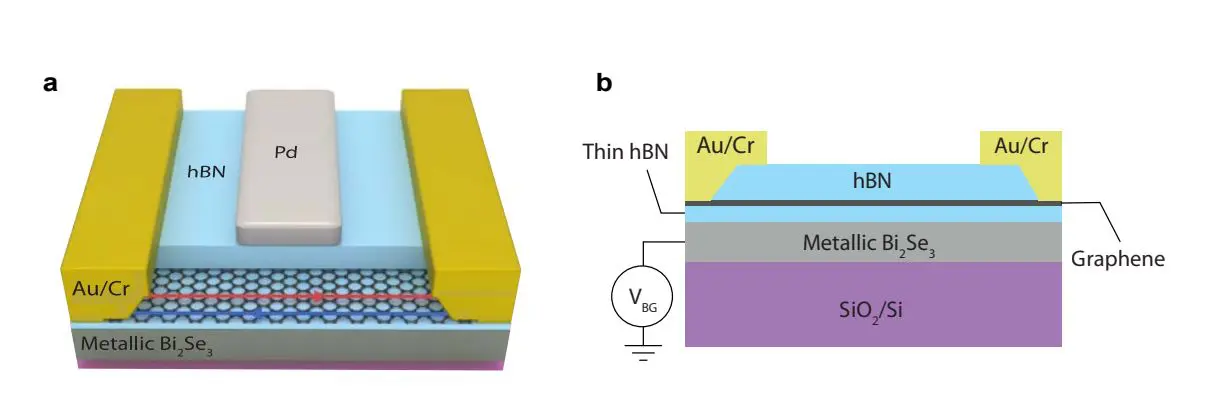
Scientists have engineered a quantum Hall topological insulator capable of supporting robust and reproducible quantized transport, overcoming a significant obstacle to realizing topological superconductivity. The team stabilized the system at low magnetic fields by screening long-range Coulomb interactions with a metallic bismuth selenide back gate, effectively suppressing unwanted effects and promoting spin polarization. This approach established a system where helical transport can be tuned using an external gate, and spatially separated helical channels can be created. Researchers fabricated devices incorporating electrostatic top gate electrodes to locally modulate the filling factor, while maintaining charge neutrality in the surrounding quantum Hall phase.
This configuration created junctions that selectively transmit or backscatter a single helical channel, a capability previously unavailable in time-reversal symmetric quantum spin Hall systems. Two-terminal resistance measurements at 1. 8 Tesla, varying both top and back gate filling factors, mapped the system’s behavior, demonstrating mode-resolved control by tuning the central region to specific filling factors. The study pioneered a spin-selective equilibration model, employing theoretical calculations to predict resistance values and compare them to experimental data. Resistance maps revealed characteristic plateaus typical of chiral quantum Hall junctions, and a horizontal offset indicated the presence of a quantum Hall topological insulator gap under the top gate. By carefully controlling the backscattering of individual helical edge states, the team achieved excellent agreement between experimental resistance values and theoretical predictions, providing definitive evidence of helical edge states in the screened graphene system.
Graphene Helical Edge States and Quantized Transport
This work establishes a robust platform for realizing helical edge states in graphene, demonstrating quantized transport stabilized by screening Coulomb interactions with a bismuth selenide back gate. Researchers achieved reproducible quantization of resistance, a key requirement for topological superconductivity, and demonstrated control over individual helical channels using gate-defined junctions, selectively transmitting or backscattering electrons, a capability not possible in conventional quantum spin Hall systems. Experiments revealed that contact-induced doping can disrupt quantization, creating unintended chiral-helical interfaces. However, the team found that utilizing larger area contacts effectively mitigates this issue by enhancing edge-channel equilibration.
Specifically, simulations showed that contact widths of 1. 4μm, corresponding to a normalized width of 56 relative to the magnetic length, are sufficient to restore the quantized resistance of 3/2 × h/e2 at a magnetic field of 1 Tesla. Measurements of two-terminal resistance in various device configurations confirmed the expected quantized values, such as 3/2 × h/e2 for a three-section configuration and h/e2 for a single section. Calculations and simulations detailed how the filling factor beneath gated regions influences edge state behavior. This research establishes a metal-screened graphene system as a promising foundation for topological devices, offering the potential to control edge excitation and create spin-selective transmission pathways.
Helical Edge State Control and Reproducibility
This research establishes a robust platform for realizing helical edge states in metal-screened graphene, demonstrating quantized transport and controllable manipulation of these states. Scientists achieved reproducible and robust quantized resistance, a key requirement for topological devices, by screening Coulomb interactions with a bismuth selenide back gate. Beyond simply observing quantization, the team demonstrated the ability to control individual helical channels using gate-defined junctions, selectively transmitting or backscattering electrons, a capability not found in conventional quantum spin Hall systems. The investigation also identified and mitigated a critical factor limiting reproducibility: contact-induced doping.
Through careful experimentation and simulation, researchers found that large area contacts promote edge-channel equilibration, effectively addressing unintentional chiral-helical interfaces that disrupt quantization. While this work confirms the existence of the quantum Hall topological insulator phase in screened graphene, maintaining charge neutrality within the topological system remains a challenge when integrating it with superconducting materials. Future work will likely focus on innovative device strategies, such as spatially selective gating or novel contact materials, to simultaneously achieve efficient superconducting proximity and preserve the helical symmetry essential for robust topological devices. This research provides a significant step towards realizing practical topological devices based on graphene, offering a pathway to control and manipulate helical edge states for future applications.
🗞 Chiral-helical junctions in screened graphene
🧠 ArXiv: https://arxiv.org/abs/2512.13256