
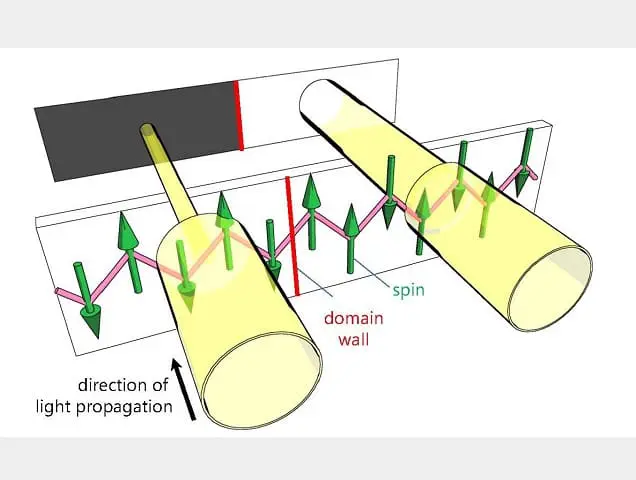
Scientists from Osaka Metropolitan University and the University of Tokyo have made a breakthrough in visualizing and controlling magnetic domains in quantum antiferromagnets, a type of material that doesn’t stick to metal surfaces. Led by Associate Professor Kenta Kimura, the team used light to visualize tiny magnetic regions within these materials, revealing that opposite domains coexist within a single crystal. They also demonstrated that these domain walls can be moved using an electric field, thanks to magnetoelectric coupling.
This achievement offers new insights into the complex behavior of magnetic materials at the quantum level, paving the way for future technological advances. Antiferromagnets are considered potential candidates for next-generation electronics and memory devices, but studying them has been challenging due to their low magnetic transition temperatures and small magnetic moments. The team’s innovative approach using nonreciprocal directional dichroism could lead to real-time visualization of moving domain walls in the future.
Illuminating Quantum Magnets: Unveiling Magnetic Domains with Light
The manipulation of magnetic materials at the quantum level has long been a subject of interest for physicists and technology developers alike. A recent study published in Physical Review Letters has made significant strides in this area, successfully visualizing and controlling magnetic domains in a specialized quantum material using light.
Visualizing Magnetic Domains with Nonreciprocal Directional Dichroism
Antiferromagnets, materials that exhibit no net magnetic field due to opposing magnetic forces or spins, have garnered attention for their potential applications in next-generation electronics and memory devices. However, studying these materials is a challenging task, particularly when it comes to observing magnetic domains – small regions within the material where atomic spins align in the same direction. Traditional observation methods have proven ineffective, prompting researchers to explore alternative approaches.
A team of scientists from Osaka Metropolitan University and the University of Tokyo employed nonreciprocal directional dichroism, a phenomenon where light absorption changes upon reversal of light direction or magnetic moments, to visualize magnetic domains within the quasi-one-dimensional quantum antiferromagnet BaCu2Si2O7. This innovative method allowed them to reveal that opposite domains coexist within a single crystal and that domain walls primarily align along specific atomic chains.
Manipulating Domain Walls with Electric Fields
The researchers also demonstrated the ability to move these domain walls using an electric field, thanks to magnetoelectric coupling – a phenomenon where magnetic and electric properties are interconnected. Notably, even when moved, the domain walls maintained their original direction. This achievement marks a significant step forward in understanding and manipulating quantum materials.
Implications for Future Quantum Devices
The study’s findings have far-reaching implications for the development of future quantum devices and materials. The optical microscopy method employed is straightforward and fast, potentially allowing real-time visualization of moving domain walls in the future. Moreover, applying this observation method to various quasi-one-dimensional quantum antiferromagnets could provide new insights into how quantum fluctuations affect the formation and movement of magnetic domains, ultimately aiding in the design of next-generation electronics using antiferromagnetic materials.
Future Directions and Applications
The successful visualization and control of magnetic domains in a quantum material using light opens up new possibilities for technological applications. Further research in this area could lead to developing novel devices that harness the unique properties of antiferromagnets, such as ultra-fast memory devices or advanced sensors. As researchers continue to explore the complex behavior of magnetic materials at the quantum level, they may uncover new frontiers in physics that could revolutionize our understanding of these enigmatic materials.
Funding and Acknowledgments
The study was funded by various organizations, including JSPS KAKENHI Grants, the MEXT Leading Initiative for Excellent Young Researchers (LEADER), the Murata Science and Education Foundation, and the Iketani Science and Technology Foundation. The authors acknowledge support from these institutions in their research endeavors.
Journal: Physical Review Letters
Title: Imaging and control of magnetic domains in a quasi-one-dimensional quantum antiferromagnet BaCu2Si2O7
DOI: 10.1103/PhysRevLett.133.086701
Authors: Masato Moromizato, Takeshi Miyake, Takatsugu Masuda, Tsuyoshi Kimura, and Kenta Kimura
Published: 22 August 2024
URL: https://doi.org/10.1103/PhysRevLett.133.086701