Deep beneath the France-Switzerland border, scientists at the Large Hadron Collider are on a mission to uncover the universe’s “missing matter.” Duke physicist Ashutosh Kotwal believes that the subatomic debris from proton collisions could hold clues to dark matter, an invisible substance five times more abundant than ordinary matter. Using artificial intelligence and image recognition, Kotwal hopes to capture these fleeting hints on camera.
The Large Hadron Collider’s detectors act like giant 3D digital cameras, taking continuous snapshots of particles produced by each collision. However, with 40 million snapshots per second, researchers need to act fast to spot the elusive tracks that could indicate dark matter. Kotwal has developed a “track trigger” algorithm that can process an image in under 250 nanoseconds, automatically weeding out uninteresting data points. His device, built directly onto a silicon chip, could help ensure that scientists don’t miss dark matter if it’s hiding among the particles produced by the collider.
Unveiling the Invisible: The Quest for Dark Matter at the Large Hadron Collider
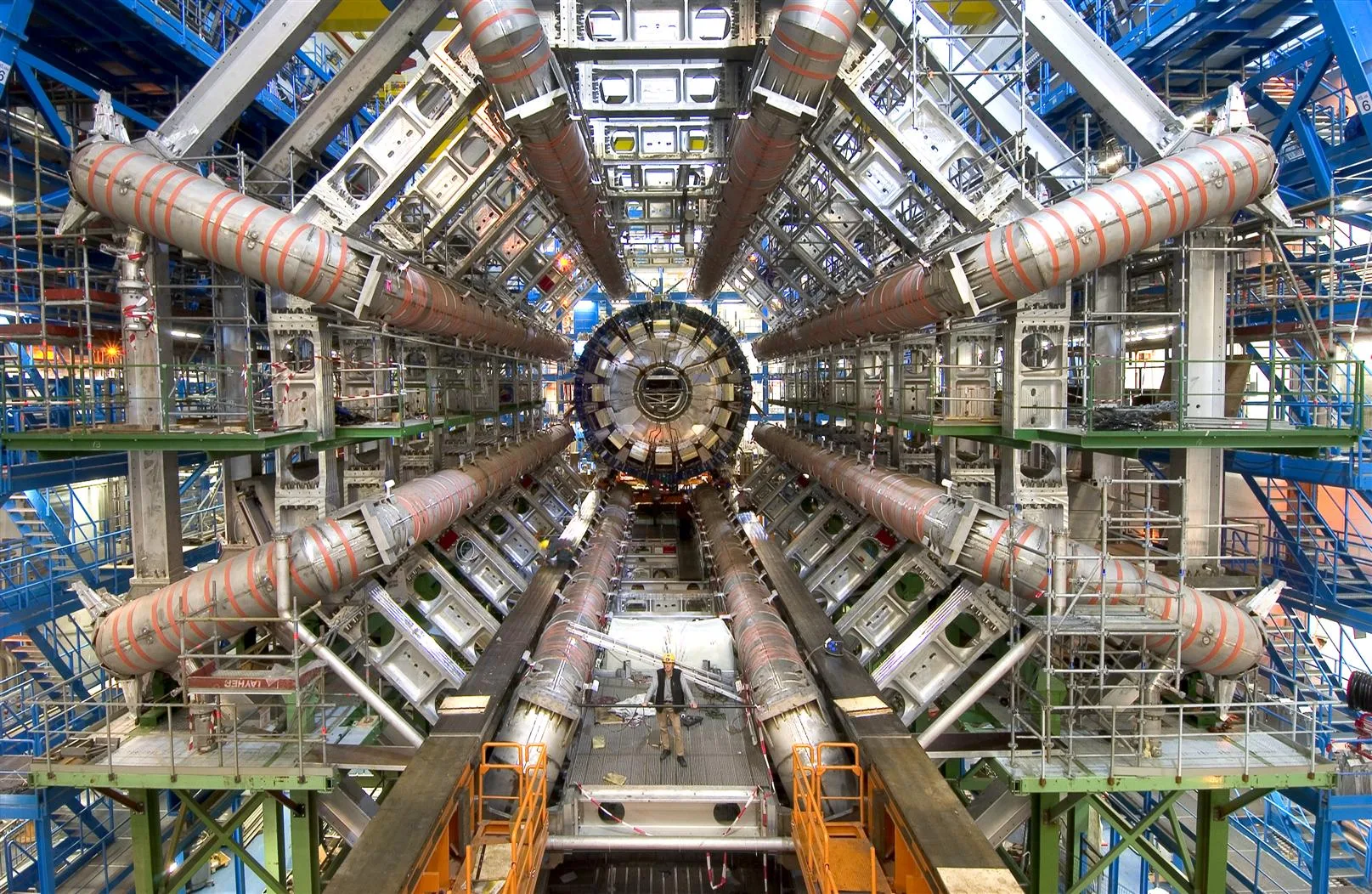
The Large Hadron Collider (LHC), situated 350 feet beneath the France-Switzerland border, is a hub of intense scientific activity. This massive device accelerates protons to nearly the speed of light, recreating conditions similar to those immediately after the Big Bang. Researchers like Duke physicist Ashutosh Kotwal believe that the subatomic debris from these collisions may hold clues to the universe’s “missing matter.” With the aid of artificial intelligence (AI), Kotwal aims to capture these fleeting hints on camera.
The Elusive Nature of Dark Matter
Ordinary matter, comprising people and planets, is only a fraction of what exists in the universe. Dark matter, an invisible entity five times more abundant than ordinary matter, remains shrouded in mystery. Its presence is inferred from its gravitational influence on stars and galaxies, but its nature remains unknown. The LHC offers a unique opportunity to uncover dark matter’s secrets using detectors that function like giant 3D digital cameras, continuously capturing snapshots of particles produced by proton-proton collisions.
The Hunt for Disappearing Tracks
Researchers believe that if dark matter is created at the LHC, it may manifest as a “disappearing act.” Heavy charged particles would travel a certain distance (around 10 inches) from the collision point before decaying invisibly into dark matter particles, leaving no trace. By retracing these particles’ paths, scientists could identify telltale “disappearing tracks” that vanish partway through the detector’s inner layers.
The Challenge of Data Overload
The LHC’s detectors capture an astonishing 40 million snapshots of flying particles every second. However, most of this raw data is uninteresting and cannot be stored indefinitely. Kotwal faces the daunting task of finding a needle in a haystack, as only one in a million images may hold the special signatures he seeks. Researchers have mere millionths of a second to determine if a particular collision is of interest and store it for later analysis.
The Power of Artificial Intelligence
Kotwal’s solution lies in developing a “track trigger,” a fast algorithm that can spot and flag fleeting tracks before the next collision occurs. His design employs multiple AI engines running simultaneously on a silicon chip, processing an image in under 250 nanoseconds and automatically weeding out uninteresting ones. Kotwal first described this approach in two papers published in 2020 and 2021, and recently demonstrated its feasibility on a silicon chip with his undergraduate student co-authors.
The Future of Dark Matter Detection
Kotwal and his students plan to build a prototype of their device by next summer, with the full device consisting of approximately 2000 chips expected to be installed at LHC detectors in three to four years. As the accelerator’s performance continues to improve, it will produce even more particles, increasing the likelihood of detecting dark matter. Kotwal’s technology aims to ensure that if dark matter production is occurring, scientists won’t miss it.
External Link: Click Here For More