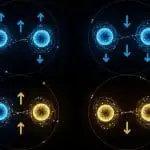
In a new development, researchers Sergio E Aguilar-Gutierrez and Filip Landgren have proposed a novel model that sheds light on the existence of multiple universes within our own universe. Dubbed T2dS wedge holography, this innovative framework attempts to explain the intricacies of the multiverse by cutting off empty AdS d1-space with accelerated dS d-space universes at a finite AdS boundary cutoff.
The model’s intricate construction involves gluing together multiple copies of this configuration in a periodic manner, allowing for the study of entanglement entropy and its implications for quantum cosmology. This pioneering work has far-reaching implications for our understanding of the multiverse and its properties, offering new insights into the nature of reality itself.
A New Multiverse Model: T2dS Wedge Holography
The concept of a multiverse has been a topic of interest in the scientific community for quite some time. Recently, researchers Sergio E Aguilar-Gutierrez and Filip Landgren have proposed a new model that attempts to explain the existence of multiple universes within the framework of T2dS wedge holography.
In this model, the authors propose that empty AdS d1-space is cut off by a pair of accelerated dS d-space universes at a finite AdS boundary cutoff. This cutoff is treated as a T2-deformation in the holographic dual and one in the AdS interior, denoted as the IR brane. The construction of this model is referred to as T2dS wedge holography.
The authors then periodically glue together several copies of this configuration along the UV cutoff and the IR branes. This process provides the model with dynamics similar to those of near Nariai black holes used in other multiverse toy models. The researchers specialize to d=2 and add dS JT gravity as an intrinsic gravity theory on the IR branes.
Understanding T2dS Wedge Holography
T2dS wedge holography is a novel approach to understanding the multiverse, which involves cutting off empty AdS d1-space with a pair of accelerated dS d-space universes at a finite AdS boundary cutoff. This process is treated as a T2-deformation in the holographic dual and in the AdS interior.
The authors propose that this model can be used to study the entanglement entropy with respect to a finite cutoff observer who finds a Page curve transition due to an entanglement island connecting the UV cutoff and IR brane. This process involves the coarse-graining of information outside the causally accessible region to the observer.
In essence, T2dS wedge holography explicitly realizes entanglement
In essence, T2dS wedge holography explicitly realizes entanglement between IR and UV degrees of freedom encoded in the multiverse. The researchers propose that this model can be used to study the dynamics of near Nariai black holes and provide insights into the nature of the multiverse.
Coarse-Graining Information in the Multiverse
The concept of coarse-graining information is crucial in understanding the behavior of the multiverse. In the context of T2dS wedge holography, the authors propose that the entanglement entropy with respect to a finite cutoff observer can be used to study the dynamics of the multiverse.
The researchers propose an information recovery protocol that involves coarse-graining information outside the causally accessible region to the observer. This process is essential in understanding the behavior of the multiverse and provides insights into the nature of entanglement between IR and UV degrees of freedom.
Braneworld Multiverse Model
The braneworld multiverse model is a theoretical framework that attempts to explain the existence of multiple universes within the context of string theory. The researchers propose that T2dS wedge holography can be used as a tool to study the dynamics of this model.
In this model, the authors propose that gravity on a 1D-dimensional antide Sitter AdS d1-space region bounded by a pair of end-of-the-world ETW branes is dual to a CFT d1-theory living on the interception between the branes. This is realized within the Karch-Randall KR braneworld models.
De Sitter Wedge Holography and T2-Deformations
The concept of de Sitter wedge holography is crucial in understanding the behavior of the multiverse. The researchers propose that this model can be used to study the dynamics of near Nariai black holes and provide insights into the nature of the multiverse.
In this context, the authors propose that T2-deformations can be used as a tool to study the behavior of the multiverse. This process involves cutting off empty AdS d1-space with a pair of accelerated dS d-space universes at a finite AdS boundary cutoff.
Incorporating T2-Deformations
The incorporation of T2-deformations into the braneworld multiverse model is essential in understanding the multiverse’s behavior. The researchers propose that this process can be used to study the dynamics of near Nariai black holes and provide insights into the multiverse’s nature.
In this context, the authors propose that the entanglement entropy for a finite cutoff observer can be used to study the dynamics of the multiverse. This process involves coarse-graining information outside the causally accessible region to the observer.
Multiverse Models from JT dS Wedge Holography
Multiverse Models from JT dS Wedge Holography
The researchers propose that T2dS wedge holography can be used as a tool to study the dynamics of near Nariai black holes and provide insights into the nature of the multiverse. In this context, the authors propose that the entanglement entropy with respect to a finite cutoff observer can be used to study the dynamics of the multiverse.
The incorporation of JT dS gravity on the IR brane is essential in understanding the behavior of the multiverse. The researchers propose that this process can be used to study the dynamics of near Nariai black holes and provide insights into the nature of the multiverse.
Central Dogma and Quantum Cosmology Interpretation
The central dogma and quantum cosmology interpretation are crucial concepts in understanding the behavior of the multiverse. The researchers propose that T2dS wedge holography can be used as a tool to study the dynamics of near Nariai black holes and provide insights into the nature of the multiverse.
In this context, the authors propose that the entanglement entropy concerning a finite cutoff observer can be used to study the dynamics of the multiverse. This process involves coarse-graining information outside the causally accessible region to the observer.
Discussion
The researchers propose that T2dS wedge holography explicitly realizes entanglement between IR and UV degrees of freedom encoded in the multiverse. Incorporating JT dS gravity on the IR brane is essential in understanding the behavior of the multiverse.
In this context, the authors propose that the central dogma and quantum cosmology interpretation can be used to study the dynamics of near Nariai black holes and provide insights into the nature of the multiverse. The researchers conclude that T2dS wedge holography is a novel approach to understanding the multiverse and offers new insights into the behavior of this complex system.
Publication Date: 2024-11-21
Authors: Sergio E. Aguilar-Gutierrez and Filip Landgren
Source: Journal of High Energy Physics
DOI: https://doi.org/10.1007/jhep11(2024)122