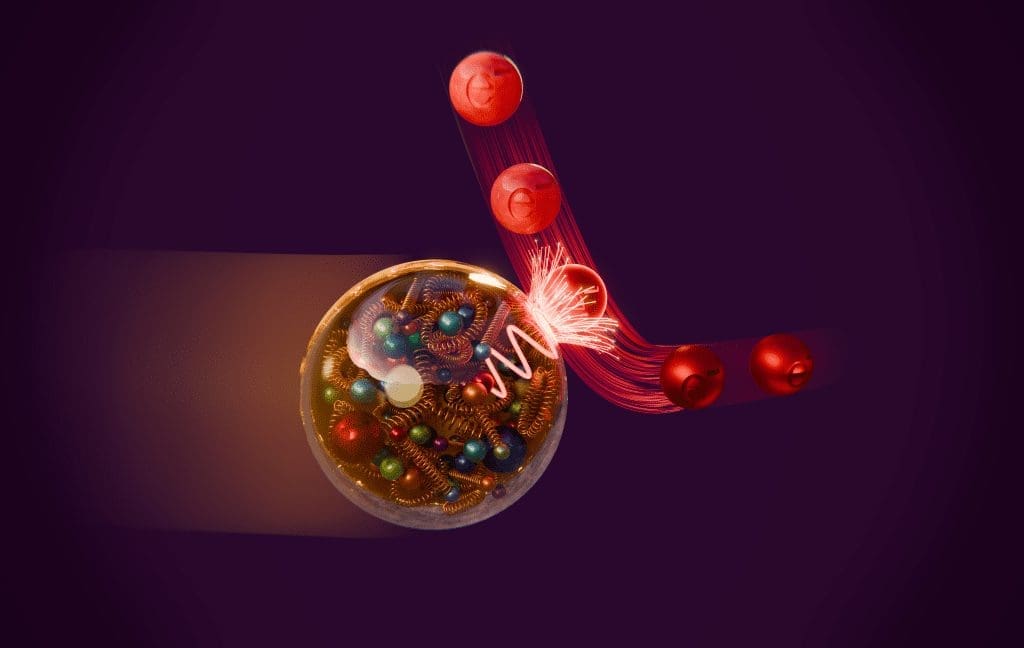
Scientists at Brookhaven National Laboratory have made a breakthrough in understanding entanglement, a phenomenon where individual particles can know about each other regardless of distance. Led by researchers Dmitri Kharzeev and Tu, they have developed a new method to study collective entanglement among quarks and gluons inside protons.
This approach could simplify complex problems in nuclear physics by focusing on the statistical behavior of the whole system rather than individual particles. The team’s findings could also shed light on how being part of a nucleus affects the quantum entanglement within a proton. Future experiments at the Electron-Ion Collider will build upon this research, exploring how the nuclear environment impacts entanglement and potentially leading to new insights into the structure of visible matter.
The idea that entanglement is not just a pairwise interaction between individual particles, but rather a system-wide phenomenon, is a crucial aspect of this research. As Dr. Kharzeev notes, “Entanglement doesn’t only happen between two particles but among all the particles.” This collective entanglement leads to the emergence of complex behavior within protons, which cannot be explained by simply studying individual quarks and gluons.
The researchers’ new method, inspired by quantum information science, offers a powerful tool for exploring this collective entanglement. By focusing on the statistical or emergent behavior of the whole system, rather than individual particles, scientists can gain insight into how entanglement leads to group behavior within protons.
One of the most intriguing aspects of this research is its potential to simplify complex problems in nuclear and particle physics. As Dr. Tu explains, “Entropy doesn’t ‘care’ about the complexity of all the in-between steps.” This means that by understanding the entanglement within protons before they collide, scientists may be able to predict certain outcomes without worrying about the intricate details of the collision process.
The implications of this research extend beyond nuclear physics. The concept of collective behavior and emergent properties is familiar in other areas of physics, such as thermodynamics, where the statistical average of individual water molecules’ vibrational motion gives rise to the property of temperature.
Looking ahead, the researchers plan to apply their model to explore how being in a nucleus affects the proton’s entanglement. Will the nuclear environment wash out the individual proton’s entanglement, leading to quantum decoherence? The Electron-Ion Collider (EIC) will provide the perfect platform for answering these questions and pushing our understanding of the structure of visible matter to new frontiers.
This research has been made possible by funding from the DOE Office of Science, the European Union’s Horizon 2020 program, and other organizations.
External Link: Click Here For More