Imagine an orchestra, where many musicians play different instruments to create a harmonious performance led by a skilled conductor. Similarly, qubits, the building blocks of quantum computers, operate like individual instruments, each fragile and requiring precise control. As the number of qubits increases, controlling them at scale becomes essential for large-scale, fault-tolerant computing.
Researchers at Diraq, a company pioneering silicon-CMOS based quantum computing, have made a breakthrough in this area. Led by Ingvild Hansen and Henry Yang, the team has developed a method to ensure excellent sustainable performance for a large number of qubits, operating in sync.
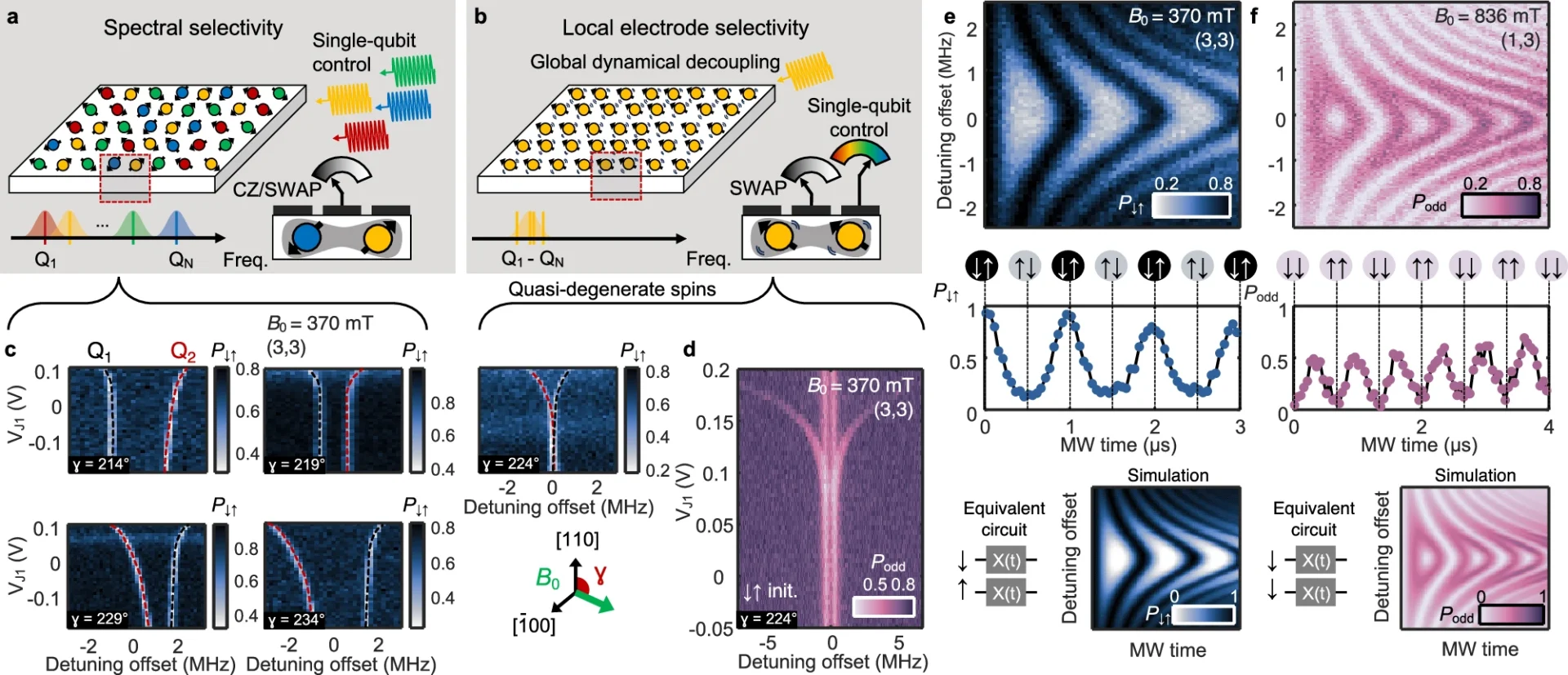
This approach uses a single global microwave field, combined with individual addressing via local electrodes, to control qubits reliably. According to Andrew Dzurak, CEO and Founder of Diraq, this research is a crucial step towards developing a reliable global qubit control strategy required for scalable, fault-tolerant quantum computing. The findings have been published in Nature Communications, marking a significant milestone in the development of large-scale quantum computers.
Synchronizing Qubits for Scalable Quantum Computing
Quantum computing relies heavily on the precise control of quantum bits, or qubits. However, as the number of qubits increases, controlling them individually becomes a significant challenge. The Diraq team has made a breakthrough in this area by developing a method to synchronize multiple qubits using a single global microwave field and individual addressing via local electrodes.
The concept of synchronizing qubits can be likened to an orchestra, where each musician plays a distinct instrument, but the conductor brings them together to create a harmonious performance. Similarly, qubits operate like individual instruments, with each one being fragile and operating independently. The Diraq team’s approach is akin to having a skilled conductor who can bring all the instruments together, setting the tempo, volume, and dynamics to create a cohesive performance.
In the context of quantum computing, this means that the team has developed a way to control multiple qubits simultaneously, ensuring that they operate in sync. This is crucial for scalable fault-tolerant computing, as individual qubit control can become impractical when dealing with large numbers of qubits. The Diraq team’s approach leverages the advantages of semiconductor spin qubits, which offer excellent qubit performance and the potential to scale up to millions of qubits on a single chip.
Overcoming Frequency Crowding and Control Signal Interference
One of the significant challenges in scaling up quantum computing is frequency crowding. As the number of qubits increases, the frequencies used to control them can become crowded, leading to interference and reduced performance. The Diraq team’s approach addresses this issue by using a single global microwave field to control multiple qubits simultaneously. This not only simplifies control signal routing but also frees up space on the chip.
Another benefit of the Diraq team’s approach is that it reduces control signal interference. By using local electrodes for individual addressing, the team has demonstrated that two degenerate spins can be driven synchronously with a single global field. This means that the qubits can operate in sync without interfering with each other, ensuring reliable and sustainable performance.
The Role of Global Control Fields in Scalable Quantum Computing
The Diraq team’s research highlights the importance of global control fields in scalable quantum computing. By using a single global microwave field to control multiple qubits, the team has demonstrated that it is possible to overcome frequency crowding and control signal interference. This approach also simplifies control signal routing and frees up space on the chip.
The use of global control fields is particularly significant for semiconductor spin qubits, which offer excellent qubit performance and the potential to scale up to millions of qubits on a single chip. By leveraging this technology, the Diraq team’s approach offers a promising solution for scalable fault-tolerant quantum computing.
The Future of Quantum Computing: Scalability and Reliability
The Diraq team’s research has significant implications for the future of quantum computing. By developing a method to synchronize multiple qubits using a single global microwave field and individual addressing via local electrodes, the team has demonstrated that it is possible to overcome the challenges associated with scaling up quantum computing.
As Andrew Dzurak, CEO and Founder of Diraq, noted, “This research is like a dress rehearsal – as we build towards opening night performance.” The results support Diraq’s leading role in developing a reliable global qubit control strategy required for semiconductor spin qubits – essential for scalable, fault-tolerant quantum computing.
The publication of this research in Nature Communications marks an important milestone in the development of scalable quantum computing. As the field continues to evolve, it is likely that we will see further breakthroughs in the area of qubit control and synchronization, paving the way for the widespread adoption of quantum computing technology.
External Link: Click Here For More