
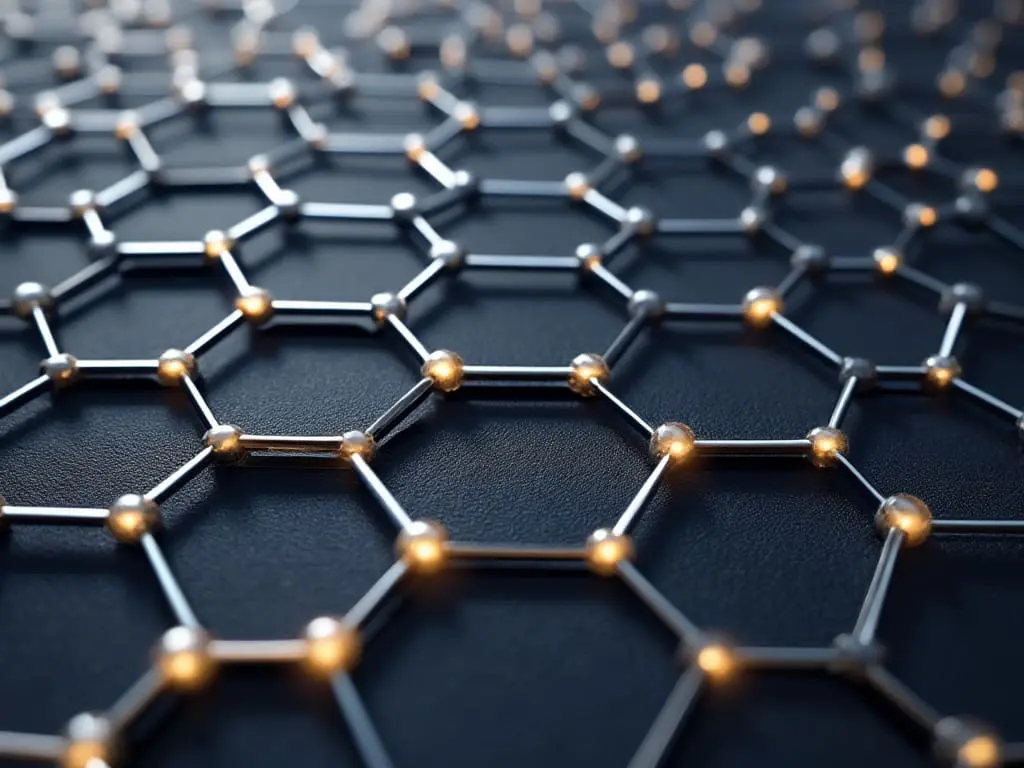
Researchers at Empa, a Swiss research institute, have made a breakthrough in quantum technology by recreating a fundamental quantum model using nanographenes, a synthetic material. This achievement brings us one step closer to harnessing the power of quantum computing, which promises to revolutionize communication, computing, and sensing technologies.
The team, led by Roman Fasel, head of Empa’s nanotech@surfaces laboratory, used tiny pieces of graphene, a two-dimensional carbon material, to create a “quantum Lego” assembled into longer chains. By linking these chains on a gold surface, they could precisely manipulate the length of the chains and investigate the complex physics of this novel quantum material in great detail.
This breakthrough was made possible through collaboration with scientists from the International Iberian Nanotechnology Laboratory and the Technical University of Dresden. The study’s findings have been published in the renowned journal Nature Nanotechnology, marking a significant step forward in developing practical applications for quantum technology.
Quantum Technologies: A Step Closer to Reality
Quantum technologies have long promised breakthroughs in communication, computing, sensors, and more by exploiting the unusual properties of fundamental building blocks of matter. However, the fragile nature of quantum states and their effects make research into real-world applications challenging. Recently, researchers at Empa’s nanotech@surfaces laboratory and partners from the International Iberian Nanotechnology Laboratory and the Technical University of Dresden have achieved a significant breakthrough in this field.
The Qubit: A Fundamental Building Block
The qubit is the quantum equivalent of the classical bit but with a crucial difference. While a classical bit can exist in one of two states (0 or 1), a qubit can exist simultaneously in a superposition of both states. This property allows qubits to assume infinite states, giving them immense computational power theoretically. However, linking these qubits is a significant challenge, as their interactions are complex and difficult to grasp.
Electron Spin: A Key to Quantum Computing
One way to realize the 0 and 1 of the qubit is through the alignment of electron spin, a fundamental quantum mechanical property of electrons and other particles. When two or more spins are quantum-mechanically linked, they influence each other’s states, allowing them to “talk” to each other. However, this interaction is enormously complex, making it difficult to implement theory.
A Model Becomes Reality: The One-Dimensional Alternating Heisenberg Model
Researchers at Empa’s nanotech@surfaces laboratory have successfully created an archetypal chain of electron spins and measured its properties in detail. This one-dimensional alternating Heisenberg model, first described by physicist Werner Heisenberg almost 100 years ago, has been a cornerstone of quantum mechanics theory. By using tiny pieces of the two-dimensional carbon material graphene, the researchers were able to assemble longer chains of spin-carrying molecules.
Nanographene Molecules: The Quantum Lego Bricks
The shape of these nanographene molecules influences their physical properties, particularly their spin. The researchers used Clar’s Goblet molecule, a special nanographene molecule consisting of eleven carbon rings arranged in an hourglass-like shape. This shape results in unpaired electrons at each end, each with an associated spin. By linking these goblets on a gold surface, the researchers were able to form chains that perfectly realized the alternating Heisenberg chain.
From Theory to Practice: The Future of Quantum Research
The successful synthesis of Clar’s Goblet and the creation of Heisenberg chains have opened new doors in quantum research. According to Roman Fasel, head of Empa’s nanotech@surfaces laboratory, “We have shown that theoretical models of quantum physics can be realized with nanographenes in order to test their predictions experimentally.” This breakthrough has significant implications for the development of applied quantum physics, as it demonstrates the potential for creating complex systems and testing theoretical predictions.
Interdisciplinary Collaboration: The Key to Success
This breakthrough was made possible by the collaboration between theoretical and experimental scientists from different disciplines. Chemists at the Dresden University of Technology provided Empa researchers with the starting molecules for their synthesis of Clar’s Goblets.
In contrast, researchers from the International Iberian Nanotechnology Laboratory contributed their theoretical expertise to the project. This sophisticated transfer between the quantum physics model and the experimental measurements is a testament to the power of interdisciplinary collaboration in driving innovation.
External Link: Click Here For More