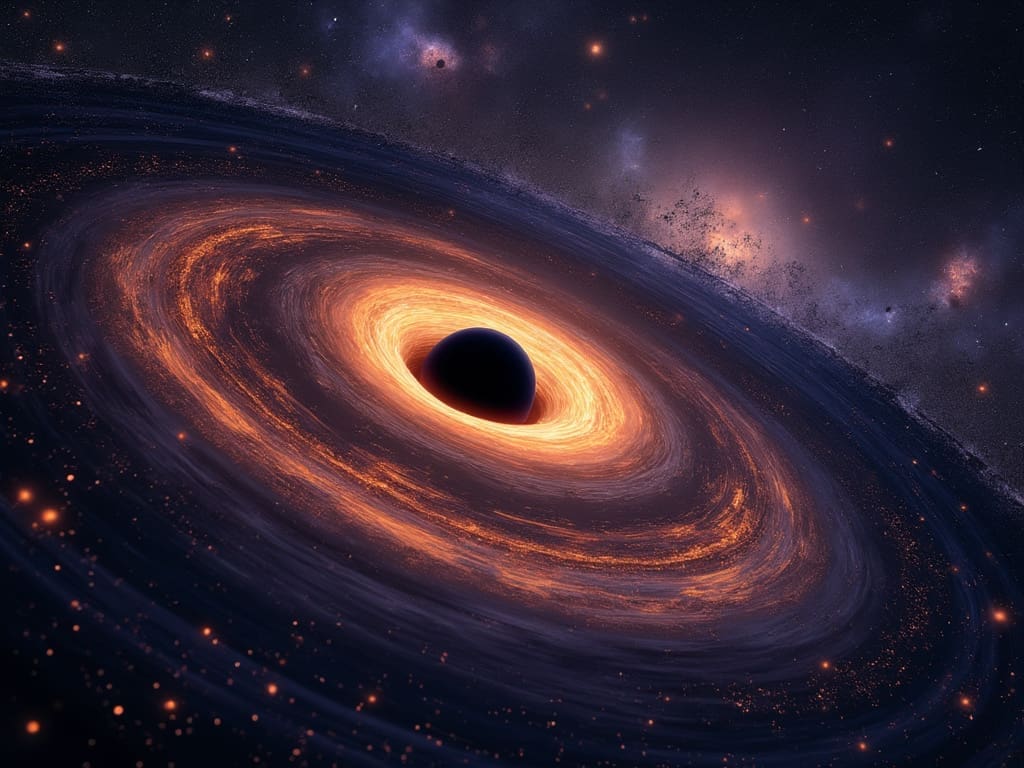
Scientists have proposed a new way to search for evidence of primordial black holes, hypothetical objects that may have formed in the early universe. According to a theoretical study led by Dejan Stojkovic, a professor of physics at the University at Buffalo, and De-Chang Dai, PhD, of National Dong Hwa University and Case Western Reserve University, these small black holes could be hiding in planets or even everyday objects on Earth.
The researchers suggest that if a primordial black hole became trapped within a large rocky object, it would consume its liquid core and leave it hollow. Alternatively, a faster primordial black hole might leave behind straight tunnels large enough to be visible by a microscope if passing through solid material. Stojkovic notes that the chances of finding these signatures are small, but searching for them would not require much resources and the potential payoff would be immense. The National Science Foundation and the National Science and Technology Council (Taiwan) supported the study.
Primordial Black Holes: The Elusive Dark Matter Candidates
The concept of primordial black holes (PBHs) has been theorized for decades, and researchers continue to explore their potential as dark matter candidates. These hypothetical objects are thought to have formed in the early universe, potentially arising from areas of space with higher density than their surroundings.
Formation and Properties of Primordial Black Holes
According to theoretical models, PBHs would have much less mass than stellar black holes formed by dying stars. However, they would still be extremely dense, with masses comparable to that of a mountain compacted into an area the size of an atom. The rapid expansion of the universe after the Big Bang could have led to the formation of these objects.
Hollow Objects as Signatures of Primordial Black Holes
Researchers propose that if a PBH became trapped within a planet, moon, or asteroid, it could absorb the liquid central core, leaving behind a hollow shell. The strength of natural materials like granite and iron would determine whether such a shell could support itself or collapse under its own tension. Calculations suggest that these hollow objects could be no more than one-tenth of Earth’s radius, making them more likely to be minor planets than proper planets.
Detecting Hollow Objects with Telescopes
Mass and density can be determined by studying an object’s orbit. If the object’s density is too low for its size, it could be a good indication that it’s hollow. Telescopes could potentially detect these objects, providing evidence for the existence of PBHs.
Primordial Black Holes as Detectors in Everyday Objects
For objects without a liquid core, PBHs might simply pass through and leave behind a straight tunnel. Researchers propose that large slabs of metal or other materials could serve as effective black hole detectors by monitoring them for the sudden appearance of these tunnels. However, searching for existing tunnels in very old materials – from buildings to rocks – may provide better odds.
Theoretical Frameworks Needed to Understand Dark Matter
Theoretical studies like this are crucial in understanding dark matter and other unresolved problems in physics. Researchers emphasize that new frameworks are needed to tackle these challenges, as extensions of existing models have not provided solutions. The field is facing serious problems, and innovative approaches are required to make progress.
Conclusion
Primordial black holes remain an intriguing area of research, with potential implications for our understanding of dark matter. While the likelihood of detecting PBHs is low, the cost-benefit analysis suggests that exploring these objects is worthwhile. As researchers continue to investigate theoretical frameworks and detection methods, we may uncover new insights into the nature of dark matter and the universe itself.
External Link: Click Here For More