

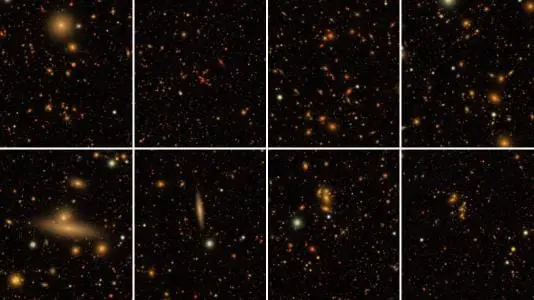
Scientists are preparing for the most ambitious sky survey yet, anticipating new insights on dark matter and dark energy. The Legacy Survey of Space and Time (LSST) will be conducted by the NSF-DOE Vera C. Rubin Observatory in northern Chile, equipped with an innovative telescope and the world’s largest digital camera. Over 10 years, the observatory will take 5.5 million data-rich images of the sky, providing an unprecedented amount of information to astronomers and cosmologists.
Argonne National Laboratory scientists, including Katrin Heitmann and Matthew Becker, are heavily involved in the LSST Dark Energy Science Collaboration (DESC). They’re performing advanced cosmological simulations and working with the Rubin Observatory to shape and process its data to maximize the potential for discovery. The simulations will help researchers predict what features will appear in real-world data from the LSST that would indicate a certain theory is true.
The observatory’s camera will capture light emitted long ago from galaxies far away, which will be converted into data and sent to facilities around the world for analysis. Argonne scientists are working with the Rubin Observatory to develop algorithms for data processing that will enable investigation of dark matter and dark energy through weak gravitational lensing.
Unveiling the Secrets of Dark Matter and Dark Energy: The Legacy Survey of Space and Time
The universe has long been shrouded in mystery, with dark matter and dark energy making up approximately 95% of its mass-energy budget. To unravel these enigmas, scientists are embarking on an unprecedented journey – the Legacy Survey of Space and Time (LSST). This ambitious project aims to map the universe in unprecedented detail, leveraging cutting-edge technology and computational power.
Simulating the Universe: A Key to Unlocking Dark Matter and Dark Energy
To prepare for the LSST, researchers at Argonne National Laboratory are employing advanced simulations to model the evolution of the universe under various dark matter and dark energy theories. By mapping their theories to detectable signatures, scientists can predict what features will appear in real-world data from the LSST, indicating which theories hold merit.
Argonne physicist Matthew Becker notes, “With the data from the LSST, things are about to get much more interesting.” These simulations not only validate code for processing and analyzing LSST data but also enable researchers to account for more physics in their models, ensuring high-resolution details are captured accurately.
The Data Deluge: Preparing for an Astronomical Amount of Information
During the LSST, light from distant galaxies will reach the Rubin Observatory, generating an astonishing 60 petabytes (60 million gigabytes) of image data. To put this into perspective, it would take over 11,000 years of watching Netflix to use that amount of data.
To tackle this data deluge, Argonne scientists are developing methods to compress and analyze the information efficiently. By combining images taken at different times, researchers can corroborate features in the images, uncovering correlations in galaxy shapes that might have otherwise been too faint to detect.
Weak Gravitational Lensing: A Window into Dark Matter and Dark Energy
One phenomenon that holds great promise for understanding dark matter and dark energy is weak gravitational lensing. As light from distant galaxies travels to the observatory, its path is influenced by the gravitational pull of intervening mass, including dark matter. By measuring this correlation, scientists can learn about the distribution of matter in the universe.
Weak gravitational lensing also offers a window into the nature of dark energy, as it can reveal how the structure of the universe has changed over time. However, the signals indicating weak gravitational lensing will be extremely faint, requiring an enormous amount of data to ensure accurate measurements.
The Future of Cosmology: Unveiling the Secrets of Dark Matter and Dark Energy
The LSST is poised to revolutionize our understanding of the universe, offering unprecedented insights into dark matter and dark energy. With the computational power of Argonne’s Aurora supercomputer and the development of sophisticated algorithms for data analysis, scientists are on the cusp of a major breakthrough.
As Matthew Becker notes, “If we know how certain we can be in our analysis, it enables us to compare our results with other experiments to understand the current state of knowledge across all of cosmology.” The LSST is about to unlock the secrets of dark matter and dark energy, forever changing our understanding of the universe.
External Link: Click Here For More


