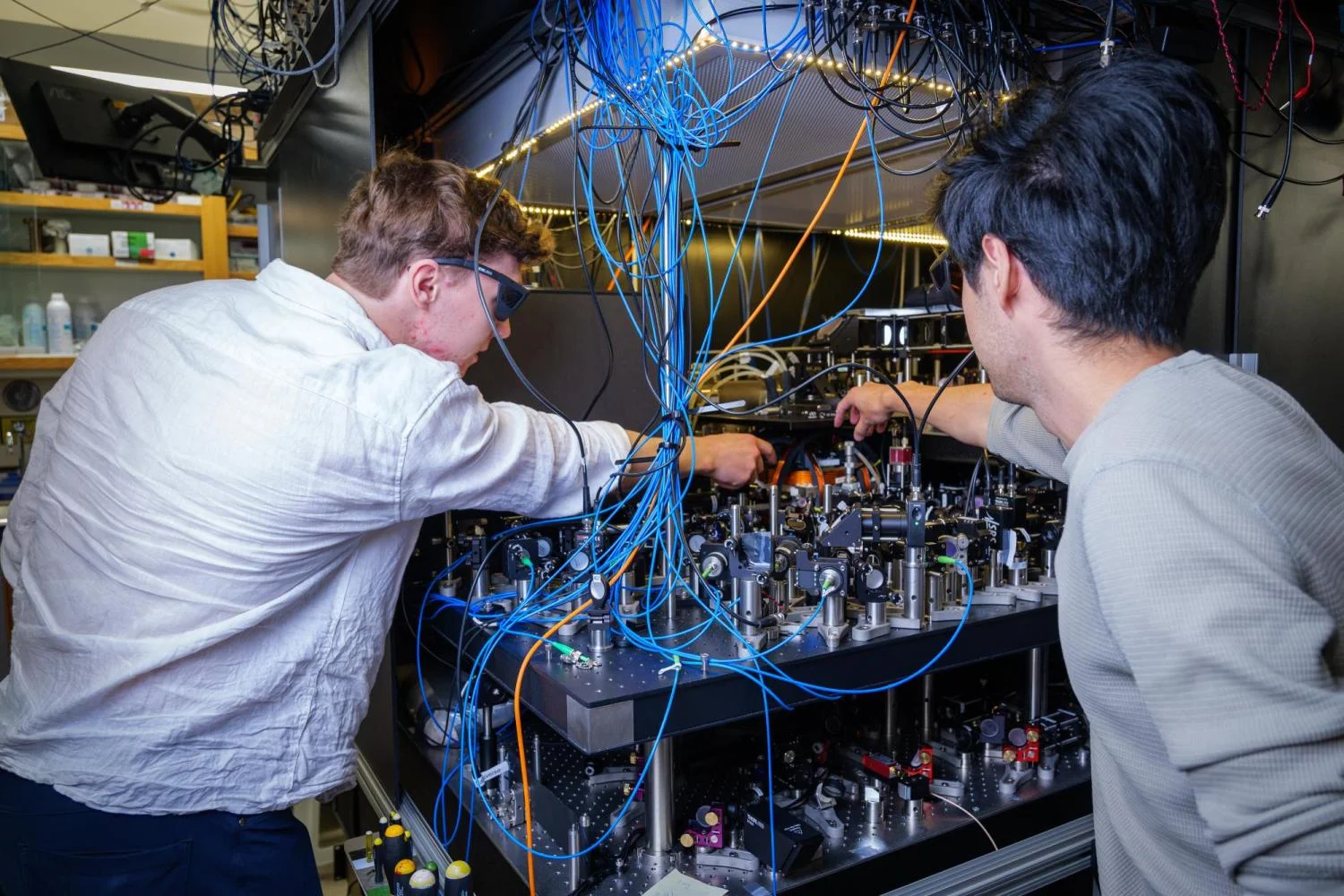
Imagine walking into a room where several different grandfather clocks hang on the walls, each ticking at a different pace. Quantum physicists at the University of Colorado Boulder and the National Institute of Standards and Technology (NIST) have essentially recreated that room at the scale of atoms and electrons. Led by physicist Adam Kaufman, the team has developed a new kind of optical atomic clock that packs several clocks into one device. This innovation could pave the way for new kinds of timekeeping technologies.
The researchers used a few dozen strontium atoms trapped in a lattice pattern to create their clock. By generating quantum entanglement between groups of these atoms, they were able to improve the device’s performance and beat a benchmark for precision called the “standard quantum limit.” This achievement could lead to new quantum technologies, including sensors that can measure subtle changes in the environment, such as how Earth’s gravity shifts with elevation. The team’s findings were published in the journal Nature on October 9.
Quantum Timekeeping: A New Frontier in Atomic Clocks
The concept of timekeeping has undergone a significant transformation with the advent of quantum physics. Researchers at the University of Colorado Boulder and the National Institute of Standards and Technology (NIST) have made a groundbreaking discovery, creating an optical atomic clock that packs multiple clocks into one device. This innovation has the potential to revolutionize the field of quantum technology, enabling the development of new sensors and devices that can measure subtle changes in the environment.
Lassoing Atoms: The Science Behind Optical Atomic Clocks
Optical atomic clocks are incredibly precise devices that operate by trapping and chilling a cloud of atoms down to frigid temperatures. These atoms are then zapped with a powerful laser, causing electrons orbiting the atoms to jump from a lower energy level to a higher energy level and back again. This process is akin to the pendulum of a grandfather clock swinging back and forth, but at an incredibly fast rate of over a trillion times per second.
The precision of these clocks is unparalleled, with some devices capable of detecting changes in gravity if lifted by just a fraction of a millimeter. However, they also have a significant drawback: natural uncertainties in quantum physics set a limit on their precision. This limitation can be overcome through the use of entanglement, a phenomenon where information about one particle reveals information about another.
Entanglement: The Key to Unlocking Precision
Entanglement is a fundamental aspect of quantum mechanics that allows particles to become connected in such a way that their behavior becomes correlated. In the context of atomic clocks, entangled atoms behave less like individuals and more like a single atom, making their behavior easier to predict.
Researchers have generated this type of quantum link by nudging strontium atoms so that their electrons orbit far away from their nuclei, creating a “fluffy” orbit. This interaction enables the creation of conjoined pairs of atoms that tick at a faster pace than individual atoms.
The Future of Quantum Timekeeping
The discovery of entangled atomic clocks has significant implications for the development of quantum technology. Researchers envision the potential to create new types of clocks with tailored properties, enabled by the exquisite control they have in these systems.
One possible application is the creation of “multi-qubit gates,” the basic operations that perform calculations in quantum computers. These devices could one day outperform traditional computers at certain tasks, revolutionizing fields such as cryptography and data analysis.
While there is still much work to be done, the potential of entangled atomic clocks is undeniable. As researchers continue to push the boundaries of what is possible with these devices, we may soon find ourselves on the cusp of a new era in quantum timekeeping.
External Link: Click Here For More