Scientists have made a groundbreaking discovery, experimentally confirming that high harmonic generation produces quantum light. This phenomenon, where a system absorbs multiple photons and emits higher-energy photons, was previously described using semi-classical theory, which treated matter quantum-mechanically but light classically. However, recent theoretical predictions suggested that the emitted light could exhibit quantum behavior, such as entanglement and squeezing.
In collaboration with multiple institutions, a team led by Jens Biegert from the Laboratoire d’Optique Appliquée and ICFO demonstrated the quantum optical properties of high-harmonic generation in semiconductors. The experiment used a commercial femtosecond infrared laser and standard semiconductors at room temperature, making it a promising platform for generating non-classical states of light.
The team observed two unmistakable signs of quantum light: entanglement, where measuring one particle instantaneously influences the outcome of another, regardless of distance; and squeezing, which reduces noise in one property by increasing it in another. This breakthrough could pave the way for more robust and scalable quantum devices that don’t require complex cooling systems.
Experimental Evidence of High Harmonic Generation Producing Quantum Light
High harmonic generation (HHG) is a highly nonlinear phenomenon where a system, such as an atom, absorbs multiple photons from a laser and emits photons with much higher energy, whose frequency is a harmonic of the incoming laser’s frequency. Historically, the theoretical description of this process was addressed from a semi-classical perspective, which treated matter (the electrons of the atoms) quantum-mechanically but the incoming light classically. According to this approach, the emitted photons should also behave classically.
However, recent studies have explored whether the emitted light could exhibit quantum behavior, which the semi-classical theory might have overlooked. Several theoretical groups have shown that under a full quantum description, the HHG process emits light with quantum features. Experimental validation of such predictions remained elusive until recently, when a team led by the Laboratoire d’Optique Appliquée (CNRS) demonstrated the quantum optical properties of high-harmonic generation in semiconductors.
Theoretical Predictions and Experimental Validation
Theoreticians had already predicted that the photons emitted through an HHG process exhibit quantum behavior, which manifests itself in two defining features: entanglement and squeezing. Entanglement occurs when two particles become interconnected, such that measuring one instantaneously influences the outcome after measuring the other, regardless of the distance between them. Squeezing relates to the unavoidable uncertainty when measuring certain pairs of properties in a quantum system.
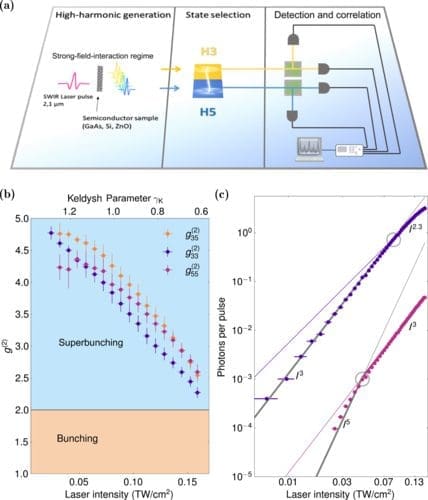
In agreement with previous theoretical predictions, the team experimentally demonstrated the presence of both entanglement and squeezing in the emitted light. The researchers directed ultrafast infrared laser pulses onto semiconductor samples to drive high-harmonic generation. From all the generated harmonics, they selected only two of them using optical filters, which were then sent to a detection system capable of simultaneously analyzing multiple harmonics.
Evidencing the Quantum Nature of HHG
The first sign of quantumness was related to squeezing. The equipment recorded that the variance of the photon arrival times decreased as the laser intensity increased. This reduction could only be explained by squeezing, providing solid evidence of this feature. After that, the team turned to entanglement. To demonstrate it, they measured the correlation between the arrival times of photons from the third and fifth harmonics. Researchers consistently observed strong correlations that are prohibitive for a classical source, unmistakably indicating the presence of quantum entanglement.
Implications and Future Directions
These findings establish high harmonic generation as an ideal platform for producing entangled and squeezed photonic systems at room temperature. Both features are key resources for many quantum technologies, which rely on entanglement to transmit information or on squeezing to enhance measurement precision. Neglecting the quantum optical effects was hindering the possibility of detecting nonclassical features. But now, researchers will be able to exploit HHG for quantum information, communication, and sensing applications in all its potential.
The experimental demonstration of quantum light produced through high harmonic generation opens up new avenues for exploring the fundamental principles of quantum mechanics and their applications in various fields. As researchers continue to investigate this phenomenon, they may uncover even more surprising properties of light and its behavior at the quantum level.
DOI: https://doi.org/10.1103/PRXQuantum.5.040319