

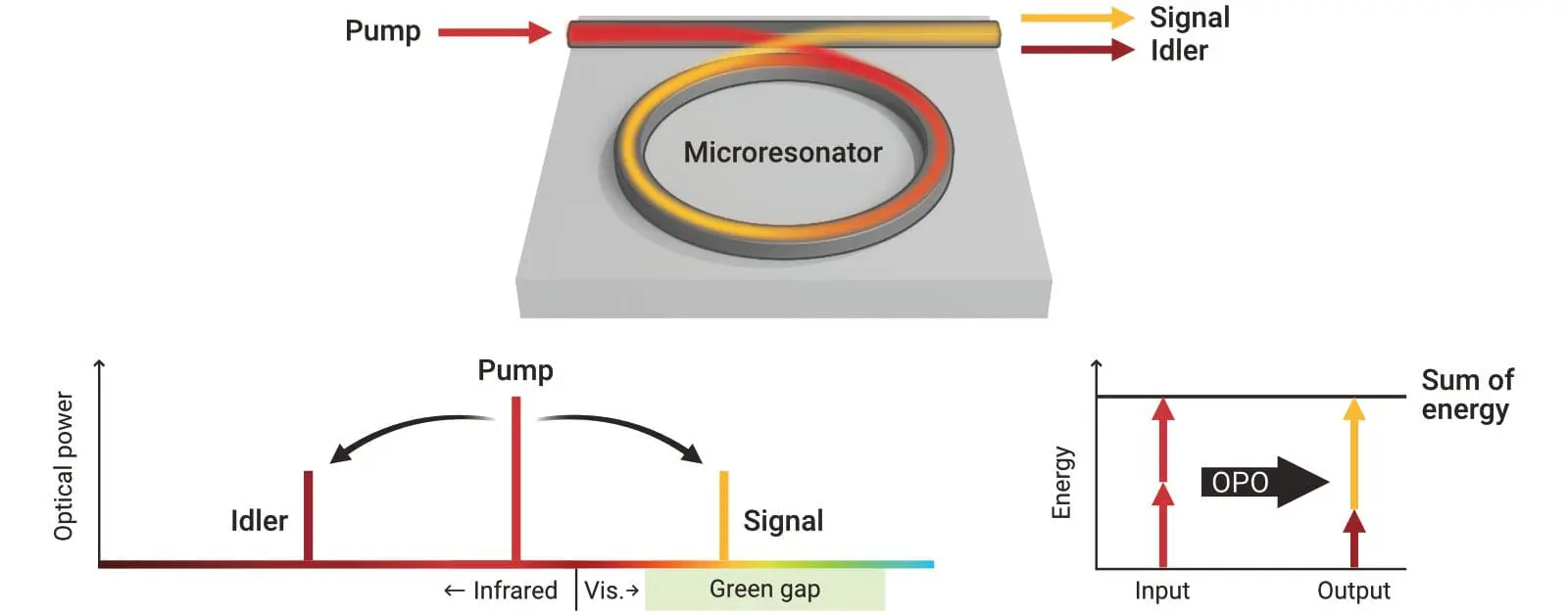
Scientists have long been able to create small red and blue lasers, but other colors have proven more challenging. Now, researchers at the National Institute of Standards and Technology (NIST) have filled a critical technology gap by creating tiny orange, yellow, and green lasers that can fit on a chip. This breakthrough is significant because compact, low-noise lasers in this wavelength range are essential for applications such as quantum sensing, communications, and information processing.
Led by Kartik Srinivasan of NIST and the Joint Quantum Institute (JQI), the team used modified microresonators to convert infrared laser light into other colors. This innovation has far-reaching implications, including improved underwater communication, full-color laser projection displays, and medical treatments such as diabetic retinopathy. Companies like Meta’s Reality Labs Research are also involved in this work, which could potentially store data in qubits, the fundamental unit of quantum information.
Filling the Green Gap in Visible-Light Colors with Tiny Lasers
For years, scientists have been able to fabricate small, high-quality lasers that generate red and blue light, but creating tiny lasers that emit light at yellow and green wavelengths has proven to be a significant challenge. This dearth of stable, miniature lasers in this region of the visible-light spectrum is referred to as the “green gap.” Researchers at the National Institute of Standards and Technology (NIST) have now closed this gap by modifying a tiny optical component: a ring-shaped microresonator, small enough to fit on a chip.
The lack of compact laser diodes that can emit green and yellow wavelengths has limited the development of various applications, including displays, lighting, and spectroscopy. The NIST researchers’ breakthrough could lead to significant advancements in these fields. By generating more than 150 distinct wavelengths across the green gap, they have demonstrated the potential for creating a wide range of colors with high precision.
Overcoming the Limitations of Conventional Microresonators
Conventional microresonators are limited in the wavelengths they can produce through optical parametric oscillation (OPO). By partially etching away the silicon dioxide film under the microresonator to create an “undercut” and using a thicker layer of silicon nitride, the NIST researchers were able to cover the entire “green gap” spectral range while also improving the density of the generated wavelengths.
The team’s modifications allowed them to access the entire range of wavelengths in the gap, rather than just hitting a couple of specific wavelengths. This was achieved by changing the dimensions of the microresonator, which determine the colors of light that are generated. The researchers were able to produce light that penetrated deeper into the green gap, to wavelengths as short as 532 nanometers.
Fine-Tuning Wavelengths with High Precision
The NIST researchers found that they could create more than 150 distinct wavelengths across the green gap and fine-tune them. This was a significant improvement over previous studies, where making small adjustments within each color band was challenging. By changing the wavelength of the infrared pump, the researchers can generate wavelengths of visible light across the entire green gap.
The team’s achievement has significant implications for various applications that require high-precision control over the generated wavelengths. The ability to fine-tune wavelengths could lead to advancements in fields such as spectroscopy, where precise control over the wavelengths used is crucial.
Boosting Energy Efficiency
While the NIST researchers have made a significant breakthrough, there is still room for improvement. Currently, the output power of their device is only a few percent of that of the input laser. To make their technology more practical, they are working to boost the energy efficiency with which they produce the green-gap laser colors.
Better coupling between the input laser and the waveguide that channels the light into the microresonator, along with better methods of extracting the generated light, could significantly improve the efficiency. The researchers are now focused on optimizing their device to make it more suitable for real-world applications.
Implications and Future Directions
The NIST researchers’ breakthrough has significant implications for various fields, including displays, lighting, and spectroscopy. Their achievement demonstrates the potential for creating a wide range of colors with high precision, which could lead to advancements in these fields.
As the team continues to optimize their device, they are likely to explore new applications for their technology. The ability to generate a wide range of wavelengths with high precision could lead to breakthroughs in fields such as biomedical imaging, where precise control over the wavelengths used is crucial.
The NIST researchers’ achievement serves as a testament to the power of innovative research and development. By pushing the boundaries of what is possible with tiny lasers, they have opened up new avenues for exploration and discovery.
External Link: Click Here For More


