Physicists at the PHENIX experiment have made a groundbreaking discovery in their quest to understand the behavior of quark-gluon plasma (QGP), a state of matter thought to have existed in the early universe. By analyzing data from high-energy collisions, researchers have found a way to directly measure the centrality of these collisions and detect the presence of QGP, which can ‘quench’ or suppress the formation of energetic jets of particles.
This innovative approach, which relies on the detection of direct photons produced in the collisions, has shed new light on the mysterious properties of QGP and could have significant implications for our understanding of the fundamental nature of matter.
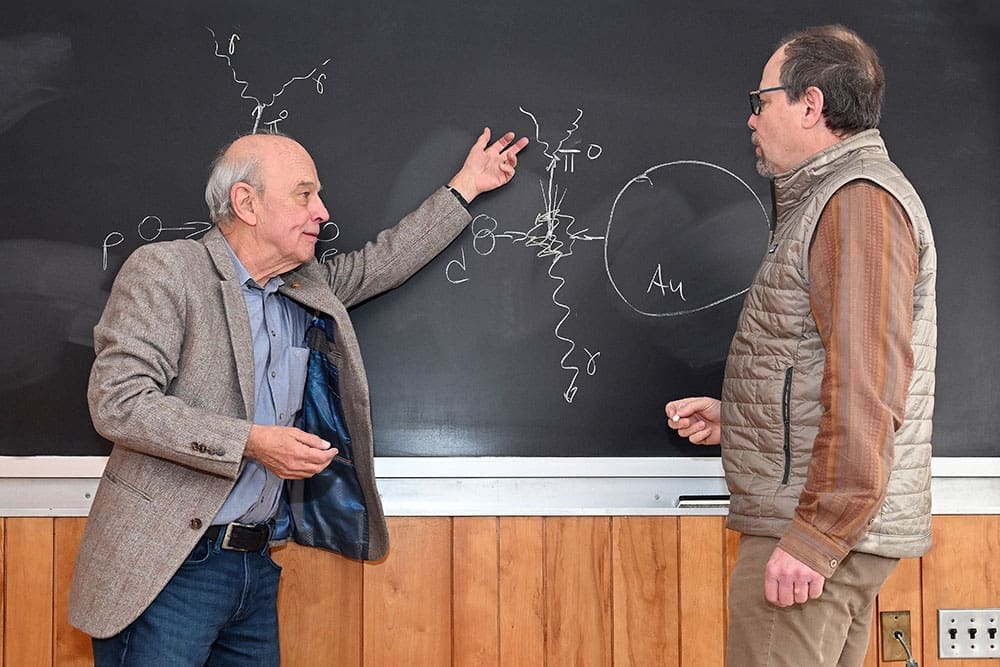
The PHENIX experiment at Brookhaven National Laboratory has made a groundbreaking discovery about the quark-gluon plasma (QGP), a state of matter thought to have existed in the early universe. By analyzing data from collisions between deuterons and gold ions, scientists have found evidence of QGP formation in central collisions.
Here’s the clever part: they used direct photons as a “probe” to measure the centrality of these collisions. When quarks and gluons interact, they produce not only energetic particles (jets) but also high-energy photons. These direct photons are created in proportion to the number of kicked-free quarks and gluons, making them an ideal indicator of collision centrality.
The key insight is that while quarks and gluons interact with the QGP, photons don’t. So, if there’s no QGP, the number of energetic jet particles detected should be proportional to the number of direct photons. However, if central collisions show a significant decrease in energetic jet particles compared to direct photons, it could indicate the presence of QGP, which is “quenching” or absorbing energy from these jets.
The researchers, led by Axel Drees and Yasuyuki Akiba, developed a sophisticated method to distinguish between direct photons and those produced by the decay of neutral pions within jets. By applying this technique to PHENIX data, they found that the initial anomaly in peripheral collisions disappeared, but a strong signal of suppression remained in central collisions.
This result has significant implications for our understanding of QGP formation and its properties. As Niveditha Ramasubramanian, a co-author on the paper, noted, “The suppression we observed in the most central collisions was entirely unexpected.”
The next step will be to apply this method to other small collision systems, such as proton-gold and helium-3-gold collisions, to further clarify the origins of this suppression. This research has been funded by the DOE Office of Science, the National Science Foundation, and a range of international universities and organizations.
In summary, the PHENIX experiment has made a crucial breakthrough in understanding QGP formation using direct photons as a precise probe of collision centrality. This innovative approach has opened up new avenues for exploring the properties of this exotic state of matter.
External Link: Click Here For More