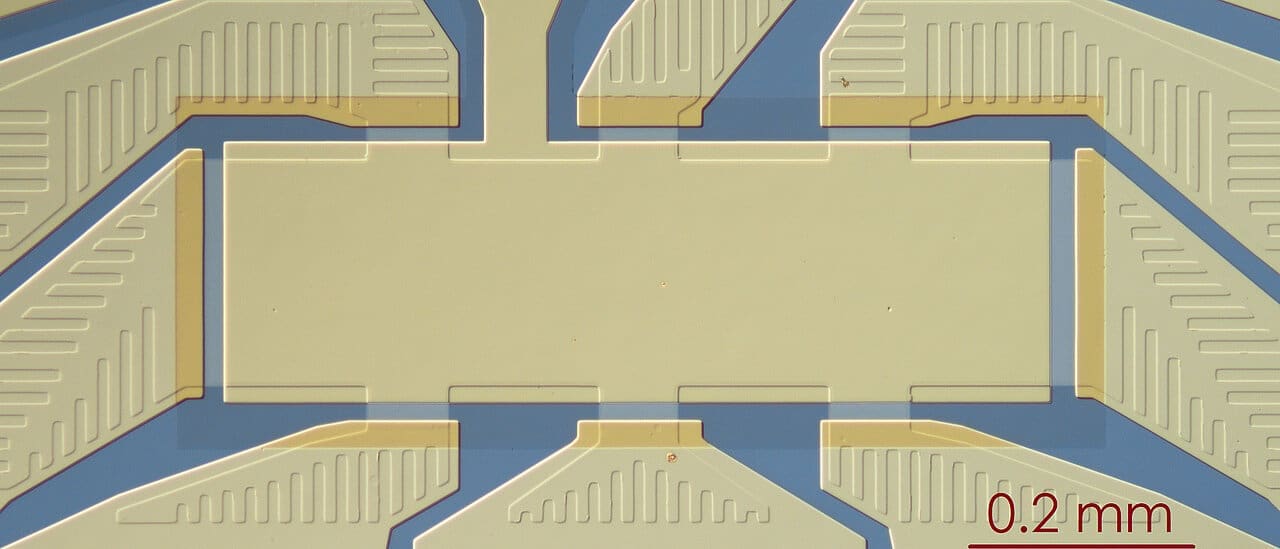
Scientists at the University of Würzburg and the German National Metrology Institute (PTB) have achieved a significant milestone in defining electrical units. They have realized a new kind of quantum standard of resistance based on the Quantum Anomalous Hall Effect. This breakthrough enables precise measurement of electrical resistance without an externally applied magnetic field, a crucial requirement for industrial production and electronics.
According to Professor Charles Gould, a physicist at the Institute for Topological Insulators at the University of Würzburg, exact measurements are essential in high-tech manufacturing, as even slight deviations can significantly affect complex systems.
The Quantum Anomalous Hall Effect allows the quantum Hall effect to exist at zero magnetic field, simplifying experiments and providing an advantage in determining another physical quantity: the kilogram. The new measurements have reached the necessary precision thresholds, placing the magnetic field-free QAHE standard on par with early conventional QHE-based resistance standards. This achievement is a significant step forward for quantum metrology, with potential applications in industry and beyond.
A milestone in Defining Electrical Units: A New Quantum Standard of Resistance
Precisely measuring electrical resistance is crucial in various industrial applications, including manufacturing high-tech sensors, microchips, and flight controls. Even slight deviations can significantly impact these complex systems. To address this need, scientists at the University of Würzburg and the German National Metrology Institute (PTB) have successfully implemented a new quantum resistance standard based on the Quantum Anomalous Hall Effect (QAHE). This achievement marks a significant milestone in defining electrical units.
The Importance of Precise Measurement
In industrial production, precise measurements are essential to ensure the quality and reliability of complex systems. Electrical resistance is a critical parameter that requires accurate measurement to prevent deviations that can have far-reaching consequences. The development of a quantum resistance standard offers a reliable reference point for calibrating measuring instruments and ensuring the precision of electrical measurements.
How the Standard Works
The QAHE is a variant of the classic Hall effect, where a current flowing through a conductor in a magnetic field generates a Hall voltage. The Hall resistance is obtained by dividing this voltage by the current. In extremely thin conductors, the Hall resistance exhibits discrete steps with universal values independent of device properties, which makes it an ideal basis for determining the resistance standard. The QAHE takes this concept further by allowing the quantum Hall effect to exist at zero magnetic fields, simplifying the experiment, and enabling the measurement of another physical quantity, the kilogram.
Advantages of the Quantum Anomalous Hall Effect
The operation of the QAHE at zero external magnetic field offers several advantages. It simplifies the experiment and provides an opportunity to measure the voltage standard simultaneously, which is essential for defining a kilogram. The QAHE-based resistance standard can operate without an externally applied magnetic field, making it more practical and reliable.
Further Plans and Collaborations
While the current implementation of the quantum resistance standard at zero external magnetic field has achieved the necessary precision thresholds, it remains limited to extremely low temperatures and low currents. Further improvements are required to make the standard commercially viable for industrial applications. The research team is working towards this goal in collaboration with international researchers as part of the European metrology consortium QuAHMET.
Funding and Research Collaborations
The European Commission, the Free State of Bavaria, and the German Research Foundation (DFG) funded the research project. The research team also participates in the Cluster of Excellence ct.qmat – Complexity and Topology in Quantum Matter, a joint initiative between the University of Würzburg (JMU) and Technische Universität (TU) Dresden. This collaboration brings together over 300 scientists from more than thirty countries to study topological quantum materials that exhibit surprising phenomena under extreme conditions.
Conclusion
The successful implementation of a quantum resistance standard based on the QAHE marks a significant milestone in defining electrical units. This achievement has far-reaching implications for industrial applications, enabling precise measurements and ensuring the quality and reliability of complex systems. As researchers continue to improve this technology, it is expected to profoundly impact various fields, from manufacturing to fundamental physics research.
External Link: Click Here For More