

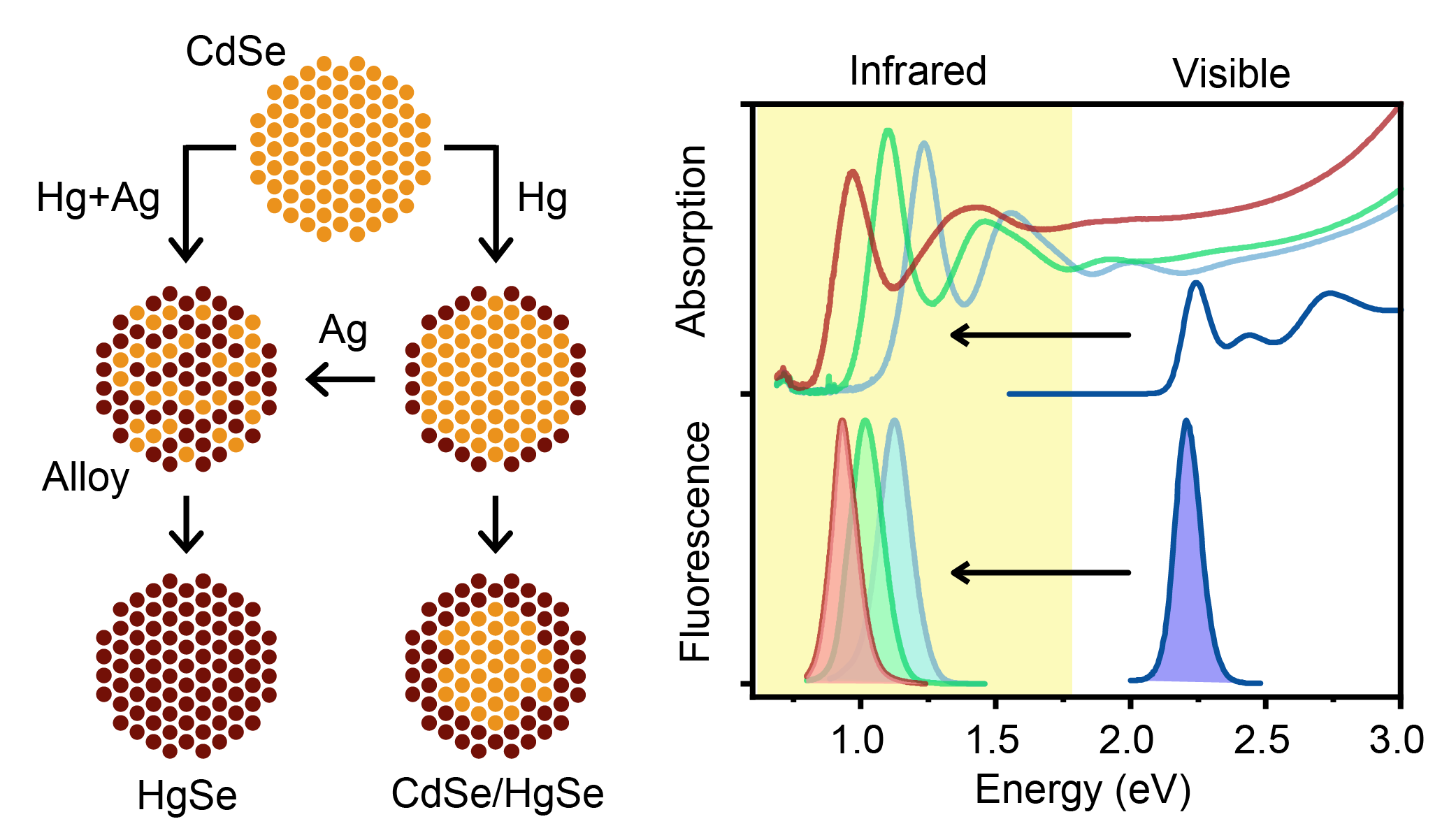
Researchers at the University of Illinois at Urbana-Champaign have made a significant breakthrough in developing high-quality nanocrystals that absorb and emit light in the infrared spectrum, expanding the potential applications of quantum dots beyond the visible spectrum. Led by bioengineering professor Andrew Smith and postdoctoral researcher Wonseok Lee, the team has successfully created mercury selenide and mercury cadmium selenide nanocrystals using well-established cadmium selenide precursors.
This achievement marks a major milestone in the development of infrared quantum dots, which have been limited by the challenges of working with heavier elements that are prone to degradation and unwanted side reactions. The new technology has far-reaching implications for various fields, including bioimaging, chemical reaction catalysis, and display devices.
Developing High-Quality Nanocrystals: A Breakthrough in Infrared Quantum Dots
The 2023 Nobel Prize in Chemistry was awarded to quantum dots, a technology that has been well-developed in the visible spectrum but has left untapped opportunities for technologies in both the ultraviolet and infrared regions of the electromagnetic spectrum. Researchers have now made a significant breakthrough in developing high-quality nanocrystals that absorb and emit in the infrared region.
Bioengineering professor Andrew Smith and postdoctoral researcher Wonseok Lee from the University of Illinois at Urbana-Champaign have developed mercury selenide (HgSe) and mercury cadmium selenide (HgCdSe) nanocrystals using already well-developed, visible spectrum cadmium selenide (CdSe) precursors. The new nanocrystal products retained the desired properties of the parent CdSe nanocrystals, including size, shape, and uniformity.
“This is the first example of infrared quantum dots that are at the same level of quality as the ones that are in the visible spectrum,” Smith says. The development of high-quality nanocrystals in the infrared region has been challenging due to the chemistry involved. Heavier elements with lower energies need to be used, which leads to more unwanted side reactions and less predictable reactions.
Overcoming Challenges in Infrared Nanocrystal Development
The development of nanocrystals that operate in the infrared region has been hindered by the difficulty in achieving light absorption and emission in this spectrum. The chemistry involved is more complex, yielding more unwanted side reactions and less predictable reactions. Additionally, these materials are prone to degradation and are susceptible to ambient changes in the environment, such as water.
To overcome these challenges, Smith and Lee focused on developing a ternary alloy—mercury cadmium selenide—which they believe could be the “perfect” material for making infrared quantum dots. By changing the ratio of cadmium and mercury atoms, it is possible to span a huge range of the electromagnetic spectrum, from the entire infrared into the entire visible spectrum.
A Novel Synthesis Method
Smith had been trying to make this material since his graduate school days with no luck, and even in the broader research community, there have been no reports of success until now. The breakthrough came when they used a novel synthesis method, taking the already perfected, visible cadmium selenide quantum dots as a “sacrificial mold.”
Replacing the cadmium atoms with mercury atoms instantly shifts everything into the infrared spectrum, retaining all the desired quality: strong light absorption, strong light emission, and homogeneity. This was achieved through a new process called interdiffusion enhanced cation exchange, developed by Lee.
Potential Applications of Infrared Quantum Dots
One potential application of infrared quantum dots with significant impact is their use as molecular probes for imaging in biological systems. Since most quantum dots emit in the visible spectrum, only emission near the surface of the skin can be detected. However, biology is fairly transparent in the infrared, allowing for deeper tissues to be probed.
The development of infrared quantum dots could revolutionize preclinical drug development by enabling researchers to see almost entirely through a living rodent to study its physiology and the locations of specific molecules throughout the body. This would allow for better understanding of biological processes and developing therapeutics without having to sacrifice the mice.
Future Directions
This research was funded by the National Institutes of Health and the National Science Foundation. The breakthrough in developing high-quality nanocrystals in the infrared region has significant implications for various fields, including biomedical imaging, optoelectronics, and materials science. Further research is needed to explore the full potential of these novel materials and their applications.
Andrew Smith is also an affiliate of several institutions, including the Holonyak Micro & Nano Technology laboratory, the Carl R. Woese Institute for Genomic Biology, the department of materials science & engineering, the Cancer Center at Illinois, and the Carle Illinois College of Medicine at Illinois. Wonseok Lee is also an affiliate of the Holonyak Micro & Nano Technology laboratory at Illinois.
External Link: Click Here For More


