Scientists from the University of Nottingham, King’s College London, and Newcastle University have created a “quantum tornado” to study black holes. The team used superfluid helium, chilled to extremely low temperatures, to create a swirling vortex that mimics the gravitational conditions near rotating black holes. The research, led by Dr. Patrik Svancara, has revealed parallels between the vortex flow and the gravitational influence of black holes. This could open new avenues for simulations of quantum field theories in curved spacetimes. The research is funded by a £5 million grant from the Science Technology Facilities Council and supported by the UKRI Network and the Leverhulme Research Leaders Fellowship.
Quantum Vortex: A New Approach to Understanding Black Holes
Scientists have successfully created a large-scale quantum vortex, a phenomenon that mimics the behavior of black holes, using superfluid helium. This groundbreaking research, led by the University of Nottingham in collaboration with King’s College London and Newcastle University, has provided a unique platform for studying the behavior and interaction of analogue black holes with their surroundings.
The team created a swirling vortex within superfluid helium, which was cooled to the lowest possible temperatures. By observing the minute wave dynamics on the superfluid’s surface, the researchers were able to demonstrate that these quantum vortices mimic the gravitational conditions near rotating black holes. The findings of this research have been published in the journal Nature.
Superfluid Helium: A Novel Experimental Platform
The research team, led by Dr. Patrik Svancara from the School of Mathematical Sciences at the University of Nottingham, utilized superfluid helium to study tiny surface waves with greater detail and accuracy than previous experiments conducted in water. The extremely low viscosity of superfluid helium allowed the team to meticulously investigate the interaction of these waves with the superfluid vortex and compare the findings with their theoretical projections.
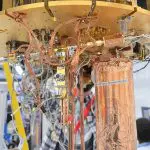
The team constructed a custom cryogenic system containing several liters of superfluid helium at temperatures lower than -271 °C. At this temperature, liquid helium acquires unusual quantum properties. These properties typically hinder the formation of large vortices in other quantum fluids like ultracold atomic gases or quantum fluids of light. However, this system demonstrates how the interface of superfluid helium acts as a stabilizing force for these objects.
Quantum Vortices and Black Hole Physics
Superfluid helium contains tiny objects called quantum vortices, which tend to spread apart from each other. In this experiment, the researchers managed to confine tens of thousands of these quanta in a compact object resembling a small tornado, achieving a vortex flow with record-breaking strength in the realm of quantum fluids.
The researchers uncovered intriguing parallels between the vortex flow and the gravitational influence of black holes on the surrounding spacetime. This achievement opens new avenues for simulations of finite-temperature quantum field theories within curved spacetimes.

Funding and Future Implications
This groundbreaking research is funded by a £5 million grant from the Science Technology Facilities Council, distributed among teams at seven leading UK institutions, including the University of Nottingham, Newcastle University and King’s College London. The project has also been supported by both the UKRI Network grant on Quantum Simulators for Fundamental Physics and the Leverhulme Research Leaders Fellowship held by Professor Silke Weinfurtner.
The culmination of this research will be celebrated and creatively explored in an exhibition titled Cosmic Titans at the Djanogly Gallery, Lakeside Arts, The University of Nottingham, from 25 January to 27 April 2025. The exhibition will comprise newly commissioned sculptures, installations, and immersive artworks by leading artists, including Conrad Shawcross RA, that result from a series of innovative collaborations between artists and scientists facilitated by ARTlab Nottingham. The exhibition will marry creative and theoretical inquiries into black holes and the birth of our Universe.
External Link: Click Here For More