

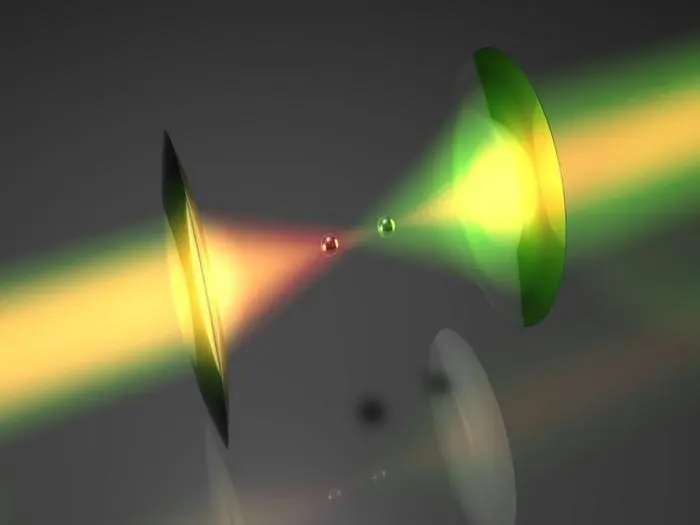
At the forefront of quantum physics research, a novel experimental device has been developed in Florence, poised to redefine our understanding of the intricate boundary between classical and quantum mechanics. This innovative “nano-oscillator” enables the simultaneous observation and investigation of phenomena from both realms, offering unprecedented insights into the behavior of matter at the nanoscale.
By leveraging the phenomenon of levitating nano-objects within a tightly focused laser beam, researchers have successfully trapped a pair of glass nanospheres using beams of light of different colors, allowing for observing both classical and quantum behaviors. This groundbreaking device has the potential to revolutionize our comprehension of collectively interacting nanosystems, permitting the experimental exploration of the subtle boundary between the classical and quantum worlds, and paving the way for new discoveries in the field of quantum science and technology.
Introduction to Nano-Oscillators and Quantum Physics
The study of matter at increasingly smaller scales reveals radically different behaviors from those observed at the macroscopic scale, which is where quantum physics comes into play. Researchers have developed a new experimental device that explores the boundary between classical and quantum physics, allowing for the simultaneous observation and investigation of phenomena from both worlds. This instrument, created in Florence, is the result of collaboration within the National Quantum Science and Technology Institute (NQSTI) and involves several institutions, including the Department of Physics and Astronomy at the University of Florence and the National Institute of Optics of the National Research Council (CNR-INO).
The device takes advantage of the phenomenon of levitating nano-objects within a tightly focused laser beam, which is the ability of light to “trap” individual microscopic particles. This phenomenon was first observed in the 1980s and further refined by American physicist Arthur Ashkin, who was awarded the Nobel Prize in Physics in 2018. The Italian team, led by Francesco Marin, has applied this technique to simultaneously trap a pair of glass nanospheres using beams of light of different colors. Within the optical trap, these spheres oscillate around their equilibrium point with very specific frequencies, allowing for the observation of both “classical” and “quantum” behaviors.
The development of this device is significant because it allows researchers to investigate the behavior of macroscopic objects in a highly controlled manner. The spheres are electrically charged and interact with each other, so the trajectory followed by one sphere is strongly dependent on the other. This opens the way for the study of collectively interacting nanosystems in both the classical and quantum regimes, thus allowing the experimental exploration of the subtle boundary between these two worlds.
Theoretical Background and Experimental Methodology
The phenomenon of levitating nano-objects within a tightly focused laser beam is based on the principle of optical tweezers. Optical tweezers use a focused laser beam to trap and manipulate small particles, such as nanospheres. The laser beam creates an optical potential that attracts the particle and holds it in place. By using beams of light of different colors, researchers can create a bichromatic optical tweezer that can trap two particles simultaneously.
The experimental methodology used in this study involves trapping a pair of glass nanospheres within the bichromatic optical tweezer. The spheres are then allowed to oscillate around their equilibrium point, and their motion is observed using high-speed cameras and other detection methods. By analyzing the motion of the spheres, researchers can gain insights into the behavior of macroscopic objects in both classical and quantum regimes.
The study of collectively interacting nanosystems is an active area of research, with potential applications in fields such as materials science and quantum computing. The development of this device and the experimental methodology used in this study provide a new tool for researchers to explore the behavior of these systems and gain a deeper understanding of the subtle boundary between classical and quantum physics.
Quantum Physics and Classical Behavior
The behavior of macroscopic objects is typically described by classical physics, which predicts that the motion of an object can be precisely determined if its initial conditions are known. However, as the size of the object decreases, quantum effects become more significant, and the behavior of the object becomes less predictable. The device developed in this study allows researchers to observe both classical and quantum behaviors in the same system.
The observation of quantum behavior in macroscopic objects is a topic of ongoing research, with potential implications for our understanding of the fundamental laws of physics. The study of collectively interacting nanosystems can provide insights into the behavior of these systems and the transition from classical to quantum behavior. By exploring this boundary, researchers can gain a deeper understanding of the underlying physics and develop new technologies that take advantage of quantum effects.
The device developed in this study is an example of a nano-oscillator, which is a system that exhibits oscillatory behavior at the nanoscale. Nano-oscillators have potential applications in fields such as materials science and quantum computing, where they can be used to manipulate and control the behavior of individual particles. The development of this device and the experimental methodology used in this study provide a new tool for researchers to explore the behavior of these systems and gain a deeper understanding of the subtle boundary between classical and quantum physics.
Experimental Results and Implications
The experimental results obtained using the device developed in this study show that the motion of the spheres is influenced by both classical and quantum effects. The observation of Coulomb coupling between the two nanospheres trapped in the bichromatic optical tweezer provides evidence for the importance of quantum effects in these systems.
The implications of this study are significant, as they provide new insights into the behavior of macroscopic objects at the nanoscale. The development of this device and the experimental methodology used in this study provide a new tool for researchers to explore the behavior of collectively interacting nanosystems and gain a deeper understanding of the subtle boundary between classical and quantum physics.
The study of nano-oscillators and collectively interacting nanosystems is an active area of research, with potential applications in fields such as materials science and quantum computing. The development of this device and the experimental methodology used in this study provide a new tool for researchers to explore the behavior of these systems and gain a deeper understanding of the underlying physics.
External Link: Click Here For More


