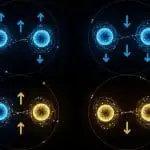
In a new development, scientists have harnessed the power of quantum correlations in light to create a new generation of ultra-sensitive devices that can surpass classical limits on measurement and sensing. By leveraging both temporal and spatial correlations in quantum states of light, researchers have demonstrated a parallel sensing configuration that enables faster and more efficient measurements, with a quantum enhancement in sensitivity ranging from 22 to 24 over the corresponding classical configuration.
This innovative approach has significant implications for various fields, including materials science, biology, and medicine. By enabling simultaneous probing of multiple parameters or independent measurement of various properties, quantum metrology can lead to breakthroughs in understanding complex systems and phenomena. The development of parallel sensing configurations using quantum states of light paves the way towards more complex quantum sensing and imaging platforms, with potential applications in sub-shot noise quantum imaging, enhanced biological imaging, molecule tracking, and beam displacement measurements.
Quantum Metrology: Enhancing Sensitivity Beyond Classical Limits
Quantum metrology is a field that leverages the unique properties of quantum systems, such as entanglement and superposition, to enhance the sensitivity of measurements and sensing devices. This approach has been shown to surpass the fundamental classical limit set by the shot noise limit (SNL). The use of quantum correlations in both temporal and spatial degrees of freedom of light can extend quantumenhanced sensing to a parallel configuration, allowing for simultaneous probing of multiple sensors or independent measurement of various parameters.
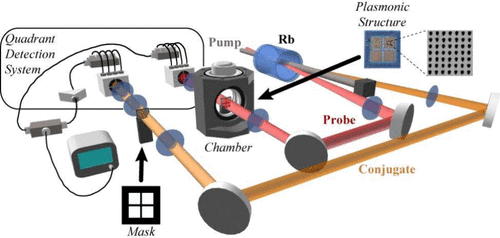
In this context, researchers have employed multispatial mode twin beams of light, characterized by independent quantum-correlated spatial subregions, along with quantum temporal correlations. This setup has been used to probe a foursensor plasmonic array, demonstrating the feasibility of independently and simultaneously measuring local changes in refractive index for all four sensors. The results show a quantum enhancement in sensitivity in the range of 22 to 24 over the corresponding classical configuration.
This achievement marks a significant step towards highly parallel spatially resolved quantumenhanced sensing techniques. It paves the way for more complex quantum sensing and imaging platforms, which could have far-reaching implications for various fields, including materials science, biology, and medicine.
The Power ofQuantum Correlations
The Power of Quantum Correlations
Quantum correlations play a crucial role in quantum metrology, enabling the enhancement of sensitivity beyond classical limits. These correlations can be harnessed in both temporal and spatial degrees of freedom of light. Temporal quantum correlations have been exploited in various applications, such as interferometry, magnetometry, and spectroscopy.
Spatial quantum correlations are at the heart of quantum imaging, leading to the generation of entangled images and enhanced measurements of beam displacements. These correlations have also found their way into applications like sub-shot noise quantum imaging, enhanced biological imaging, and molecule tracking.
In this study, researchers have taken advantage of both temporal and spatial quantum correlations in multispatial mode twin beams of light. This approach has enabled the development of a quantumenhanced parallel sensing configuration, which can simultaneously probe multiple sensors or independently measure various parameters.
Multispatial Mode Twin Beams: A Key to Parallel Sensing
Multispatial mode twin beams of light are a crucial component in this study’s setup. These beams are characterized by independent quantum-correlated spatial subregions, along with quantum temporal correlations. This unique property allows for the simultaneous probing of multiple sensors or independent measurement of various parameters.
The use of multispatial mode twin beams has been shown to enhance sensitivity beyond classical limits, making it possible to independently and simultaneously measure local changes in refractive index for all four sensors in the plasmonic array. This achievement demonstrates the potential of this approach for highly parallel spatially resolved quantumenhanced sensing techniques.
Quantum Sensing and Imaging: A New Frontier
Quantum sensing and imaging are emerging fields that leverage the unique properties of quantum systems to enhance measurement capabilities beyond classical limits. These approaches have far-reaching implications for various fields, including materials science, biology, and medicine.
The study presented here marks a significant step towards highly parallel spatially resolved quantumenhanced sensing techniques. It paves the way for more complex quantum sensing and imaging platforms, which could revolutionize our understanding of various phenomena and enable new applications.
The Future of Quantum Metrology
The Future of Quantum Metrology
Quantum metrology is an evolving field that has shown tremendous promise in enhancing measurement capabilities beyond classical limits. The use of quantum correlations in both temporal and spatial degrees of freedom of light has enabled the development of quantumenhanced sensing configurations, such as parallel sensing.
As researchers continue to explore the possibilities offered by quantum metrology, it is likely that we will see significant advancements in various fields. These developments could lead to breakthroughs in materials science, biology, medicine, and other areas, ultimately benefiting society as a whole.
The Role of Quantum Correlations in Sensing
Quantum correlations play a vital role in sensing applications, enabling the enhancement of sensitivity beyond classical limits. These correlations can be harnessed in both temporal and spatial degrees of freedom of light, making it possible to develop quantumenhanced sensing configurations.
In this study, researchers have taken advantage of quantum correlations in multispatial mode twin beams of light to enable a quantumenhanced parallel sensing configuration. This approach has been shown to enhance sensitivity beyond classical limits, making it possible to independently and simultaneously measure local changes in refractive index for all four sensors in the plasmonic array.
Conclusion
Quantum metrology is a rapidly evolving field that has shown tremendous promise in enhancing measurement capabilities beyond classical limits. The use of quantum correlations in both temporal and spatial degrees of freedom of light has enabled the development of quantumenhanced sensing configurations, such as parallel sensing.
This study marks a significant step towards highly parallel spatially resolved quantumenhanced sensing techniques. It paves the way for more complex quantum sensing and imaging platforms, which could have far-reaching implications for various fields, including materials science, biology, and medicine.
Publication Date: 2024-07-22
Authors: Mohammadjavad Dowran, Aye Win, Umang Jain, Ashok Kumar, et al.
Source: ACS Photonics
DOI: https://doi.org/10.1021/acsphotonics.4c00256