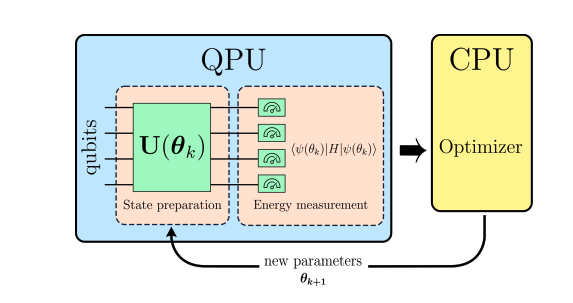
The challenge of overcoming noise in current quantum computers represents a significant hurdle to realising their potential for complex calculations, particularly in fields like chemistry. Nacer Eddine and colleagues at IBM Research, along with collaborators, investigate how to improve the accuracy of the Variational Eigensolver (VQE) algorithm on these noisy machines. Their research demonstrates that a computationally efficient error mitigation technique, known as Twirled Readout Error Extinction (T-REx), can dramatically enhance VQE performance, even on older hardware. Surprisingly, the team finds that a five-qubit processor, when paired with T-REx, delivers ground-state energy estimations an order of magnitude more accurate than those from a much larger, 156-qubit device without mitigation, highlighting the importance of parameter quality over sheer computational power. This work suggests that optimising the variational parameters within VQE, aided by error mitigation, provides a more dependable measure of performance than relying solely on the final energy estimations, and paves the way for more effective molecular simulations on near-term quantum hardware.
The inherent noise in current Noisy Intermediate-Scale Quantum (NISQ) devices presents a major obstacle to the accurate implementation of quantum algorithms, such as the Variational Quantum Eigensolver (VQE), for quantum chemistry applications. The investigation focuses on understanding how these techniques can reduce the effects of noise and enhance the reliability of quantum computations, establishing a pathway towards more robust and dependable quantum simulations of molecular systems despite the limitations of present-day quantum hardware.
Variational Quantum Eigensolver and Molecular Ansatzes
Research in variational quantum algorithms (VQAs) and quantum chemistry dominates the field, with many studies focusing on using VQAs, like VQE, to solve electronic structure problems. Core VQE concepts are explored alongside different ansatzes, which are parameterized quantum circuits used within VQAs, including Unitary Coupled Cluster (UCC), local UCC, optimized UCC, and hardware-efficient ansatzes designed for near-term quantum hardware. Quantum-Selected Configuration Interaction offers a hybrid approach combining quantum and classical computation. Research extends to quantum hardware and benchmarking, including randomized benchmarking, trapped-ion quantum computers, and superconducting qubit systems. Optimization and machine learning techniques, such as Simultaneous Perturbation Stochastic Approximation, are used in conjunction with quantum algorithms, alongside advanced topics like non-Abelian topological order and fidelity witnesses. A key trend is the use of hybrid quantum-classical algorithms, combining the strengths of both types of computers, with error mitigation being critical for advancing fields like materials science and drug discovery.
Smaller Processor Outperforms Larger with Mitigation
Researchers have demonstrated a surprising result: a smaller, older quantum processor, when paired with error mitigation techniques, can outperform a much larger, more advanced device. This finding challenges the assumption that simply increasing the number of qubits automatically leads to more accurate results. The research highlights the critical importance of mitigating errors inherent in current quantum hardware, demonstrating that sophisticated error correction can significantly enhance performance even on relatively small systems. The T-REx technique effectively reduces the impact of noise, allowing the smaller processor to achieve higher accuracy in determining molecular ground-state energies. Importantly, the accuracy of the optimized parameters used within the VQE algorithm provides a more reliable benchmark for performance than the raw energy estimations obtained from the quantum hardware itself, suggesting that focusing on the quality of the algorithm’s optimization process is crucial for assessing progress in quantum chemistry simulations.
Error Mitigation Beats Hardware Scale for Molecules
This study demonstrates that, for small molecular systems, an older five-qubit quantum processing unit, when combined with optimized readout error mitigation, can outperform a more advanced 156-qubit device without such mitigation. This suggests that focusing on the accuracy of these optimized parameters provides a more reliable measure of VQE performance than relying solely on hardware energy estimates, highlighting the critical role of error mitigation in maximizing the potential of current noisy quantum hardware for molecular simulations. While the study focused on small systems due to computational costs, the improved performance achieved with error mitigation suggests a pathway for extending the capabilities of existing devices. The authors acknowledge that further improvements are possible through the application of heavier error mitigation techniques, such as zero-noise extrapolation, and through the use of advanced quantum methods to refine VQE results, with future work exploring the optimal application of error mitigation strategies in the presence of different types of noise and investigating ways to reduce the computational cost of techniques like T-REx.
🗞 Improving VQE Parameter Quality on Noisy Quantum Processors with Cost-Effective Readout Error Mitigation
🧠 ArXiv: https://arxiv.org/abs/2508.15072