Scientists, led by Dr. Jayadev Vijayan from the University of Manchester, in collaboration with researchers from ETH Zurich and the University of Innsbruck, have developed a method to observe quantum phenomena in larger scales. The team used levitated optomechanics to amplify interactions between two optically trapped glass particles, overcoming environmental losses. The research, published in Nature Physics, could help understand the transition from classical to quantum physics. The findings could also have practical applications in sensor technology for environmental monitoring and offline navigation. The team plans to combine this method with quantum cooling techniques to validate quantum entanglement.
Quantum Physics: Bridging the Gap Between Classical and Quantum Realms
Quantum physics, the branch of science that governs the behavior of particles at minuscule scales, has been a subject of intense study for over a century. It has led to the discovery of phenomena such as quantum entanglement, where the properties of entangled particles become inextricably linked in ways that cannot be explained by classical physics. However, the tiny scales at which quantum systems operate can make them difficult to observe and study.
Over the past century, physicists have successfully observed quantum phenomena in increasingly larger objects, from subatomic particles like electrons to molecules containing thousands of atoms. The field of levitated optomechanics, which deals with the control of high-mass micron-scale objects in vacuum, aims to push the envelope further by testing the validity of quantum phenomena in objects that are several orders of magnitude heavier than atoms and molecules.
However, as the mass and size of an object increase, the interactions which result in delicate quantum features, such as entanglement, get lost to the environment, resulting in the classical behavior we observe. This has been a significant challenge in the field, but a team of scientists led by Dr. Jayadev Vijayan, Head of the Quantum Engineering Lab at The University of Manchester, has established a new approach to overcome this problem.
Amplifying Quantum Features to Overcome Environmental Noise
To observe quantum phenomena at larger scales and shed light on the classical-quantum transition, quantum features need to be preserved in the presence of noise from the environment. There are two ways to do this: one is to suppress the noise, and the second is to boost the quantum features.
The team’s research demonstrates a way to tackle the challenge by taking the second approach. They show that the interactions needed for entanglement between two optically trapped 0.1-micron-sized glass particles can be amplified by several orders of magnitude to overcome losses to the environment.
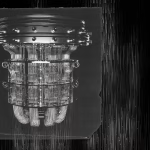
The scientists placed the particles between two highly reflective mirrors which form an optical cavity. This way, the photons scattered by each particle bounce between the mirrors several thousand times before leaving the cavity, leading to a significantly higher chance of interacting with the other particle.
Harnessing Optical Interactions for Quantum Research
Remarkably, because the optical interactions are mediated by the cavity, its strength does not decay with distance meaning we could couple micron-scale particles over several millimeters. The researchers also demonstrate the remarkable ability to finely adjust or control the interaction strength by varying the laser frequencies and position of the particles within the cavity.
This finding represents a significant leap towards understanding fundamental physics, but also holds promise for practical applications, particularly in sensor technology that could be used towards environmental monitoring and offline navigation.
Quantum Sensors: A New Frontier in Environmental Monitoring and Navigation
The key strength of levitated mechanical sensors is their high mass relative to other quantum systems using sensing. The high mass makes them well-suited for detecting gravitational forces and accelerations, resulting in better sensitivity. As such, quantum sensors can be used in many different applications in various fields, such as monitoring polar ice for climate research and measuring accelerations for navigation purposes.
Future Directions: Validating Quantum Entanglement and Quantum Sensing
The team of researchers will combine the new capabilities with well-established quantum cooling techniques in a stride towards validating quantum entanglement. If successful, achieving entanglement of levitated nano- and micro-particles could narrow the gap between the quantum world and everyday classical mechanics.
At the Photon Science Institute and the Department of Electrical and Electronic Engineering at The University of Manchester, Dr. Jayadev Vijayan’s team will continue working in levitated optomechanics, harnessing interactions between multiple nanoparticles for applications in quantum sensing.
External Link: Click Here For More