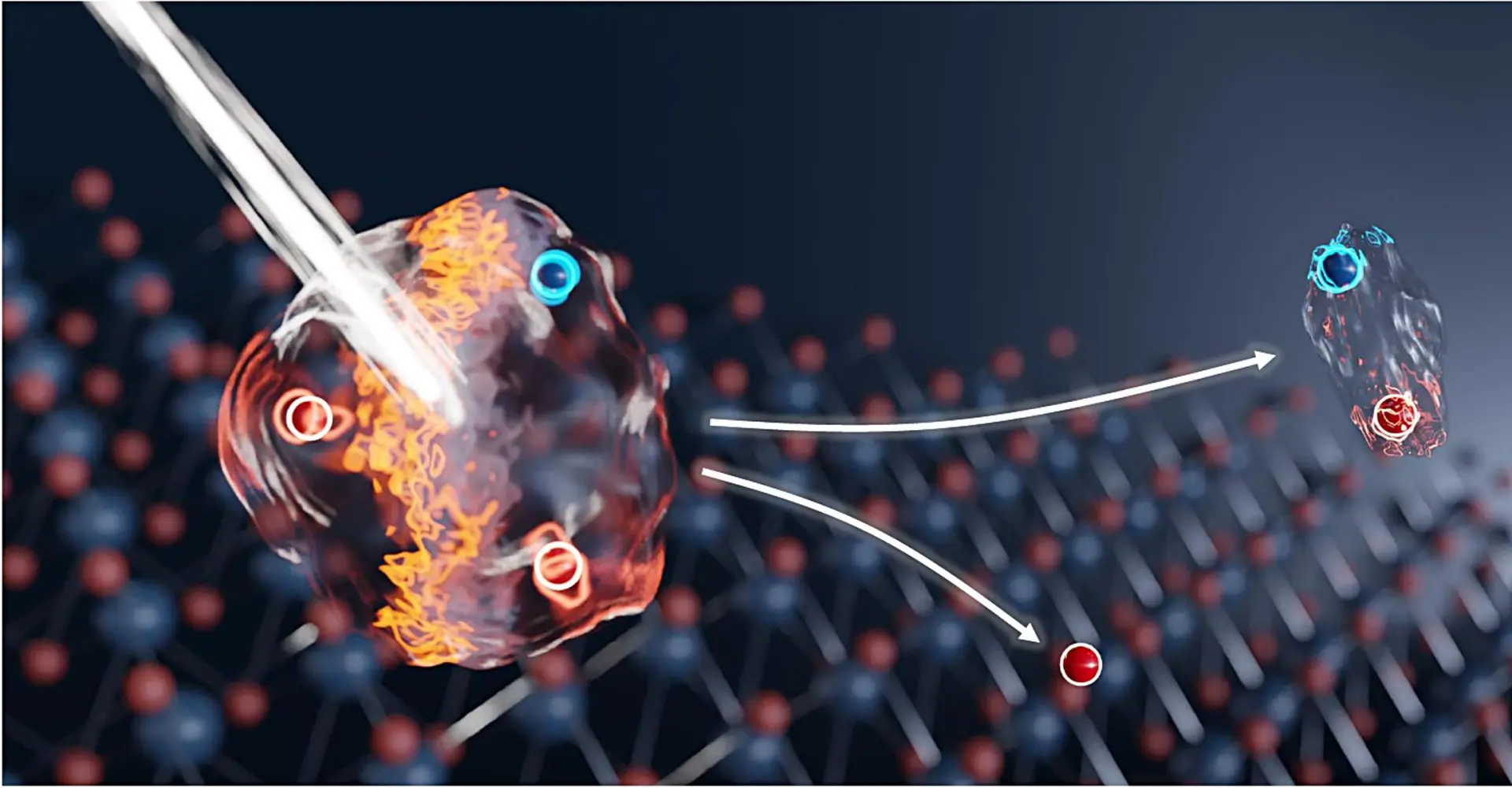
Researchers have made a breakthrough in ultra-fast switching of tiny light sources, paving the way for advancements in electronics and quantum technologies. An international team led by Professor Alexey Chernikov from TU Dresden and Dr. Stephan Winnerl from Helmholtz-Zentrum Dresden-Rossendorf (HZDR) has successfully demonstrated an extremely fast switching process between electrically neutral and charged luminescent particles in an ultra-thin, two-dimensional material.
The experiment involved using a special facility at HZDR to generate intense terahertz pulses, which were then used to separate charged luminous trions into individual electrons and neutral excitons. This separation took place at record speed, with the bond being broken within a few picoseconds – almost a thousand times faster than previously possible with purely electronic methods.
The research, published in Nature Photonics, opens up new perspectives for optical data processing and flexible detectors. The team’s findings could also lead to applications in sensor technology, with potential uses in detecting and imaging technologically relevant terahertz radiation. Key contributors to the project included researchers from Marburg, Rome, Stockholm, and Tsukuba.
Ultra-Fast Switching of Tiny Light Sources: A Breakthrough in 2D Materials
The manipulation of light at the nanoscale has long been a topic of interest in the field of quantum technologies. Recently, an international team led by TU Dresden has made significant progress in this area, achieving ultra-fast switching between electrically neutral and charged luminescent particles in an ultra-thin, effectively two-dimensional material. This breakthrough opens up new perspectives for research as well as for optical data processing and flexible detectors.
Two-Dimensional Semiconductors: A Platform for Exciton and Trion Particles
Two-dimensional semiconductors exhibit fundamentally different properties compared to more conventional bulk crystals. In particular, it is easier to generate so-called exciton particles in these materials. When an electron is excited by absorbing energy, it leaves behind a mobile charge – a positively charged “hole”. The electron and hole attract each other and form together a bound state called an exciton, a kind of electronic pair. If another electron is nearby, it is pulled towards the exciton to form a three-particle state – known as a trion in scientific jargon.
The special feature of the trion is the combination of electrical charge with strong light emission, which allows simultaneous electronic and optical control. The interplay between exciton and trion has been considered as a switching process that is both intriguing in itself and could also be of interest for future applications.
Accelerating the Switching Process: A Record-Breaking Achievement
Many laboratories have already succeeded in switching between the two states in a targeted manner – but so far with limited switching speeds. The international team led by Prof. Alexey Chernikov from TU Dresden and HZDR physicist Dr. Stephan Winnerl has now achieved ultra-fast switching of trions in 2D materials using terahertz photons.
The researchers first illuminated an atomically-thin layer of molybdenum diselenide at cryogenic temperatures with short laser pulses, generating the excitons. As soon as they were created, each exciton captured an electron from those already present in sufficient numbers in the material, and thus became trions. When terahertz pulses were then shot at the material, the trions formed back into excitons extremely quickly.
The separation into excitons took place at record speed, with the bond being broken within a few picoseconds – trillionths of a second. This is almost a thousand times faster than previously possible with purely electronic methods and can be generated on demand with terahertz radiation.
Prospects for Research and Applications
The new method offers interesting prospects for research. The next step could be to extend the demonstrated processes to a variety of complex electronic states and material platforms. Unusual quantum states of matter, which arise from the strong interaction between many particles, would thus come within reach, as would applications at room temperature.
Furthermore, the results could also become useful for future applications, such as in sensor technology or optical data processing. The demonstrated switching process could be adapted for new types of modulators with rapid switching, and in combination with ultra-thin crystals, this could be used to develop components that are both extremely compact and capable of electronically controlling optically encoded information.
Another field would be applications in the detection and imaging of technologically relevant terahertz radiation. Based on the demonstrated switching processes in atomically thin semiconductors, it may be possible in the long term to develop detectors that work in the terahertz range, are adjustable in a wide frequency range, and could be realized as terahertz cameras featuring a large number of pixels.
In principle, even a comparatively low intensity should be sufficient to trigger the switching process. Converting trions to excitons leads to characteristic changes in the emitted near-infrared light wavelength. Detecting this and converting it into images would be fairly straightforward and could be achieved using already existing state-of-the-art technology.
External Link: Click Here For More