The pursuit of controlling light at its most fundamental level has led researchers to explore squeezed light, a state where quantum fluctuations are reduced below standard limits, offering potential for enhanced precision in sensing and communication. Sahil D. Patel and Galan Moody, both from the University of California, Santa Barbara, alongside Weng W. Chow at Sandia National Laboratories, present a new theoretical framework for generating squeezed light using semiconductor quantum dots embedded within microcavities. Their work demonstrates that, under specific conditions, these systems can produce significant squeezing, reducing light fluctuations by as much as 5 dB, with remarkably low power requirements. This achievement is particularly noteworthy because it reveals how quantum correlations, arising from a process called four-wave mixing, not only shape the light’s characteristics but also directly contribute to the generation of squeezed light, potentially paving the way for more efficient and compact quantum light sources.
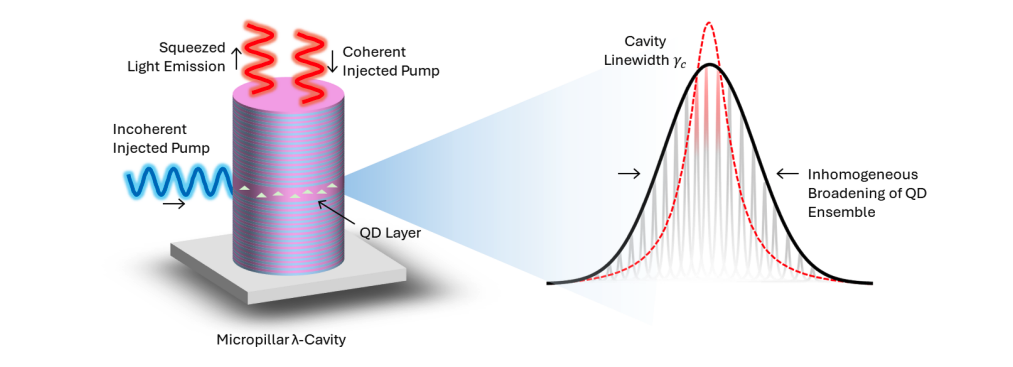
This work presents a cavity-QED theory for generating squeezed light from semiconductor quantum dots (QDs) integrated within microcavities. The researchers formulate equations of motion to describe an inhomogeneously broadened QD ensemble, subject to incoherent pumping and simultaneous driving by a coherent seed field, solving these to determine steady-state conditions and compute output-field quadrature variances. The analysis identifies specific operating conditions that yield amplitude-quadrature squeezing, achieving photon-number fluctuations reduced below the coherent-state limit and demonstrating squeezing levels as large as 5 dB.
Quantum Dot Sources of Squeezed Light
This research focuses on developing improved sources of squeezed light using quantum dots (QDs) as the active material, driven by the need for advancements in quantum technologies. Squeezed light enhances the security and range of Quantum Key Distribution (QKD) systems, improves the sensitivity of gravitational wave detectors like LIGO, and provides a valuable resource for quantum computing and information processing, also enhancing the precision of quantum sensing applications. Squeezed light is a non-classical state of light where quantum fluctuations in one property, such as amplitude or phase, are reduced below the standard quantum limit, trading noise in one direction for another to reduce overall uncertainty. Quantum dots are semiconductor nanocrystals exhibiting quantum mechanical properties, acting like artificial atoms that emit light at specific wavelengths when excited, offering small size, tunable emission wavelengths, and potential for high efficiency.
The research explores key concepts including Four-Wave Mixing (FWM), a nonlinear optical process where photons interact to generate new photons at different frequencies, and Injection Locking, a technique used to synchronize the frequency and phase of a laser to an external signal. Microcavities enhance light-matter interactions, while Quantum Combs provide a coherent source of multiple frequencies with quantum properties. The research acknowledges challenges like dephasing, absorption, and efficiency, proposing solutions to improve the quality and scalability of QD-based squeezed light sources.
Specific research directions include improving QD quality, optimising microcavity design, exploring new materials, and developing new pump schemes. The document highlights the potential applications of QD-based squeezed light sources in QKD, gravitational wave detection, and quantum computing, with a key focus on creating on-chip squeezed light sources for miniaturisation, cost reduction, and integration with other quantum devices. Using QD lasers as a pump source is a novel approach that could lead to more efficient squeezed light generation, and the development of on-chip quantum combs based on QDs is a promising area of research for quantum metrology and spectroscopy. Addressing decoherence in QDs is crucial for improving the quality of squeezed light. This document provides a comprehensive overview of the research landscape in QD-based squeezed light sources, highlighting the challenges and opportunities in this field and outlining a roadmap for future research. The focus on on-chip integration and the development of new materials and pump schemes are particularly promising, offering valuable insight into the cutting edge of quantum photonics.
Squeezed Light from Quantum Dot Microcavities
Researchers have demonstrated a method for generating squeezed light using semiconductor quantum dots integrated within microcavities, achieving a significant reduction in light fluctuations. This technique leverages the unique quantum properties of these nanoscale structures to create light with less noise than conventional sources, potentially enhancing the sensitivity of various optical measurements and communication systems. Theoretical work and simulations confirm that squeezing levels up to 5 decibels are attainable with remarkably low pump power, around 1 microwatt, using currently available materials and device designs. The process relies on carefully controlling the interaction between the quantum dots and the cavity light field, utilising four-wave mixing to shape the light’s spectrum and generate squeezing, linked to mechanisms also responsible for ultra-narrow lasing in quantum dot lasers, suggesting a pathway to combine these functionalities.
Simulations reveal that the system achieves a reduction in noise below the standard quantum limit, as evidenced by a sub-Poissonian photon number distribution and a minimum uncertainty product of light quadratures. This approach offers a substantial advantage over existing methods for generating squeezed light, which often require significantly higher power levels, typically in the tens or hundreds of milliwatts, to achieve comparable levels of noise reduction. The theoretical analysis indicates that the generated squeezed light output power increases with injected power and benefits from narrower cavity linewidths, suggesting that optimising these parameters is crucial for maximising performance. Furthermore, the simulations demonstrate that the squeezing remains robust even with realistic levels of laser frequency instability, provided the linewidth is sufficiently narrow, and is largely unaffected by slow thermal drifts. The research highlights the potential of quantum dot-based devices to provide a compact, energy-efficient, and high-performance platform for generating squeezed light, opening up possibilities for advancements in quantum communication, precision sensing, and other areas of quantum technology. The team’s findings suggest that this technology could offer a pathway to achieving significant improvements in the sensitivity of optical measurements while minimising energy consumption.
Quantum Dot Squeezed Light at Low Power
This research presents a theoretical framework demonstrating how to generate squeezed light using semiconductor quantum dots integrated within microcavities. The analysis reveals that, under specific operating conditions, it is possible to reduce fluctuations in the amplitude of light below the standard quantum limit, achieving squeezing levels of up to 5 dB with very low pump power, around 1 microwatt. This squeezing arises from quantum correlations linked to four-wave mixing, which both shape the gain spectrum and contribute to the generation of squeezed light, mirroring mechanisms observed in ultra-narrow lasing achieved with quantum dot lasers. The study highlights the importance of minimising noise from the pump source and maintaining the stability of the injected laser frequency to preserve the squeezing effect.
While the model assumes a specific inhomogeneous distribution of quantum dots, narrowing this distribution promises tighter coupling, reduced pump requirements, and broader squeezing bandwidth. Importantly, the theoretical results demonstrate that these quantum dot devices can achieve comparable levels of quadrature noise reduction to state-of-the-art nonlinear resonators, but with significantly lower power consumption, sub-milliwatt electrical input compared to tens or hundreds of milliwatts. The authors acknowledge that maintaining narrow cavity linewidths is crucial for achieving stronger squeezing, and future work could explore optimising device parameters to.
🗞 Microscopic Theory of Squeezed Light in Quantum Dot Systems
🧠 ArXiv: https://arxiv.org/abs/2508.15114