

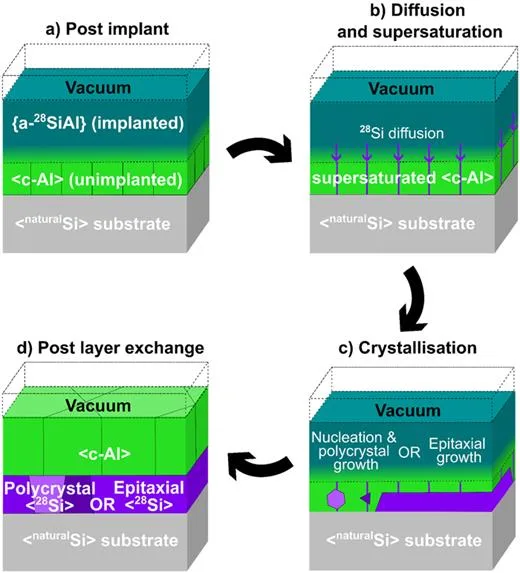
Researchers from the University of Surrey have developed a novel enrichment process that could enable the use of industrial complementary metal oxide semiconductor implanters to manufacture quantum grade 28Si layers for quantum computers. The process, known as implanted layer exchange enrichment, involves replacing a step of depositing a silicon layer above an aluminum layer with a 28Si implant into the top of an Al layer. The researchers have also developed a model to predict the outcomes of this process. This research could potentially revolutionize the manufacturing process for quantum computers, making them more accessible and efficient.
What is the Crystallization Kinetics during Layer Exchange of 28Si Implanted Al Films?
The research article, authored by Ella B Schneider and Jonathan England from the Ion Beam Centre Advanced Technology Institute at the University of Surrey, delves into the investigation of a novel enrichment process. This process could potentially enable the use of industrial complementary metal oxide semiconductor implanters to manufacture quantum grade 28Si layers for use in quantum computers. The process, known as implanted layer exchange enrichment, is a modification of conventional deposition-based layer exchange approaches. It involves replacing a step of depositing a silicon (Si) layer above an aluminum (Al) layer with a 28Si implant into the top of an Al layer.
The subsequent anneal dissolves Si into Al beneath the implanted region, where Si diffuses and either epitaxially grows onto the substrate or forms polycrystals in the Al. This process was previously discussed in a paper by Schneider and England published in ACS Appl Mater Interfaces. The researchers have developed a qualitative model using simple assumptions and boundary conditions to estimate characteristic times and rates of epitaxy or polycrystallization for this novel layer exchange process.
How Does the Model Explain Crystallization Outcomes?
The model developed by Schneider and England has been used to explain crystallization outcomes reported in this paper and previously. The researchers found that the absence of an oxide boundary layer separating Si and Al allows Si diffusion to become established within the first second of all the anneals studied. Furthermore, they discovered that crystallization actually completes during the temperature ramp of most of the anneals.
The rapid evolution of Si supersaturation in Al beneath the implanted layer explains the ratios of epitaxial growth to polycrystallization observed after these anneals. This understanding of the process and its outcomes is crucial in the development of the implanted layer exchange enrichment process.
What are the Implications for Quantum Computing?
The research conducted by Schneider and England has significant implications for the field of quantum computing. The implanted layer exchange enrichment process they are investigating could potentially allow for the production of high-quality monocrystalline quantum grade Si. This would be a significant advancement in the manufacturing process for quantum computers, potentially making them more accessible and efficient.
The researchers’ model provides a theoretical framework for understanding and predicting the outcomes of the implanted layer exchange process. This could guide future research and development efforts in the field, helping to optimize the process and improve the quality of the resulting quantum grade Si layers.
What are the Next Steps in the Research?
The research conducted by Schneider and England is a significant step forward in the development of the implanted layer exchange enrichment process. However, there is still much work to be done. The researchers propose the implant layer exchange conditions that could produce the highest quality monocrystalline quantum grade Si. These proposed conditions will need to be tested and validated in future research.
Furthermore, the researchers’ model will need to be refined and expanded upon as more data is collected. This will help to improve the accuracy of the model’s predictions and further our understanding of the implanted layer exchange process.
What is the Significance of this Research?
The research conducted by Schneider and England is of significant importance to the field of quantum computing. The development of a process that could potentially allow for the production of high-quality monocrystalline quantum grade Si would be a major advancement. This could potentially make quantum computers more accessible and efficient, opening up new possibilities in the field.
Furthermore, the researchers’ model provides a theoretical framework for understanding and predicting the outcomes of the implanted layer exchange process. This could guide future research and development efforts in the field, helping to optimize the process and improve the quality of the resulting quantum grade Si layers.
Conclusion
In conclusion, the research conducted by Schneider and England represents a significant advancement in the field of quantum computing. Their investigation into the implanted layer exchange enrichment process and the development of a theoretical model to predict its outcomes could potentially revolutionize the manufacturing process for quantum computers. However, further research is needed to validate their findings and refine their model.
Publication Date: 2024-05-17
Authors: E. Schneider and Jonathan England
Source: Journal of vacuum science & technology. A. Vacuum, surfaces, and films
DOI: https://doi.org/10.1116/6.0003638


