

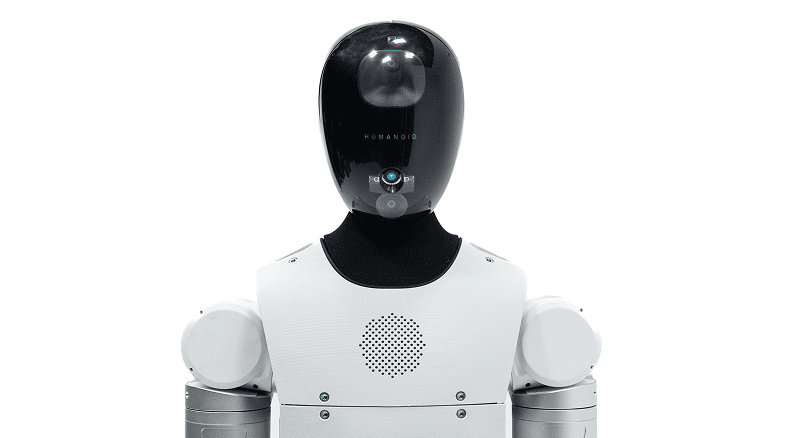
Forget rigid robotic arms – the future of factory automation may walk, grasp, and learn on two feet. UK-based robotics firm Humanoid has completed a successful proof-of-concept with automotive and industrial supplier Schaeffler, deploying a pre-alpha humanoid robot to sort metallic bearing rings from cluttered bins autonomously. This isn’t just a tech demo; it signals a potential shift away from traditional automation, which often struggles with complex, unstructured tasks, and towards more adaptable, AI-powered systems. The collaboration demonstrates the promise of humanoid robots to boost efficiency and ROI in real-world manufacturing settings – and highlights a growing trend towards flexible, intelligent automation.
Successful Humanoid-Schaeffler Bin Picking Proof of Concept
The successful bin-picking proof of concept between Humanoid and Schaeffler isn’t simply about automating a task – it’s about demonstrating a new paradigm for manufacturing flexibility. Unlike traditional robotic solutions that often require dedicated, fixed setups for specific parts, Humanoid’s pre-alpha robot successfully sorted metallic bearing rings of varying types thanks to adaptable AI models. This capability – honed through a combination of teleoperation data collection using a physical twin lab robot and a pre-trained VLA model – enabled autonomous correction and regrasp in real time, addressing the limitations of conventional automation in unstructured environments. Importantly, the robot’s integrated cameras and sensors minimized installation complexities, a key factor for industrial adoption. Schaeffler anticipates deploying a “significant number” of humanoid robots across its global manufacturing footprint, viewing this POC as a crucial step, and plans to move into a second phase utilizing Humanoid’s more advanced alpha robot – boasting increased payload and AI capabilities – within a live production environment to further validate performance under realistic conditions.
Key Advantages of Humanoid Robotics
Beyond simply automating a specific task, the advantages of humanoid robotics – as demonstrated by Humanoid and Schaeffler’s successful proof-of-concept – lie in their potential to redefine manufacturing flexibility and ROI. Unlike traditional robotic arms constrained by fixed setups, Humanoid’s robots leverage adaptable AI models, generalizing skills across varying part types – in this case, metallic bearing rings – and minimizing the need for reprogramming. This inherent adaptability extends to physical mobility, allowing a single unit to operate across multiple machines, a significant advantage over static automation. Furthermore, the integrated cameras and sensors simplify installation, reducing complexities often associated with industrial robotics. Schaeffler’s anticipation of deploying a “significant number” of these robots across its global footprint underscores a key benefit: scalability. The transition to Humanoid’s alpha robot – boasting increased payload and enhanced AI – promises even greater performance validation within realistic production environments, addressing challenges like noise and dust, and solidifying the case for a truly versatile and intelligent automation solution.
Future Plans – Next Phase & Alpha Robot
The momentum from the successful proof-of-concept will now shift to a second phase, crucially moving beyond the lab and into a live production environment at Schaeffler. This next stage will feature Humanoid’s alpha robot—a fully in-house-designed platform that represents a significant leap in capability. While the pre-alpha robot demonstrated core functionality, the alpha version boasts increased payload capacity – essential for handling a wider range of components – alongside more advanced manipulation skills and enhanced AI performance. This isn’t simply about incremental improvements; Humanoid aims to rigorously validate the robot’s performance under the demanding conditions of a real factory—contending with factors such as ambient noise, dust, varied materials, and the continuous operational demands of a production line. Schaeffler’s commitment to deploying a “significant number” of these robots globally underscores the potential for widespread adoption, contingent upon successful validation of the alpha robot’s robustness and efficiency in this critical next phase of testing.


