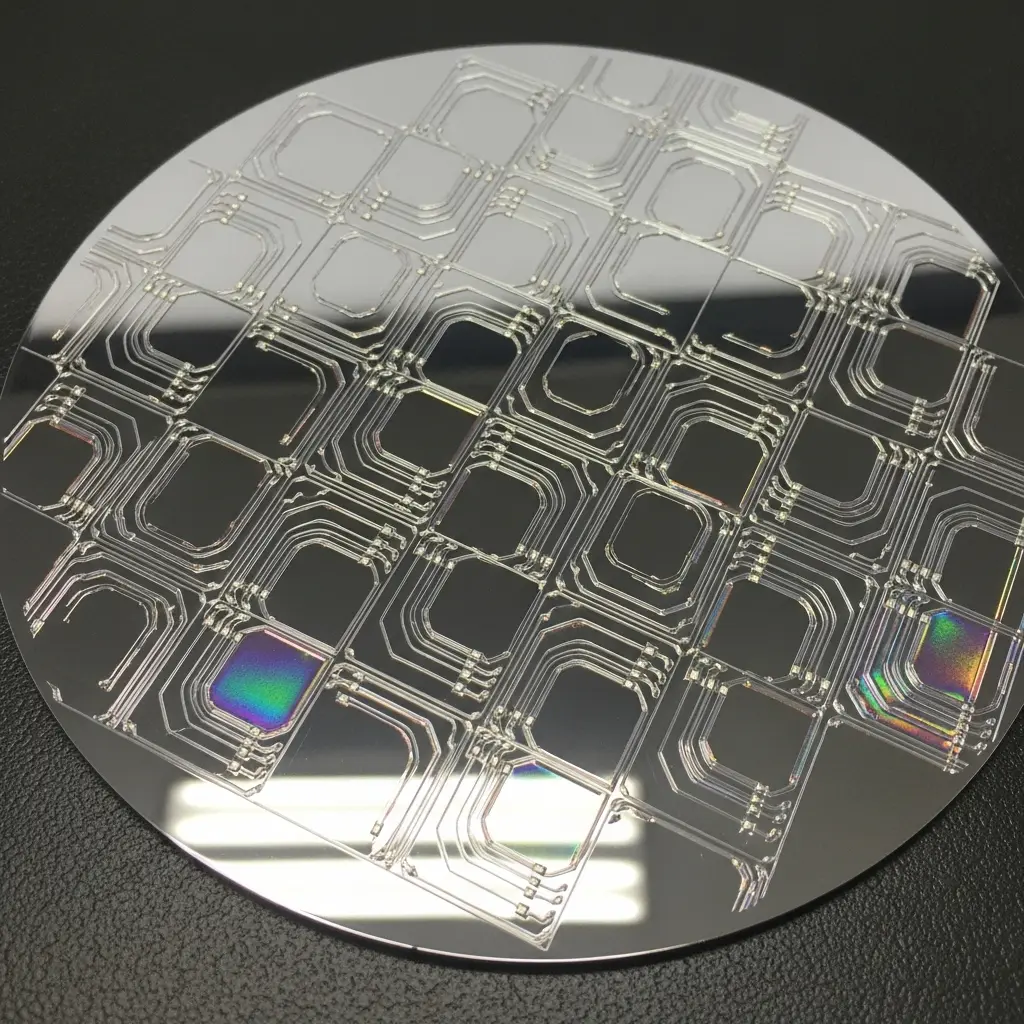
The pursuit of more efficient and compact photonic circuits, crucial for advancements in integrated circuits and augmented reality displays, demands materials with both high refractive index and scalable manufacturing processes. Aleksandr Slavich, Georgy Ermolaev, and Dmitriy Grudinin, alongside colleagues at their institutions, now demonstrate that large-scale films of gallium sulfide, created using a technique called atomic layer deposition, overcome longstanding limitations in this field. Their research establishes that these films possess optical properties virtually identical to those of pristine, single-crystal materials, offering a significant breakthrough in van der Waals photonics. By retaining the natural anisotropy of the material, the team demonstrates superior performance in suppressing unwanted signal interference within densely packed waveguides, paving the way for brighter, more efficient visible-spectrum photonic devices.
Van der Waals (vdW) materials possess exceptional optical properties, including high refractive indices and significant anisotropy, but their implementation has been limited by the small area and uncontrolled thickness of mechanically exfoliated flakes. This work demonstrates a method for overcoming these limitations, enabling the widespread use of vdW materials in advanced photonic devices, focusing on achieving precise control over material thickness and uniformity, critical parameters for optimising device performance and scalability.
Large-Area GaS Films Grown by Atomic Layer Deposition
Scientists have developed a robust method for fabricating large-scale, high-quality gallium sulfide (GaS) films using atomic layer deposition, overcoming limitations in traditional van der Waals material implementation. The team grew thick GaS films on large-area substrates, achieving thicknesses of approximately 20 micrometers while maintaining exceptional structural and optical properties. Energy-dispersive X-ray spectroscopy confirmed near-ideal stoichiometry with a Ga:S atomic ratio of 49. 5:50. 5, and scanning electron microscopy revealed a continuous, macroscopic foil-like film capable of withstanding substrate release without fracturing.
Optical profilometry measurements confirmed the substantial thickness and uniformity of the deposited layers. Raman spectroscopy, employing both 532nm and 633nm excitation wavelengths, revealed sharp, intense peaks corresponding to characteristic GaS vibrational modes, indicating high phase purity and minimal defects. The narrow linewidths of these peaks confirmed the exceptional crystalline quality of the ALD-grown films. Researchers also demonstrated the ability to mechanically exfoliate thin flakes from the bulk film, achieving atomically flat surfaces with an ultra-low root-mean-square roughness of 0.
14nm, as measured by atomic force microscopy. High-resolution transmission electron microscopy revealed clear lattice fringes consistent with GaS crystal structure, and a corresponding hexagonal diffraction pattern, further confirming the material’s crystalline integrity. These techniques demonstrate that ALD-grown GaS forms thick films with high crystal quality and stoichiometric composition over large areas, paving the way for advanced photonic components.
D Materials for Nanoscale Light Control
This research explores and characterizes materials suitable for building advanced nanophotonic devices, focusing on materials that can guide and manipulate light at the nanoscale, operate across a broad spectrum, enable new functionalities, and integrate into compact devices. Key material classes investigated include transition metal dichalcogenides, transition metal disulfides/diselenides/diphosphides, group V chalcogenides, hexagonal boron nitride, germanium disulfide, and cadmium phosphide sulfide. A significant emphasis is placed on creating heterostructures by stacking different 2D materials, allowing researchers to combine the best properties of different materials and engineer new functionalities. The research relies heavily on precise material characterization using techniques such as spectroscopic ellipsometry and atomic force microscopy. The ultimate goal is to develop materials and devices for compact optical components, augmented reality displays, reconfigurable optics, high-performance nanophotonic circuits, and ultraviolet nanophotonics.
Gallium Sulfide Enables Scalable Photonics Fabrication
This research establishes atomic layer deposition-grown gallium sulfide as a viable, high-refractive-index dielectric platform, successfully uniting the desirable optical properties of van der Waals materials with the demands of scalable manufacturing techniques. The team demonstrates that the optical characteristics of these gallium sulfide films closely match those found in pristine single crystals, confirming that optical performance is maintained during large-scale production. Importantly, the material’s inherent anisotropy offers a significant advantage over conventional isotropic materials, leading to improved optical confinement and reduced crosstalk in densely integrated photonic circuits. The achievement resolves a long-standing challenge in the field, overcoming the trade-off between high optical performance and manufacturability. This breakthrough provides a foundation for developing next-generation visible-spectrum photonic integrated circuits, ultra-compact optical components, and advanced display technologies. While acknowledging that gallium sulfide is not suitable for full-color devices due to its absorption of blue light, the researchers highlight its scalability as ideal for prototyping refractive optics and augmented reality waveguides, particularly for monochrome applications.
🗞 Scalable van der Waals Photonics: High-Refractive-Index Gallium Sulfide Films with Single-Crystal Optical Properties
🧠 ArXiv: https://arxiv.org/abs/2512.09255