

The quest for scalable quantum computing has been a longstanding challenge in the field of quantum information processing. One crucial requirement for achieving this goal is the development of high-fidelity qubit readout techniques that can efficiently and accurately measure the state of individual qubits. In this context, researchers have been exploring various approaches to improve the performance of charge sensors, which are essential components in spin-based qubit architectures.
Can Scalable Quantum Computing Be Achieved with High-Fidelity Qubit Readout?
The quest for scalable quantum computing has been a longstanding challenge in the field of quantum information processing. One crucial requirement for achieving this goal is the development of high-fidelity qubit readout techniques that can efficiently and accurately measure the state of individual qubits. In this context, researchers have been exploring various approaches to improve the performance of charge sensors, which are essential components in spin-based qubit architectures.
The Limitations of Conventional Charge Sensors
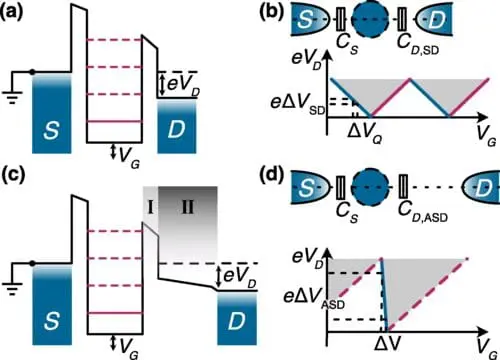
Conventional charge sensors, such as quantum point contacts or sensing dots (SDs), have been widely used for readout purposes. However, these devices often suffer from negative feedback effects, which can significantly limit their output swing and overall performance. In particular, the drain reservoir in conventional SDs is strongly coupled to the sensor dot, leading to a reduced response and increased noise.
The Advantages of Asymmetric Sensing Dots
To overcome these limitations, researchers have designed asymmetric sensing dots (ASDs) that decouple the drain reservoir from the sensor dot. This innovative approach enables a significantly improved response compared to conventional SDs. The ASD design features a strongly decoupled drain reservoir, which mitigates negative feedback effects and boosts the output swing.
Boosting the Output Swing
The ASD design has been demonstrated to provide an impressive output swing of 3 mV, exceeding the response in the conventional regime by more than ten times. This enhanced output signal paves the way for employing very low-power readout amplifiers in close proximity to the qubit, which is essential for scalable quantum computing.
The Importance of Scalability
Scalability is a critical aspect of quantum computing, as it enables the development of large-scale quantum processors that can efficiently process complex calculations. High-fidelity qubit readout techniques are essential for achieving this goal, as they provide the necessary accuracy and efficiency for measuring the state of individual qubits.
The Role of Baseband Readout
Baseband readout is a promising approach for scalable quantum computing, as it eliminates the need for RF components and enables the use of low-power amplifiers. This technique has the potential to significantly reduce the complexity and size of the readout periphery, making it more suitable for large-scale quantum processors.
The Future of Quantum Computing
The development of high-fidelity qubit readout techniques is a crucial step towards achieving scalable quantum computing. The ASD design demonstrates the potential for improving the performance of charge sensors, which can lead to significant advancements in the field of quantum information processing. As researchers continue to explore innovative approaches and push the boundaries of what is possible, we can expect to see significant progress in the development of large-scale quantum processors that can efficiently process complex calculations.
The Challenges Ahead
Despite the promising results from the ASD design, there are still several challenges that need to be addressed before scalable quantum computing can become a reality. For example, researchers will need to develop more efficient and accurate qubit readout techniques that can handle the increased complexity of large-scale quantum processors. Additionally, the development of robust and reliable qubit architectures is essential for achieving high-fidelity qubit readout.
The Path Forward
The path forward for scalable quantum computing involves continued research and innovation in the development of high-fidelity qubit readout techniques. By exploring new approaches and pushing the boundaries of what is possible, researchers can make significant progress towards achieving large-scale quantum processors that can efficiently process complex calculations.
Publication Date: 2024-08-15
Authors: Eugen Kammerloher, Andreas Schmidbauer, Laura K. Diebel, Inga Seidler, et al.
Source: Physical Review Applied
DOI: https://doi.org/10.1103/physrevapplied.22.024044


