

Accurate modelling of molecular electronic structure remains a significant computational challenge in chemistry, crucial for advancements in materials science, drug discovery, and fundamental chemical understanding. Researchers are increasingly exploring neural network quantum states (NQS), a variational approach employing artificial neural networks to represent quantum many-body wavefunctions, as a potential solution. However, training these networks typically demands substantial computational resources that scale exponentially with system size, limiting their practical application to realistically complex molecules. Now, Hongtao Xu, Zibo Wu, Mingzhen Li, and Weile Jia, collaborating across the University of Chinese Academy of Sciences and Beijing Normal University, detail a high-performance framework, presented in their article “Large-scale Neural Network Quantum States for ab initio Quantum Chemistry Simulations on Fugaku”, designed to overcome these scalability limitations and accelerate ab initio electronic structure calculations. Ab initio methods refer to calculations based on first principles, without empirical parameters.
Accurately modelling complex molecular systems remains a persistent challenge within computational chemistry, demanding substantial computational resources and innovative algorithmic approaches. Traditional ab initio methods, including Configuration Interaction and Coupled-Cluster theory, struggle with the exponential scaling of computational cost as system size increases, limiting their applicability to relatively small molecules. Ab initio methods refer to calculations performed from first principles, using only fundamental physical constants, without empirical parameters. Researchers now introduce QChem-Trainer, a high-performance framework designed to accelerate Neural Network Quantum States (NNQS) training for ab initio electronic structure calculations, offering a pathway to overcome these limitations and explore larger, more complex chemical systems.
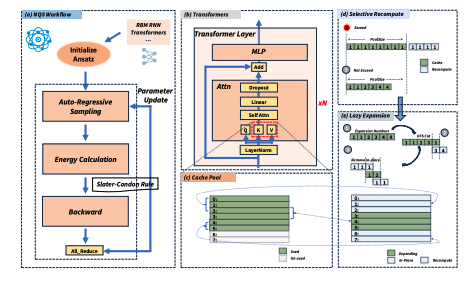
QChem-Trainer addresses scalability limitations through a multi-layered approach to parallelism, efficiently distributing computational tasks across multiple processing units. The system implements a scalable sampling strategy, dividing the workload across multiple layers and utilising a hybrid sampling scheme, enabling training of larger systems with reduced computational demands. Furthermore, the framework incorporates local energy parallelism, optimising the computation of local energies within the neural network, significantly reducing the time required for each training iteration and accelerating the overall computational process. Local energies represent the energy contribution of individual electrons within the molecule, and their efficient calculation is crucial for accurate electronic structure determination.
A key innovation within QChem-Trainer lies in its
A key innovation within QChem-Trainer lies in its cache-centric optimisation specifically tailored for transformer-based ansatzes, the neural network architectures used to represent quantum wavefunctions. An ansatz is a trial wavefunction, a mathematical function that approximates the true quantum state of the molecule. By carefully managing the Key/Value caches within the transformer model, the system controls peak memory consumption, preventing bottlenecks and maintaining stable performance at scale. This optimisation, combined with the sampling parallelism and local energy parallelism, delivers substantial speedups in NNQS training, enabling researchers to tackle previously intractable computational problems.
Experiments demonstrate that QChem-Trainer achieves up to an 8.41x speedup in NNQS training and maintains a parallel efficiency of up to 95.8% when scaling to 1,536 nodes, confirming the effectiveness of the framework’s parallelisation strategies. The strong scaling performance validates the design principles and implementation details of QChem-Trainer, suggesting it offers a practical solution for enabling large-scale ab initio quantum chemistry simulations on high-performance computing systems, opening new avenues for scientific discovery. Parallel efficiency measures how well a computation scales with increasing numbers of processors, with higher values indicating better performance.
The design of QChem-Trainer prioritises efficient resource utilisation, particularly memory management, which is critical when scaling to high-performance computing environments. By employing a hierarchical workload division and hybrid sampling scheme, QChem-Trainer effectively distributes computational tasks across multiple nodes, enabling parallel processing and reducing the overall computational time. The implementation of cache-centric optimisation further enhances performance by minimising data transfer and maximising the utilisation of fast on-chip memory, ensuring optimal resource allocation and efficient computation.
Future work focuses on extending the framework’s capabilities to encompass a wider range of molecular systems and quantum chemical methods, broadening its applicability and impact. Researchers plan to investigate alternative neural network architectures and optimisers, aiming to further enhance performance and accuracy. Exploring the integration of QChem-Trainer with other quantum chemistry software packages will facilitate collaborative research and streamline computational workflows. Research will also address the challenges associated with applying NNQS to dynamical simulations, such as time-dependent quantum chemistry, expanding the scope of simulations. Developing efficient algorithms for calculating forces and gradients within the NNQS framework is crucial for enabling accurate and reliable simulations of chemical reactions and molecular processes. Investigating the potential of QChem-Trainer for accelerating other machine learning applications in chemistry and materials science represents a promising avenue for future research, extending its impact beyond quantum chemistry.
QChem-Trainer represents a significant advancement in computational quantum
QChem-Trainer represents a significant advancement in computational quantum chemistry, offering a powerful tool for exploring complex molecular systems and accelerating scientific discovery. By addressing the limitations of traditional methods and leveraging the power of parallel computing and machine learning, QChem-Trainer opens new avenues for understanding and predicting the behaviour of molecules, paving the way for breakthroughs in various fields, including drug discovery, materials science, and energy research. The framework’s efficient design, scalability, and versatility make it a valuable asset for researchers seeking to push the boundaries of computational chemistry and unlock the secrets of the molecular world.
🗞 Large-scale Neural Network Quantum States for ab initio Quantum Chemistry Simulations on Fugaku
🧠 DOI: https://doi.org/10.48550/arXiv.2506.23809


