A scalable parallel algorithm, based on operator-represented quantum algebra (ORQA), simulates many-body dynamics on large quantum systems. Demonstrated on a 127-qubit lattice using the Fugaku supercomputer, it exhibits strong scaling with near-linear communication overhead, offering a practical tool for hybrid quantum-classical computation.
Understanding the behaviour of interacting quantum systems remains a central challenge in modern physics, with implications ranging from materials science to fundamental tests of quantum mechanics. Accurately modelling these ‘many-body’ problems demands computational techniques capable of handling exponential complexity, a task increasingly addressed through innovative algorithmic development and leveraging the power of high-performance computing. Researchers at RIKEN, including Lukas Broers, Rong-Yang Sun, and Seiji Yunoki, detail a scalable parallel algorithm in their paper, ‘Scalable Simulation of Quantum Many-Body Dynamics with Or-Represented Quantum Algebra’. The work presents a method based on ‘or-represented algebra’ (ORQA), a framework for efficiently simulating the time evolution of quantum systems. It demonstrates its efficacy on a large-scale simulation of the kicked Ising model utilising the Fugaku supercomputer. This approach offers a promising avenue for integrating quantum and classical computational resources, building upon existing techniques such as tensor networks and surrogate modelling.
The simulation of many-body quantum dynamics presents a
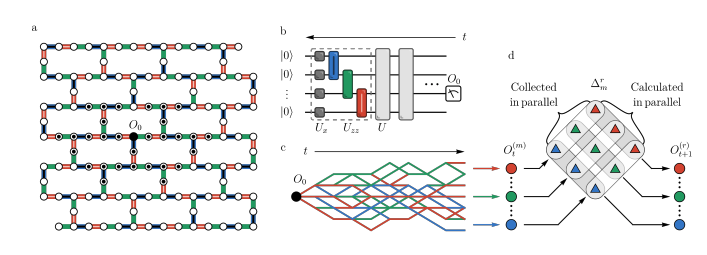
The simulation of many-body quantum dynamics presents a substantial computational challenge, limiting our understanding of complex quantum systems. Researchers now introduce ORQA, or or-represented algebra, a scalable and general-purpose parallel algorithm designed to overcome this limitation. This method applies to arbitrary spin systems and integrates seamlessly with circuit simulation within the Heisenberg picture, a mathematical formalism describing the time evolution of quantum states. The Heisenberg picture is particularly relevant to experiments utilising superconducting qubit processors, the fundamental building blocks of many quantum computers.
ORQA’s adaptability arises from its capacity to represent quantum states using Pauli strings, a basis for describing spin operators. A Pauli string is a product of Pauli matrices, which represent fundamental operations on individual qubits. This representation facilitates efficient manipulation and calculation of quantum properties. The algorithm’s efficacy is demonstrated through a simulation of the kicked Ising model, a standard benchmark in quantum chaos, on a substantial 127-qubit heavy-hexagon lattice. Researchers tracked the time evolution of local magnetisation, utilising up to one trillion Pauli strings to represent the system’s state.
Execution of ORQA on the Fugaku supercomputer underscores the importance of investment in high-performance computing infrastructure to support advanced scientific research. The algorithm’s ability to simulate complex quantum systems with unprecedented accuracy and efficiency will enable researchers to explore new frontiers in quantum physics, materials science, and related fields. The computational cost of simulating quantum systems typically scales exponentially with the number of qubits, making simulations of even moderately sized systems intractable on classical computers.
The development of ORQA involved a multidisciplinary team
The development of ORQA involved a multidisciplinary team of researchers with expertise in quantum physics, computer science, and high-performance computing, highlighting the necessity of collaboration in addressing complex scientific challenges. The algorithm’s open-source implementation will facilitate its widespread adoption by the scientific community, fostering innovation and accelerating the pace of discovery. Open-source software allows for peer review, collaborative development, and broader accessibility, which are crucial for advancing scientific progress.
The integration of ORQA with existing quantum computing frameworks will pave the way for hybrid simulations that combine the strengths of both classical and quantum computation, accelerating the pace of scientific discovery. By exploring the application of ORQA to diverse areas of physics, researchers can gain new insights into the fundamental laws of nature and develop innovative technologies based on quantum principles. This research represents a significant step towards unlocking the full potential of quantum simulation and harnessing its power to solve some of the most challenging problems in science and engineering.
Future research will focus on optimising the algorithm’s performance, extending its capabilities, and exploring its applications to a wider range of scientific problems. This includes investigating methods to reduce the computational resources required for simulations and adapting the algorithm to different types of quantum systems and physical models.
🗞 Scalable Simulation of Quantum Many-Body Dynamics with Or-Represented Quantum Algebra
🧠 DOI: https://doi.org/10.48550/arXiv.2506.13241