

The increasing prevalence of large satellite constellations promises global connectivity, but efficient data routing within these complex networks remains a significant hurdle. Hailong Su, Jinshu Su, and Yusheng Xia, along with colleagues, investigate the underlying structure of a representative mega-constellation comprising over ten thousand satellites and nearly two hundred ground stations. Their analysis reveals that these networks exhibit surprisingly strong ‘small-world’ properties, allowing data to travel efficiently across vast distances, and highlights the crucial role ground stations play in connecting different layers of the constellation. This research not only explains how current systems like Starlink function, but also provides vital insights for designing the next generation of resilient and high-performance satellite networks.
Employing tools from complex network analysis, the study identifies several critical findings regarding this architecture. The constellation exhibits strong small-world characteristics, enabling efficient routing despite large network diameters, a key feature for global coverage. Ground stations play a pivotal role in enhancing inter-shell connectivity by bridging otherwise disconnected components, improving overall network resilience. Furthermore, feeder links significantly reduce average path length, making long-haul communication more feasible across the expansive network, and analysis reveals load imbalances among ground stations, indicating the need for traffic-aware management strategies to optimise performance.
Starlink Network Performance and Gateway Placement
This research examines the network characteristics and performance of Low Earth Orbit (LEO) satellite constellations, specifically focusing on Starlink. The core goal is to understand how these networks function, how to optimise their performance, and how to ensure their robustness. The study explores the optimal placement of ground stations to serve the satellite constellation, investigating how gateway density impacts coverage, capacity, and latency. It highlights the challenges of balancing coverage with the cost of deploying and maintaining these stations. The research also investigates the network’s ability to withstand failures, such as satellite outages or gateway failures, and examines how network topology and routing protocols affect resilience.
The study focuses on metrics like throughput, latency, and capacity, and explores techniques for optimising network performance, such as load balancing and efficient routing. It addresses the challenges of scaling the network to accommodate a growing number of users and satellites, and examines how network architecture and protocols need to evolve to support increased demand. The document details the unique characteristics of LEO satellite networks, including the dynamic topology, high propagation delays, and limited bandwidth of satellite links. Starlink serves as a primary case study, leveraging publicly available information about its network configuration and performance.
The research relies on network simulation tools to model the behavior of LEO constellations, evaluating different network configurations and protocols. It employs concepts from graph theory to analyse the network topology and identify critical nodes, and uses queueing theory to model network queues and analyse the impact of congestion. The research explores various load balancing techniques to distribute traffic evenly across the network and prevent congestion, and investigates different routing protocols for LEO constellations, including those designed to minimise latency and maximise throughput. Consistent hashing is mentioned as a technique for distributing data across the network in a scalable and resilient manner, and the use of phased array antennas at gateways is discussed as a way to improve signal quality and increase capacity.
The key findings demonstrate that gateway placement is crucial for providing reliable coverage and minimising latency. Network topology significantly affects the network’s ability to withstand failures, and effective load balancing is essential for preventing congestion and maximising throughput. Dynamic routing protocols are needed to adapt to the changing network topology and optimise performance. LEO satellite networks are inherently complex due to the dynamic topology and the challenges of managing a large number of moving satellites, and scaling these networks to accommodate a growing number of users and satellites presents a major challenge.
Tools and technologies mentioned include network simulators, software packages for complex network research, Starlink, phased array antennas, and consistent hashing. Future research areas include developing more sophisticated routing protocols, investigating network security vulnerabilities, exploring the benefits of inter-satellite links, investigating onboard processing, and developing seamless integration between LEO networks and terrestrial networks. In essence, this document provides a comprehensive technical analysis of LEO satellite networks, with a particular focus on the challenges and opportunities associated with building and operating a large-scale internet service like Starlink.
Small-world properties in satellite constellations
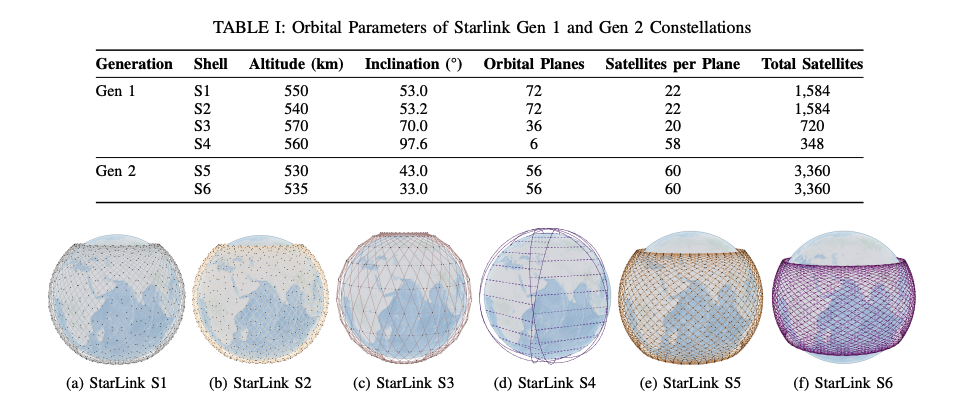
Recent research has investigated a representative six-shell constellation comprising over 10,000 satellites and nearly 200 ground stations, revealing key insights into its structural properties and dynamic behavior. The study demonstrates that this complex network exhibits characteristics of a “small-world” network, meaning information can travel efficiently despite the vast number of nodes and the large distances involved. This efficiency stems from the constellation’s inherent structure, allowing for relatively short communication paths between any two points. Ground stations play a critical role in bridging disconnected parts of the network and enhancing overall connectivity.
Analysis reveals that these stations act as vital relays, ensuring signals can reach destinations even when direct satellite links are unavailable. Furthermore, the inclusion of “feeder links”, connections between satellites and ground stations, significantly reduces the average path length for communication, making long-distance connections more practical and reliable. However, the research also highlights an uneven distribution of traffic load among ground stations, with some stations bearing a disproportionately high burden. This imbalance suggests a need for intelligent traffic management strategies to optimise network performance and prevent bottlenecks.
Despite the complexity of the system, the constellation demonstrates remarkable resilience. Simulations under various failure scenarios, including the loss of ground station connectivity, show minimal impact on overall network performance and routing efficiency. This robustness is crucial for ensuring uninterrupted service and maintaining connectivity even in challenging conditions. The research confirms the constellation provides extensive spatial coverage, offering numerous simultaneous access options for users across the globe. The average degree of connectivity within the network is high, indicating a robust and well-connected infrastructure capable of supporting a large number of users and applications. These findings not only explain the design choices behind current constellations like Starlink, but also provide valuable guidance for the development of future satellite networks.
Mega-constellations exhibit robust small-world properties
This research demonstrates that large multi-shell satellite constellations exhibit strong small-world characteristics, enabling efficient data routing despite their vast size and complexity. The study reveals the critical role of ground stations in bridging disconnected network components and enhancing inter-shell communication, alongside the significant benefits of utilising feeder links to reduce communication distances. By analysing a representative six-shell constellation, researchers found that this architecture offers both excellent spatial coverage and resilience, maintaining connectivity even with the simulated failure of some ground stations. These findings explain key design choices in current mega-constellations and provide valuable insights for future network development.
The authors acknowledge that their analysis focuses on a specific constellation configuration and that real-world performance may vary. They suggest that future research should focus on treating inter-satellite and ground-satellite links as a unified routing resource, enabling more coordinated and efficient end-to-end communication, rather than relying solely on one type of link. This approach, they contend, will be crucial for optimising performance in increasingly complex satellite networks.
🗞 The Small-World Beneath LEO Satellite Coverage: Ground Hubs in Multi-Shell Constellations
🧠 ArXiv: https://arxiv.org/abs/2508.14335


