

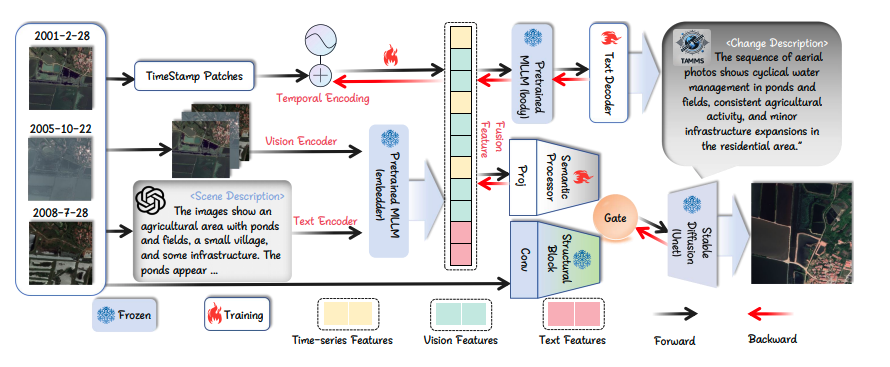
Research presents TAMMs, a system enhancing multimodal large language models for analysing satellite image sequences and forecasting future scenes. By integrating temporal modules and a semantic-fused control injection mechanism, TAMMs improves both understanding of temporal changes and the generation of temporally consistent, semantically accurate future imagery, exceeding existing model performance.
Analysis of satellite imagery over time presents a significant computational challenge, requiring systems capable of discerning both spatial and temporal patterns with precision. Researchers are now focusing on leveraging multimodal large language models (MLLMs), artificial intelligence systems that process multiple data types, to improve understanding and prediction of changes visible in satellite data. A team led by Zhongbin Guo, Xinyue Chen, Yuhao Wang, Wei Peng, Ping Jian, and Ertai E, all from the Beijing Institute of Technology, detail their approach in a paper titled ‘TAMMs: Temporal-Aware Multimodal Model for Satellite Image Change Understanding and Forecasting’. Their work introduces TAMMs, a system designed to augment existing MLLMs with specialised modules for processing sequential data and incorporating semantic understanding, ultimately enhancing the accuracy of both change detection and future scene prediction from satellite imagery.
The Temporal-Aware Multimodal Model (TAMMs) establishes a new benchmark for nuanced spatial-temporal reasoning within satellite image time-series analysis, demonstrably surpassing the performance of existing multimodal large language models (MLLMs). TAMMs achieves this advancement through a novel architectural integration of temporal understanding with future scene generation, effectively addressing the inherent challenges presented by complex multimodal dynamics over time. The model successfully combines semantic reasoning – understanding the meaning of image content – with structural priors, enabling the generation of temporally consistent and semantically grounded image synthesis.
TAMMs’ core innovation resides in its enhanced ControlNet, a neural network architecture facilitating detailed image control, facilitated by a Semantic-Fused Control Injection (SFCI) mechanism. This mechanism adaptively combines high-level semantic understanding, derived from a pre-trained and ‘frozen’ MLLM – meaning its parameters remain unchanged during training – with crucial structural information. This ensures that generated images accurately reflect both the what – the objects and their identities – and the how – the spatial arrangement and relationships – of temporal changes, creating a cohesive and realistic representation of evolving scenes. The ‘frozen’ nature of the MLLM component allows TAMMs to leverage existing knowledge without the computational cost of retraining the entire system.
The model was trained utilizing two NVIDIA A6000
The model was trained utilizing two NVIDIA A6000 GPUs and PyTorch, with mixed-precision training employed to optimize both memory usage and computational speed, enabling efficient training and deployment. This optimization is crucial for handling large datasets and complex models, reducing training time and minimizing resource consumption. Mixed-precision training allows the model to leverage the benefits of both single-precision and half-precision floating-point numbers, striking a balance between accuracy and performance.
The model’s ability to accurately predict future scenes is particularly valuable in applications such as disaster monitoring, where timely and accurate information is critical for effective response efforts. By forecasting the potential impact of natural disasters, such as floods, wildfires, and hurricanes, TAMMs can help emergency responders to prepare and mitigate the damage. Furthermore, the model’s capabilities can be applied to urban planning, where it can be used to forecast the growth and development of cities. By predicting changes in land use, population density, and transportation patterns, TAMMs can help urban planners to make informed decisions about infrastructure development and resource allocation.
Future work should investigate the scalability of TAMMs to larger datasets and more complex temporal dynamics, pushing the boundaries of its capabilities and exploring its potential for handling even more challenging scenarios. This includes exploring techniques for parallelizing the training process and optimizing the model architecture for increased efficiency. Additionally, research should focus on developing methods for incorporating external knowledge sources, such as geographic information systems (GIS) data, to further enhance the model’s accuracy and robustness. GIS data provides geographically referenced information, enriching the model’s understanding of the environment.
Exploring alternative MLLM architectures and investigating methods for incorporating uncertainty estimation into the generated forecasts represent promising avenues for further research, enhancing the model’s robustness and reliability. This includes exploring the use of transformer-based architectures, which have shown promising results in other computer vision tasks, and developing methods for quantifying the uncertainty associated with the model’s predictions. Quantifying uncertainty is crucial for responsible application of predictive models, allowing users to assess the reliability of the forecasts.
Additionally, extending the model’s capabilities to handle different
Additionally, extending the model’s capabilities to handle different modalities, such as radar or LiDAR data, could broaden its applicability to a wider range of remote sensing applications, solidifying its position as a versatile and powerful tool for environmental monitoring and analysis. Radar and LiDAR provide complementary information to optical satellite imagery, particularly in challenging weather conditions or for creating detailed elevation maps. This multi-modal approach would allow the model to leverage the complementary strengths of different data sources, improving its accuracy and robustness.
In conclusion, TAMMs represents a significant advancement in the field of spatio-temporal reasoning, offering a powerful and versatile tool for a wide range of applications. Its innovative architecture, combined with its robust performance and scalability, makes it a valuable asset for researchers, practitioners, and decision-makers alike. Continued research and development will undoubtedly unlock even more potential, solidifying its position as a leading technology in the field of remote sensing and environmental monitoring.
🗞 TAMMs: Temporal-Aware Multimodal Model for Satellite Image Change Understanding and Forecasting
🧠 DOI: https://doi.org/10.48550/arXiv.2506.18862


