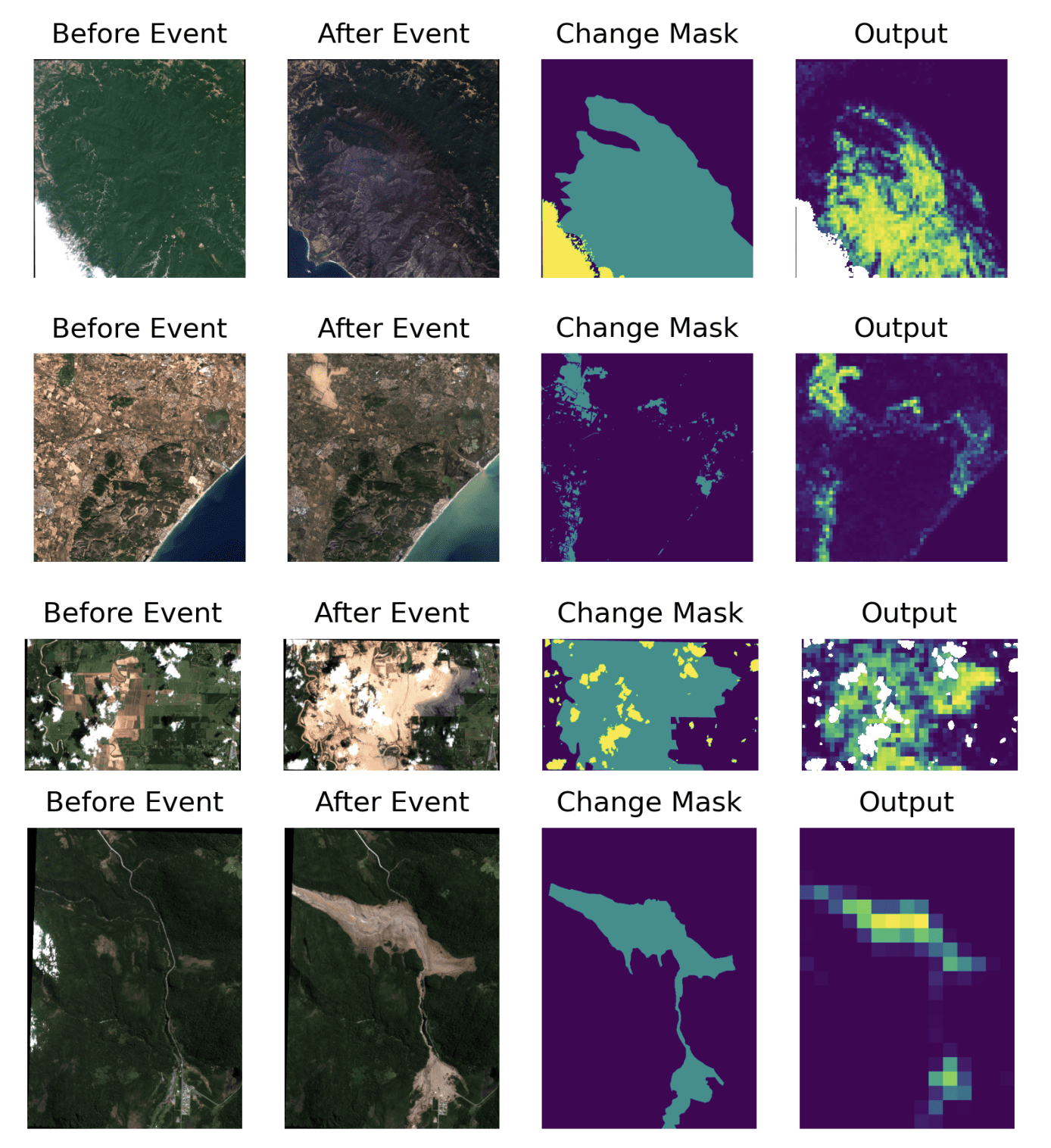
A Physics Aware Network (PANN) successfully detects changes indicative of natural disasters directly from satellite imagery without requiring training. Mimicking physical systems with memristors—electronic components exhibiting memory—the PANN prioritises relevant data downlink, achieving performance comparable to, or exceeding, existing artificial intelligence models with reduced computational demand.
The efficient analysis of Earth observation data is critical for timely responses to natural disasters, yet bandwidth limitations often hinder the rapid delivery of information from satellite to ground station. Researchers are now exploring novel approaches to on-board data processing, moving beyond conventional artificial intelligence to systems inspired by the fundamental laws of physics. A new study, detailed in “Training-free AI for Earth Observation Change Detection using Physics Aware Neuromorphic Networks”, demonstrates a physics-informed neural network capable of identifying disaster-related changes in multi-spectral satellite imagery without requiring computationally intensive training. This work is the result of a collaboration between Stephen Smith and Zdenka Kuncic of the University of Sydney, and Cormac Purcell of the University of New South Wales.
Physics-Inspired Network Accelerates Disaster Assessment from Satellite Imagery
A novel Physics-Aware Network (PANN) demonstrates considerable potential for detecting changes indicative of natural disasters from multi-spectral satellite imagery, offering a means to improve rapid disaster response capabilities. The PANN successfully generates change maps, enabling prioritisation of pertinent data for downlink and addressing the inherent bandwidth limitations of satellite communication systems. Benchmarking against a current state-of-the-art artificial intelligence model reveals comparable, and in some instances superior, performance across various disaster categories, validating its potential for operational deployment.
The core innovation lies in the network’s physics-informed architecture, drawing inspiration from memristor-based nano-electronic circuits and departing from traditional deep learning approaches. Memristors are passive circuit elements that exhibit resistance dependent on the history of applied voltage; their behaviour mimics synaptic plasticity in biological systems. By incorporating memristor equations and fundamental electrical circuit conservation laws – specifically Kirchhoff’s current and voltage laws – the PANN dynamically adjusts its internal weights in response to incoming signal inputs, creating a system that mimics the adaptive behaviour of physical circuits. This yields physics-constrained dynamical features, enabling change detection via distance-based metrics without requiring the extensive computational resources and time associated with traditional model training, a critical advantage for on-board satellite processing.
Analysis utilises dimensionality reduction techniques, specifically UMAP (Uniform Manifold Approximation and Projection) projections of pixel and feature spaces, to visualise the network’s ability to discern pre- and post-disaster states, providing a clear and intuitive representation of its performance. These projections confirm the PANN’s ability to identify affected areas and facilitate the dissemination of critical information to emergency responders and humanitarian organisations.
The PANN’s training-free characteristic is particularly advantageous for resource-constrained on-board satellite processing, reducing the need for extensive computational resources and enabling real-time disaster assessment. This capability is crucial for situations where immediate action is required, such as in the aftermath of a hurricane or earthquake.
Effective disaster management requires a novel approach to satellite image analysis and enabling more effective and timely response efforts. Satellite imagery provides a valuable source of information, but bandwidth limitations often restrict the amount of data that can be transmitted, hindering rapid response efforts. The PANN offers a promising solution for prioritising data downlink and enabling rapid disaster response, addressing a critical need in the field of disaster management.
Researchers are actively exploring the potential of adapting the PANN for predictive modelling, enabling proactive mitigation strategies and reducing the impact of future disasters. By analysing historical data and identifying patterns indicative of potential hazards, the PANN can provide early warnings and enable communities to prepare for impending threats.
The development of the PANN underscores the importance of interdisciplinary research, bringing together expertise in physics, computer science, and disaster management. This collaborative approach has resulted in a novel solution that addresses a critical need in the field of disaster response.
The PANN’s success demonstrates the potential of physics-inspired machine learning for solving complex real-world problems. By leveraging the principles of physical systems, researchers can develop more robust, efficient, and adaptable algorithms that outperform traditional machine learning approaches. This emerging field holds immense promise for a wide range of applications.
The deployment of the PANN in real-world scenarios will require careful consideration of various factors, including data availability, computational resources, and communication bandwidth. Researchers are actively working to address these challenges and ensure that the PANN can be deployed effectively in diverse environments.
The PANN’s ability to prioritise data downlink will streamline disaster assessment workflows, enabling faster and more accurate identification of affected areas. This integration will also facilitate the dissemination of critical information to emergency responders and humanitarian organisations, enabling them to provide timely assistance to those in need.
The development of the PANN represents a significant advancement in the field of disaster management, offering a robust, efficient, and adaptable solution for disaster assessment. Future research will focus on expanding the network’s capabilities and deploying it in real-world scenarios, ultimately contributing to a more resilient and prepared society.
👉 More information
🗞 Training-free AI for Earth Observation Change Detection using Physics Aware Neuromorphic Networks
🧠 DOI: https://doi.org/10.48550/arXiv.2506.04285