

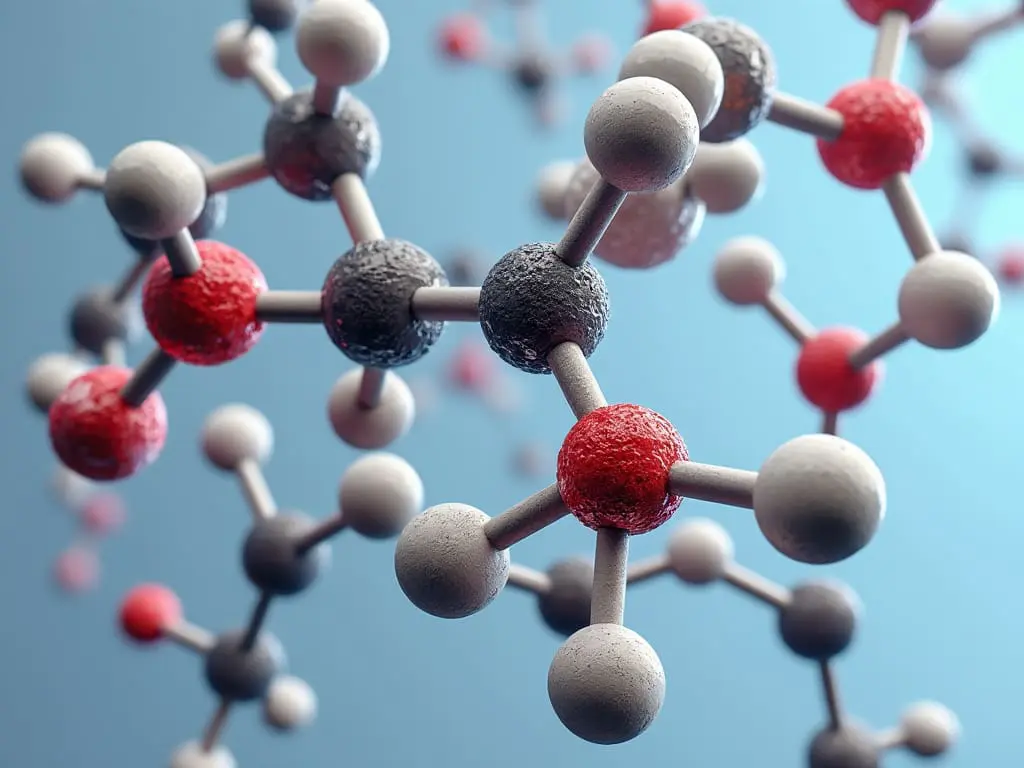
SandboxAQ, a leading AI solutions company, has announced a series of scientific and technical milestones that mark significant advances in its core research and product development activities. These achievements have far-reaching implications for biopharma drug discovery, development of new materials, and battery chemistry.
The company’s Large Quantitative Models (LQMs) are at the forefront of scientific and computational advancements, pushing boundaries in multiple technical areas. Geoff Ling, Founding Director of the Biotech Office at DARPA, praised SandboxAQ’s work, saying it has the potential to strengthen the United States and its allies while setting the stage for a new era of global scientific collaboration and industrial leadership.
The company’s LQMs have been used to accelerate simulations of complex biochemical systems, predict chemical and material properties, and enable accurate calculations of transition metal complexes. Key collaborators include NVIDIA, NOVONIX, and Dainippon Ink and Chemicals, Inc. Adam Lewis, Head of LQM Research at SandboxAQ, highlighted the transformative potential of LQMs across diverse fields, including battery technology, where failure can have catastrophic consequences.
“The cross-cutting nature of SandboxAQ’s Large Quantitative Models is a game-changer for innovation in biopharma, materials science, and beyond. SandboxAQ’s bench of PhDs and engineers are delivering deep science breakthroughs that are evident in their published research and collaborations. The ability to harness such advancements not only strengthens the United States and our allies but also sets the stage for a new era of global scientific collaboration and industrial leadership.”
Geoff Ling, Founding Director of the Biotech Office at DARPA
Scientific Breakthroughs in Quantitative Methods: Impact on Biopharma, Catalysts, and Novel Materials
SandboxAQ has recently announced a series of scientific and technical milestone publications that collectively mark significant advances in the company’s core research and product development activities. These achievements unlock new methods for biopharma drug discovery as well as the development of new materials and battery chemistry.
One of the key areas where SandboxAQ has made significant progress is in quantum chemistry, particularly with its absolute free energy perturbation (FEP) solution, AQ-FEP. This method computes the binding affinity between a drug molecule and a protein, thus predicting the drug’s potency. Unlike its predecessors, AQ-FEP is an absolute method that does not require comparison to known or experimental measurements to get started, enabling the exploration of novel, unprecedented chemistries.
Moreover, AQ-FEP enjoys order-of-magnitude speed improvements over other solutions, allowing SandboxAQ to scan through massive libraries of molecules and predict their binding affinities with high accuracy. This technology has far-reaching implications for drug discovery, enabling researchers to identify potential drug candidates more quickly and efficiently.
Multi-Objective Molecular Design: A New Paradigm in Drug Discovery
Another area where SandboxAQ has made significant progress is in multi-objective molecular design. The company’s IDOLpro solution outputs new molecules from whole cloth, similar to other generative models that output text or images. However, IDOLpro outputs molecules with 3.4x binding affinity compared to state-of-the-art methods, exceeding even the experimentally measured binding affinities from its training data.
What’s more, IDOLpro allows its output to be further conditioned by additional filters for synthetic accessibility, selectivity, and druggability, meaning that medicinal chemists can use the molecules it outputs in practice. This technology has the potential to revolutionize drug discovery by enabling researchers to design new molecules with specific properties and functions.
Large Quantitative Models (LQMs) for Lab-Accurate Quantum Chemistry
SandboxAQ’s LQM approach involves training deep learning models on data from millions of quantum-level chemical calculations. Achieving this requires advances in both AI models, trained on both first-principles simulated and experimentally measured data, to predict useful materials properties.
The company has demonstrated its ability to run lab-accurate quantum chemistry at massive scale, simulating the breakdown of toxic PFAS “forever” chemicals on over one million cloud vCPUs. This gives researchers the ability to probe some of the smallest components of our universe – atoms and molecules – with unprecedented accuracy, allowing them to anticipate how a material will behave before it’s ever built in the lab.
This technology has already been applied by the U.S. Army to create strong and lightweight alloys for vehicular armor and develop advanced battery chemistries for next-generation energy solutions. Additionally, this technology enabled Dainippon Ink and Chemicals, Inc. to accurately calculate transition metal complexes, revealing limitations of conventional methods and advancing catalyst design for industrial innovation.
Complex Biochemical Simulation: Density Matrix Renormalization Group (DMRG) Algorithms for Battery Lifecycle Testing
SandboxAQ has also used the DMRG algorithm to accelerate simulations of complex biochemical systems such as transition metal metalloenzymes, directly in collaboration with NVIDIA on distributed GPU hardware. These highly-accurate first principles models have been used by SandboxAQ to predict chemical and materials properties such as battery lifecycles.
The company’s battery lifecycle LQM enables predictions with 35x greater accuracy and 50x less data than would traditional AI models, reducing testing time for new batteries by 95%. This technology has far-reaching implications for the development of more efficient and sustainable energy solutions.
In conclusion, SandboxAQ’s recent scientific breakthroughs in quantitative methods have significant implications for various industries, including biopharma, catalysts, and novel materials. The company’s LQM approach is poised to bring disruptive impact across diverse fields, exceeding that of generative language and image modeling.
External Link: Click Here For More


