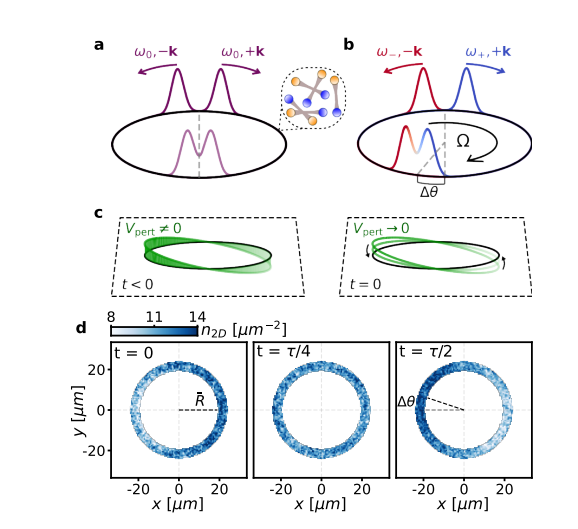
Fermionic superfluids represent a unique system for investigating the emergence of collective behaviours, such as macroscopic coherence and superfluidity, and scientists are continually seeking ways to understand their fundamental properties. Marcia Frómeta Fernández, Diego Hernández Rajkov, and Giulia Del Pace, working at the European Laboratory for Nonlinear Spectroscopy in Florence, alongside colleagues including Francesco Scazza from the University of Trieste, have now directly measured the angular momentum carried by individual particles within these exotic fluids. The team achieved this breakthrough by employing a novel technique, analogous to the optical Sagnac effect, to create an in-situ interferometer using sound waves within an annular fermionic superfluid. This innovative approach allows for the precise measurement of superflow circulation, revealing that it is quantized differently in fermionic systems compared to bosonic condensates, and provides a powerful new method for probing the behaviour of strongly-correlated fermionic matter across a wide range of temperatures.
Strongly Interacting Fermi Gases and Superfluidity
Fermionic systems, composed of particles obeying the Pauli Exclusion Principle, offer a unique environment to investigate the emergence of collective quantum behaviours, such as superfluidity, where fluids flow without resistance. This research explores the dynamics of strongly interacting Fermi gases, combining theoretical modelling and numerical simulations to understand how individual particles cooperate to form a collective state. The team investigates the formation of Cooper pairs, bound pairs of fermions, and their role in establishing superfluidity, examining how varying interaction strengths and external conditions influence the system’s properties. This work advances our understanding of collective quantum phenomena in fermionic systems, with implications for condensed matter physics and quantum information science.
Strongly Interacting Fermi Gas Superfluidity Investigated
This research focuses on understanding the superfluid component within a special state of matter known as a unitary Fermi gas. Superfluidity is a state where a fluid flows without any resistance, and scientists are measuring and understanding the superfluid fraction in this unitary Fermi gas, comparing their findings to previous experiments and theoretical models. They employ techniques simplifying calculations in systems with varying density and analyse the equation of state, which describes the relationship between pressure, volume, and temperature. By examining collective modes, or vibrations within the system, the team gains insights into the superfluid behaviour, contributing to a deeper understanding of superfluidity and testing the validity of existing theoretical frameworks.
Fermionic Superfluid Circulation Quantization Confirmed
This research details a significant advance in understanding superfluidity in fermionic systems, revealing how these materials support persistent currents and carry angular momentum. Scientists developed a sonic analog of the Sagnac effect, using a loop interferometer to probe the composite nature of fermionic condensates across the transition between Bose-Einstein condensate and Bardeen-Cooper-Schrieffer states. By exciting sound waves travelling in opposite directions within an annular superfluid, the team detected a measurable shift in frequency, directly revealing that the superflow circulation is quantized in units of h/2m, where m is the mass of the constituent particles. This is distinct from bosonic condensates, which exhibit different quantization rules. Experiments demonstrated a substantial enhancement in the signal for fermionic superfluids near the unitary regime, linking this behaviour to quantum-limited sound transport. Further measurements of angular momentum per particle showed a sustained circulating flow, confirming the persistent nature of the superfluidity.
Fermionic Superfluid Circulation Reveals Fermion Mass
This research demonstrates a novel method for probing the fundamental properties of fermionic condensates, revealing how the mass of the constituent particles influences superfluid behaviour. Scientists developed a sonic analog of the optical Sagnac effect, using a loop interferometer to measure the quantized circulation of superflow across the transition between Bose-Einstein condensate and Bardeen-Cooper-Schrieffer states. By creating an in-situ loop interferometer within an annular fermionic superfluid, the team directly measured the quantized circulation of superflow, confirming that superflow is carried by pairs of fermions, even at the unitary regime. Furthermore, the team successfully measured the thermal depletion of the superfluid in a unitary Fermi gas, establishing phonon interferometry as a powerful technique for investigating strongly correlated fermionic systems. This research provides a valuable new tool for exploring the complex interplay between interactions and collective behaviour in fermionic systems, furthering our understanding of superfluidity and strongly correlated matter.
🗞 Angular momentum of rotating fermionic superfluids by Sagnac phonon interferometry
🧠 ArXiv: https://arxiv.org/abs/2511.02664