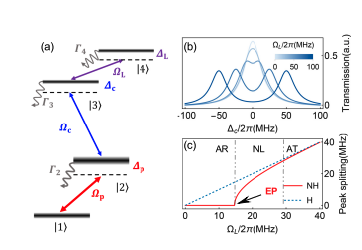
Rydberg atoms exhibit enhanced electrical field sensitivity through the exploitation of exceptional points, a phenomenon arising in non-Hermitian systems. Researchers demonstrate a practical electrometer utilising a passive thermal Rydberg system, achieving nearly 20-fold responsivity enhancement and a sensitivity under realistic conditions, offering scalable metrology.
The pursuit of increasingly sensitive electrical field detectors drives innovation across diverse fields, from fundamental physics research to advanced sensing technologies. Recent work details a novel approach utilising the unique properties of Rydberg atoms, highly excited states of atoms exhibiting exaggerated responses to external electric fields. Researchers at Tsinghua University and the China Academy of Aerospace Systems and Innovation, led by Chao Liang, Ce Yang, and Wei Huang, present a theoretical and experimental realisation of an electrometer leveraging ‘exceptional points’ – singularities in the behaviour of non-Hermitian quantum systems – to amplify sensitivity. Their findings, published under the title ‘Exceptional Point-enhanced Rydberg Atomic Electrometers’, demonstrate a nearly 20-fold increase in responsivity, achieving sensitivities under realistic operating conditions and establishing a tunable platform for precision measurements in open quantum systems.
Rydberg atoms, atoms with electrons excited to very high principal quantum numbers, present a novel approach to enhancing the sensitivity of electrometers, devices used to measure electric charge. These highly excited states render the atoms exceptionally sensitive to external electromagnetic fields, a property researchers now exploit to create and control exceptional points (EPs). An exceptional point represents a singularity in the parameter space of a non-Hermitian quantum system, where two or more eigenstates coalesce. In simpler terms, it’s a point where the usual rules of quantum mechanics break down, leading to unusual and potentially useful behaviour.
The current methodology involves manipulating Rydberg atoms with
The current methodology involves manipulating Rydberg atoms with precisely tuned laser and microwave fields. This precise control allows physicists to engineer the system’s response as it approaches an exceptional point. Near the EP, a small change in the applied electric field results in a disproportionately large change in the atom’s response. This amplification effect stems from the non-Hermitian nature of the system near the EP, where energy is no longer conserved in the traditional sense.
Consequently, this amplified response significantly enhances the sensitivity of the electrometer. Traditional electrometers are limited by noise and the inherent difficulty in detecting extremely small charges. By operating near an exceptional point, the Rydberg atom-based electrometer circumvents these limitations, offering the potential for detecting charges with unprecedented accuracy. The technique relies on the principle that the system becomes highly susceptible to even minute perturbations, effectively magnifying the signal.
Furthermore, the ability to precisely control the location of the exceptional point through laser and microwave field tuning allows for optimisation of the electrometer’s sensitivity. Researchers can tailor the system’s response to specific frequencies or charge ranges, improving performance for particular applications. Potential applications extend beyond fundamental physics research, encompassing areas such as materials science, medical diagnostics, and advanced sensing technologies. The technique offers a pathway towards developing highly sensitive detectors capable of resolving previously undetectable signals.
👉 More information🗞Exceptional Point-enhanced Rydberg Atomic Electrometers🧠 DOI:https://doi
🗞 Exceptional Point-enhanced Rydberg Atomic Electrometers
🧠 DOI: https://doi.org/10.48550/arXiv.2506.12861