The quest to understand matter existing far from equilibrium has led scientists to explore novel states beyond traditional crystals, including discrete time quasicrystals. Dong-Yang Zhu, Zheng-Yuan Zhang, and Qi-Feng Wang, along with colleagues, now report the first experimental observation of this elusive phase of matter, achieved within a carefully controlled system of strongly interacting Rydberg atoms. Their work demonstrates a robust, rhythmic response to a specifically tailored, quasi-periodic drive, revealing the emergence of temporal order without strict repetition. This breakthrough establishes a new platform for investigating non-equilibrium phenomena and expands our understanding of how symmetry breaks down in systems driven away from stability, offering insights into the fundamental nature of time itself.
Rydberg Atoms Demonstrate Quasicrystal Phase Stability
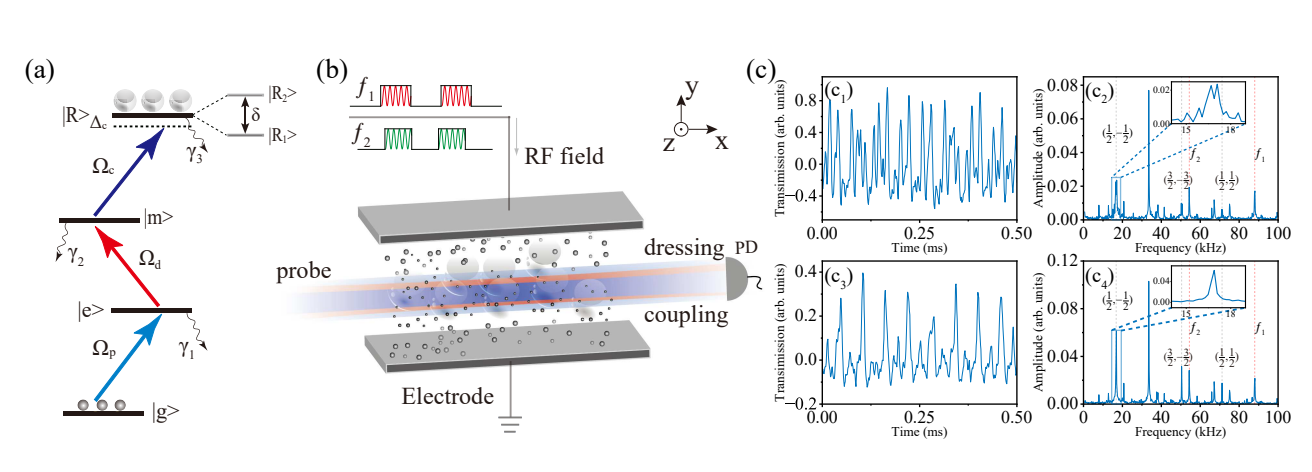
Supplementary materials detail the observation of a discrete time quasicrystal (DTC) in a system of Rydberg atoms, providing further evidence for this novel state of matter. These materials bolster the primary publication by demonstrating the specific conditions under which the DTC phase emerges and presenting detailed experimental data supporting the analysis. The experiment utilizes two radio frequency (RF) fields to drive the Rydberg atoms, with a crucial frequency ratio that is commensurate, leading to the appearance of a subharmonic frequency in the Fourier spectrum, which serves as the signature of the DTC phase. Researchers found that applying only one of the RF fields produces a different symmetry, while applying both fields without observing the DTC phase does not lead to the emergence of higher-order symmetries, highlighting the importance of dimensionality and coupling in these synthetic time crystals. Supporting data, presented as Fourier spectra, demonstrates the 5kHz subharmonic peak confirming the DTC phase, and further spectra illustrate the system’s response under different driving conditions. These results demonstrate the conditions under which the DTC phase is observed and explain the limitations on the emergence of higher-order symmetries.
Rydberg Atoms Reveal Discrete-Time Quasicrystal Phase
Scientists have experimentally observed a discrete-time quasicrystal (DTQC) within a system of strongly interacting Rydberg atoms, demonstrating a novel state of matter characterized by temporal order without strict periodicity. The team drove and probed the atomic ensemble using a dual-frequency technique, applying two incommensurate radio frequency (RF) fields to induce and characterize the DTQC phase. To map the DTQC phase, researchers scanned the coupling detuning while monitoring the transmission of a probe laser, revealing the characteristic subharmonic responses indicative of the DTQC phase. They further investigated the symmetry of the DTQC phase by systematically varying the parameters of the driving fields, demonstrating that the system’s response is governed by a finite Abelian group symmetry dependent on the frequencies of the driving fields. The robustness of the subharmonic response against perturbations in RF field intensity and laser detuning confirms the stability of the DTQC phase, providing a versatile platform for exploring non-equilibrium phases of matter and understanding the dynamics of time-translation symmetry breaking.
Discrete-Time Quasicrystal Emerges in Rydberg Atoms
Scientists have experimentally observed a discrete-time quasicrystal (DTQC) within a system of strongly interacting Rydberg atoms, demonstrating a novel state of matter characterized by temporal order without strict periodicity. This work expands understanding of far-from-equilibrium matter and spontaneous symmetry breaking beyond conventional periodic regimes. Experiments revealed a complex phase diagram for the system, including the DTQC phase, and demonstrated its rigidity against perturbations in both RF field intensity and laser detuning. Specifically, the researchers measured the transmission of probe light while scanning the coupling detuning, confirming the emergence of the DTQC.
The team confirmed the DTQC’s robustness by observing that its characteristic subharmonic response remained stable even with changes to experimental parameters. Measurements demonstrate that the system exhibits a unique symmetry group, which dictates the spectral structure of the subharmonic response and influences the system’s dynamics. This establishes a versatile platform for investigating non-equilibrium phases of matter and provides insights into the dynamics of time-translation symmetry breaking in these complex systems.
Discrete Time Quasicrystals Observed in Rydberg Atoms
This research demonstrates the experimental observation of discrete time quasicrystals, a novel state of matter exhibiting temporal order without strict periodicity, in a system of strongly interacting Rydberg atoms. Scientists achieved this by applying a specific quasi-periodic drive using multiple frequencies, revealing a robust subharmonic response that signifies the emergence of the DTQC phase. The findings establish a versatile platform for investigating non-equilibrium matter and expand understanding of how time-translation symmetry can be broken in complex quantum systems. Researchers observed a cyclic group symmetry effect that limits the construction of certain DTQCs, providing insight into the fundamental constraints governing these phases. The long-range interactions between the Rydberg atoms proved crucial for the emergence of the DTQC phase, enabling the mixing of driving frequencies and the creation of the observed spectral signatures.
🗞 Observation of Discrete Time Quasicrystal in Rydberg Atomic Gases
🧠 ArXiv: https://arxiv.org/abs/2509.21248