

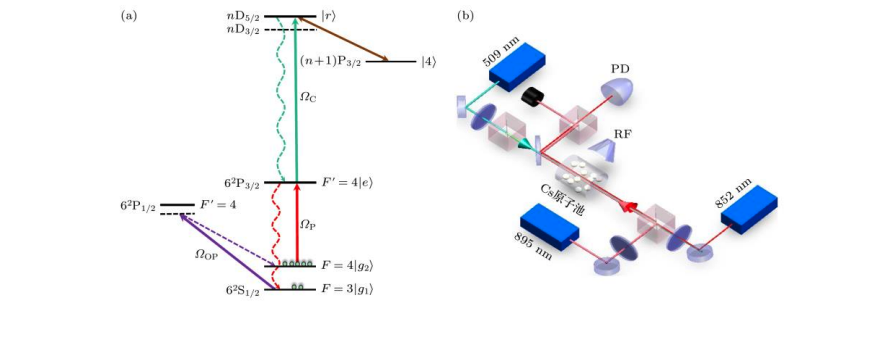
Detecting microwave signals with high precision is crucial for applications ranging from telecommunications to security, and researchers are increasingly turning to the unique properties of atoms to achieve this goal. XUE Jingjing, LI Ruonan, and HU Xuesong, along with colleagues from Shanxi University and Zhejiang University, demonstrate a novel approach to microwave sensing using a multi-level system of Rydberg atoms. Their work significantly enhances the detection of 3. 4 GHz microwave signals by optimising the coherence of these atoms, effectively transforming microwave information into a measurable optical signal. This improved coherence narrows the detection window and boosts sensitivity by over 30%, offering a promising new pathway for highly accurate atomic microwave detection and potentially surpassing the limitations of traditional technologies.
Rydberg Atoms Detect Microwaves via EIT
Researchers have developed a novel method for detecting microwave signals using Rydberg atoms and a technique called Electromagnetically Induced Transparency (EIT) with Autler-Townes (AT) splitting. Rydberg atoms, with their highly energetic electrons, are exceptionally sensitive to electromagnetic fields. EIT creates a pathway for light to pass through an otherwise opaque material, while Autler-Townes splitting modifies this pathway when a strong microwave signal is present, allowing for precise measurement. The team aimed to enhance the sensitivity of this detection method by employing Optical Pumping, a technique that prepares a large population of atoms in a specific energy state, strengthening the EIT signal.
The primary goal was to narrow the width of the EIT-AT spectral lines, as a narrower spectrum indicates higher sensitivity and the ability to detect weaker microwave signals. Experiments confirmed that optical pumping effectively narrows the spectrum, improving the sensitivity of microwave detection. The results demonstrate a 1. 3 times improvement in the sensitivity of microwave electric field measurement. Researchers also observed differences in spectral widths depending on the microwave signal’s frequency, potentially due to interactions within the atom’s internal structure. This new approach offers potential benefits for advanced microwave sensors, quantum radar systems, wireless communication, electromagnetic field mapping, and fundamental physics research.
Rydberg Atoms Detect Microwaves via Optical Conversion
Researchers have developed a new approach to microwave detection using Rydberg atoms, highly excited states of matter that strongly interact with electromagnetic fields. Unlike traditional detectors, this technique transforms microwave signals into the optical domain, potentially offering greater sensitivity and precision. The system utilizes a carefully designed multi-level atomic structure, transitioning atoms between energy levels with precisely tuned laser beams. This method relies on Electromagnetically Induced Transparency (EIT), where laser beams create a window of transparency in the atomic material.
Applying microwave radiation further alters the atomic energy levels, causing a splitting of the EIT signal known as Autler-Townes splitting. The magnitude of this splitting directly corresponds to the strength of the microwave field, enabling accurate measurement. A key innovation is the use of optical pumping, which manipulates the population distribution of atoms to enhance the EIT effect and narrow the spectral width of the signal. By optimizing laser parameters and employing optical pumping, the team achieved a significant improvement in sensitivity and bandwidth. This involved carefully controlling the intensity and frequency of the laser beams to maximize the EIT signal and minimize noise. The researchers demonstrated that optical pumping effectively narrows the EIT and Autler-Townes spectral features, leading to a 1. 3 times improvement in the sensitivity of microwave field measurement, paving the way for advanced applications in radio astronomy and secure communications.
Rydberg Atoms Enhance Microwave Detection Sensitivity
Researchers have demonstrated a new approach to microwave detection using Rydberg atoms, achieving enhanced sensitivity and bandwidth compared to traditional methods. This technology leverages the strong interaction between microwave fields and highly excited Rydberg atoms, transforming microwave signals into detectable optical signals. The team focused on optimizing the quantum coherence within the atomic system, specifically utilizing a multi-level structure to improve both the range of detectable frequencies and the precision of the measurements. The core of this advancement lies in manipulating the coherence of Rydberg atoms through optical pumping.
By carefully directing laser light at specific atomic energy levels, researchers were able to narrow the width of key spectral features, namely Electromagnetically Induced Transparency (EIT) and Autler-Townes (AT) splitting. This narrowing effect is crucial because a narrower spectrum directly translates to a more sensitive detector, allowing for the detection of weaker microwave signals. The results show that this optimized optical pumping technique effectively improves the EIT and AT spectra, leading to a 1. 3 times increase in the sensitivity of microwave electric field measurement. This new method offers significant advantages over conventional microwave detectors, which often suffer from limitations in calibration and interference. By utilizing the quantum properties of Rydberg atoms, the team has created a system that is potentially more accurate and reliable. The enhanced bandwidth achieved through this approach allows for the detection of a wider range of microwave frequencies, expanding the potential applications of this technology for telecommunications, spectroscopy, and fundamental physics research.
Rydberg Atoms Enhance Microwave Detection Sensitivity
This research demonstrates a new approach to microwave detection using the interaction between microwave fields and Rydberg atoms, offering enhanced control and precision compared to traditional antenna methods. By exploiting coherent coupling between microwaves and atoms, the team successfully transformed microwave field detection into measurements within the optical frequency band. Experiments using cesium atoms revealed that optical pumping narrows the width of the Rydberg Electromagnetically Induced Transparency (EIT) and microwave induced Autler-Townes (AT) splitting spectra, thereby improving the sensitivity of microwave electric field measurement. The sensitivity of microwave electric field measurement was improved by 1.
EIT amplitude and the addition of single-frequency microwaves. While this technique offers significant advantages, further improvements in measurement accuracy depend on achieving narrower linewidths and higher signal-to-noise ratios in the Rydberg EIT-AT spectra. Future work could explore this technique for applications beyond microwave detection, including studies of dipole-dipole interactions in highly excited Rydberg states, laser frequency stabilisation, and the traceable detection of environmental electromagnetic fields using quantum sensors.
🗞 Enhanced sensing of 3.4 GHz microwave in multi-level Rydberg atomic system
🧠 ArXiv: https://arxiv.org/abs/2508.01260


