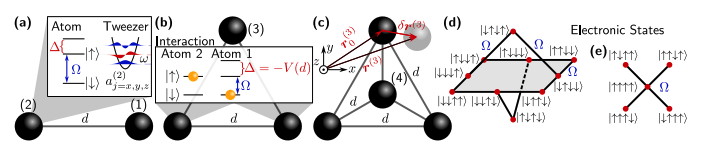
Rydberg atom arrays enable microscopic control of vibrational and electronic states, simulating artificial molecular systems and probing complex dynamics. Researchers manipulate interatomic interactions and electron-phonon coupling to design electronic states, study structural transitions and explore non-classical vibrations, testing the validity of the Born-Oppenheimer approximation.
The simulation of molecular behaviour represents a persistent challenge in physics and chemistry, demanding computational resources that often strain even the most powerful supercomputers. Researchers are now investigating novel approaches utilising the unique properties of Rydberg atoms, highly excited states of atoms possessing exaggerated electronic properties. These atoms, when arranged in precisely controlled arrays using optical tweezers – highly focused laser beams that can hold and manipulate microscopic particles – offer a promising platform for emulating complex molecular dynamics. A team led by Simon Euchner and Igor Lesanovsky, spanning the Institut für Theoretische Physik and the Center for Integrated Quantum Science and Technology at the Universität Tübingen, alongside researchers at The University of Nottingham, detail their exploration of this approach in the article, “Rydberg atom arrays as quantum simulators for molecular dynamics”. Their work focuses on harnessing the vibrational and electronic degrees of freedom within these atom arrays to create artificial molecular systems, allowing for controlled investigation of phenomena such as structural transitions and non-classical vibrational states, and providing a means to rigorously test fundamental approximations underpinning molecular physics.
Rydberg atom tweezer arrays represent a developing platform for simulating and investigating complex molecular dynamics, with a particular focus on the interplay between electronic and vibrational states. These arrays utilise highly excited Rydberg atoms, held and controlled by tightly focused laser beams (the ‘tweezers’), to mimic the behaviour of molecules. Researchers meticulously control interatomic interactions and electron-phonon coupling – the interaction between electrons and vibrations within the material – effectively designing tailored electronic state manifolds. This level of control facilitates the study of structural transitions and the exploration of non-classical vibrational states occurring near molecular instabilities, where the system deviates from predictable behaviour.
Researchers accurately map the potential energy surface, denoted
Researchers accurately map the potential energy surface, denoted EBO (Born-Oppenheimer potential energy surface), and subsequently identify the minimum ground state energy (MGSE), labelled EGS, across a range of Ω values. The parameter Ω represents a control variable influencing the interactions between the atoms. This reveals how the system transitions from a symmetric state to one where symmetry is broken, a phenomenon visually represented in Figure 3(a) and quantified in Figure 3(b). Symmetry breaking occurs when a system loses its inherent symmetry, often leading to changes in its physical properties.
Calculations detailed in supplemental material demonstrate how the MGSE is determined, employing the Born-Oppenheimer approximation (BOA) to simplify complex calculations. The BOA assumes that the nuclei are much heavier than the electrons, allowing for the separation of electronic and nuclear motion. This simplification enables the derivation of analytical expressions for the MGSE, as presented in equations within the supporting information, crucial for understanding system stability. The research investigates transitions between symmetric and symmetry-broken states as parameters, such as Ω, are varied, involving the fixing of vibronic couplings – interactions between vibrational and electronic states – and minimization of the energy surface to generate data for analysis.
The system actively probes the validity of the BOA, a cornerstone of molecular physics. The analytical expression derived for EBO when Ω approaches zero serves as a crucial validation step, confirming the accuracy of the numerical calculations and strengthening the reliability of the findings. The detailed methodology, including the application of the Bogoliubov-Born-Oppenheimer approximation to further simplify calculations by treating vibrations quantum mechanically, facilitates reproducibility for other researchers. By meticulously mapping the potential energy landscape and identifying the MGSE, researchers gain valuable insights into the complex interplay between electronic and vibrational degrees of freedom in these artificial molecular systems.
Future work should explore the sensitivity of these
Future work should explore the sensitivity of these results to different system parameters and investigate the potential for extending this approach to more complex molecular systems. Researchers should also consider incorporating more realistic descriptions of the electronic and vibrational degrees of freedom, requiring the development of more sophisticated computational methods and the use of more powerful computing resources, ultimately contributing to a deeper understanding of fundamental molecular behaviour and paving the way for the design of new materials with tailored properties.
🗞 Rydberg atom arrays as quantum simulators for molecular dynamics
🧠 DOI: https://doi.org/10.48550/arXiv.2506.09865