

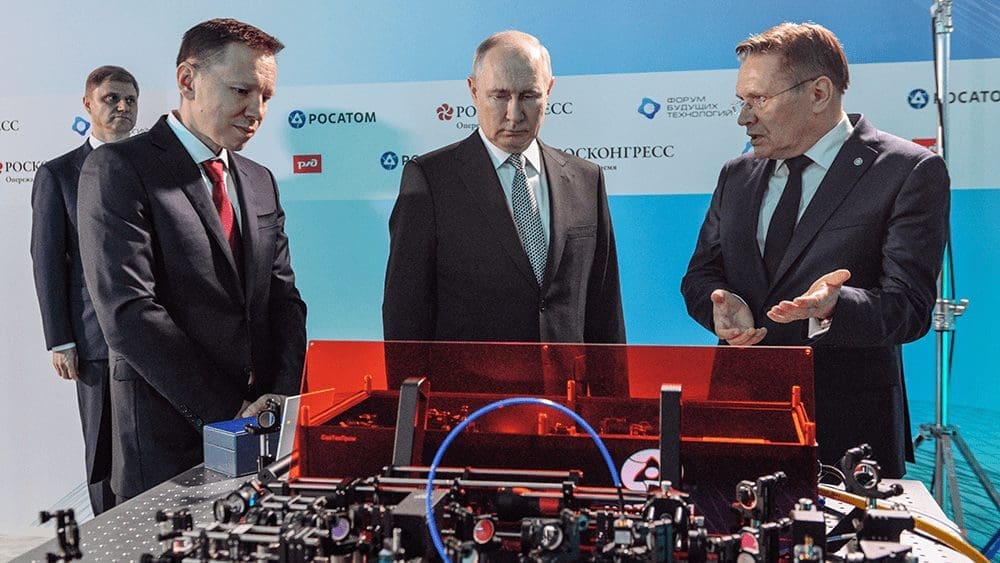
At the Forum of Future Technologies in Moscow, Rosatom’s head, Alexei Likhachev, and adviser Ruslan Yunusov showcased a 16-qubit ion quantum computer to President Vladimir Putin. The processor was developed by scientists from the Lebedev Institute of Physics and Technology and the Russian Quantum Center, coordinated by Rosatom. The quantum computer is already used for practical applications such as modelling molecules. The team aims to create a quantum processor that can solve problems faster than a supercomputer. Rosatom, Moscow City Hall, and the Russian Quantum Center have also agreed to construct a laboratory and industrial centre in Skolkovo.
“Our quantum computer, which is important, is already doing useful things – modeling molecules, and not doing scientific abstraction,”
Ilya Semerikov
Quantum Computing Advancements in Russia
At the Forum of Future Technologies in Moscow, Alexei Likhachev, head of Rosatom, and Ruslan Yunusov, adviser to the general director of Rosatom, showcased a 16-qubit ion quantum computer to President Vladimir Putin. The processor was developed by scientists from the Physical Institute, Lebedev Institute of Physics and Technology of the Russian Academy of Sciences (FIAN), and the Russian Quantum Center, coordinated by Rosatom. The development of this quantum computer began in 2015, with the creation of traps and attempts to keep ions in them. The team aims to create a quantum processor that can solve problems faster than a supercomputer and be useful to a wide range of people.
The quantum computer is already used for practical applications such as modelling molecules. However, the team at FIAN believes it will take at least ten years to realise their ideas fully. The development of this technology is part of the government’s “Quantum Computing” roadmap, overseen by the state corporation.
Rosatom’s Role in Quantum Technology
Rosatom’s tasks include incorporating emerging quantum technologies into the nuclear industry and their rapid industrialisation. They also assist scientists with a component base and equipment. At the current stage of development of the quantum drive, Alexei Likhachev believes Russia can already offer cooperation on an equal footing to scientists from other countries.
“We have uniquely built a roadmap – not as a management mechanism, but as a mechanism for interaction, mutual support and, I’m not afraid of this word, trust,”
Aleksey Likhachev
Russia’s National Project for Data Economy
President Vladimir Putin proposed a new national project for the formation of a data economy for the period up to 2030. This project aims to transfer the entire Russian economy, social sphere, and government to new principles of work based on big data. The project will cover research, training, creating conditions for the release and testing of samples, organising demand, flexible regulation and production support, as well as technologies for collecting, transferring, storing, ensuring data security, national standards and algorithms for storing and processing information, creating a repository of codes.
“Our solutions based on artificial intelligence technologies are widely used in the industry both for product quality management and forecasting the technical condition of equipment, as well as for intelligent verification of scientific and technical documentation,”
Evgeny Abakumov
Construction of a Laboratory and Industrial Centre
The Moscow City Hall, Rosatom and the Russian Quantum Center signed an agreement on the construction of a laboratory and industrial centre in Skolkovo. The centre will be a hub for technologies, startups, laboratories, and product samples. The aim is to provide infrastructure, help to concentrate scattered enterprises at these sites, and find buyers for their products.
“There was a big discussion about whether to include our ion platform. And I am grateful to Rosatom, which then believed in us,”
Ilya Semerikov
Artificial Intelligence Solutions
Atomdata-Integration and the Resource Center for Universal Design and Rehabilitation Technologies signed an agreement of intent to develop solutions in the field of artificial intelligence. These solutions are widely used in the industry for product quality management and forecasting the technical condition of equipment, as well as for intelligent verification of scientific and technical documentation. A new challenge is the implementation of artificial intelligence in critical infrastructure. At the exhibition, nuclear scientists showed the Prime Minister the AtomMind predictive analytics system based on AI technologies. This system monitors the process, alerts to violations, and captures compliance metrics to predict product quality and equipment problems before they affect production.
“This digital product is presented on the domestic market for use in various industries,”
Ekaterina Solntseva
Quick Summary
At the Forum of Future Technologies in Moscow, Rosatom, Russia’s state atomic energy corporation, showcased a 16-qubit ion quantum computer capable of modelling molecules. The development of this quantum computer is part of a broader national project proposed by President Vladimir Putin, aiming to transition the Russian economy, social sphere, and government to work on principles based on big data and advanced technologies, including quantum ones, by 2030.
- At the Forum of Future Technologies in Moscow, Rosatom’s head, Alexei Likhachev, and adviser Ruslan Yunusov demonstrated a 16-qubit ion quantum computer to President Vladimir Putin.
- The quantum computer was developed by scientists from the Physical Institute, Lebedev Institute of Physics and Technology, and the Russian Quantum Center, coordinated by Rosatom.
- The team, led by researcher Ilya Semerikov, began development in 2015, with the aim of creating a quantum processor that can solve problems faster than a supercomputer.
- Rosatom’s tasks include integrating emerging quantum technologies into the nuclear industry and aiding scientists with equipment and components.
- Putin proposed a new national project for the formation of a data economy by 2030, which will support technologies including quantum ones.
- An agreement was signed between Moscow City Hall, Rosatom, and the Russian Quantum Center for the construction of a laboratory and industrial center in Skolkovo.
- Atomdata-Integration and the Resource Center for Universal Design and Rehabilitation Technologies signed an agreement to develop artificial intelligence solutions.
- The AtomMind predictive analytics system, based on AI technologies, was demonstrated to Prime Minister Mikhail Mishustin.
- Rusatom Infrastructure Solutions presented its IoT platform for enterprises, which can reduce operating costs by 9-16% and increase labour productivity fivefold.
Read More


