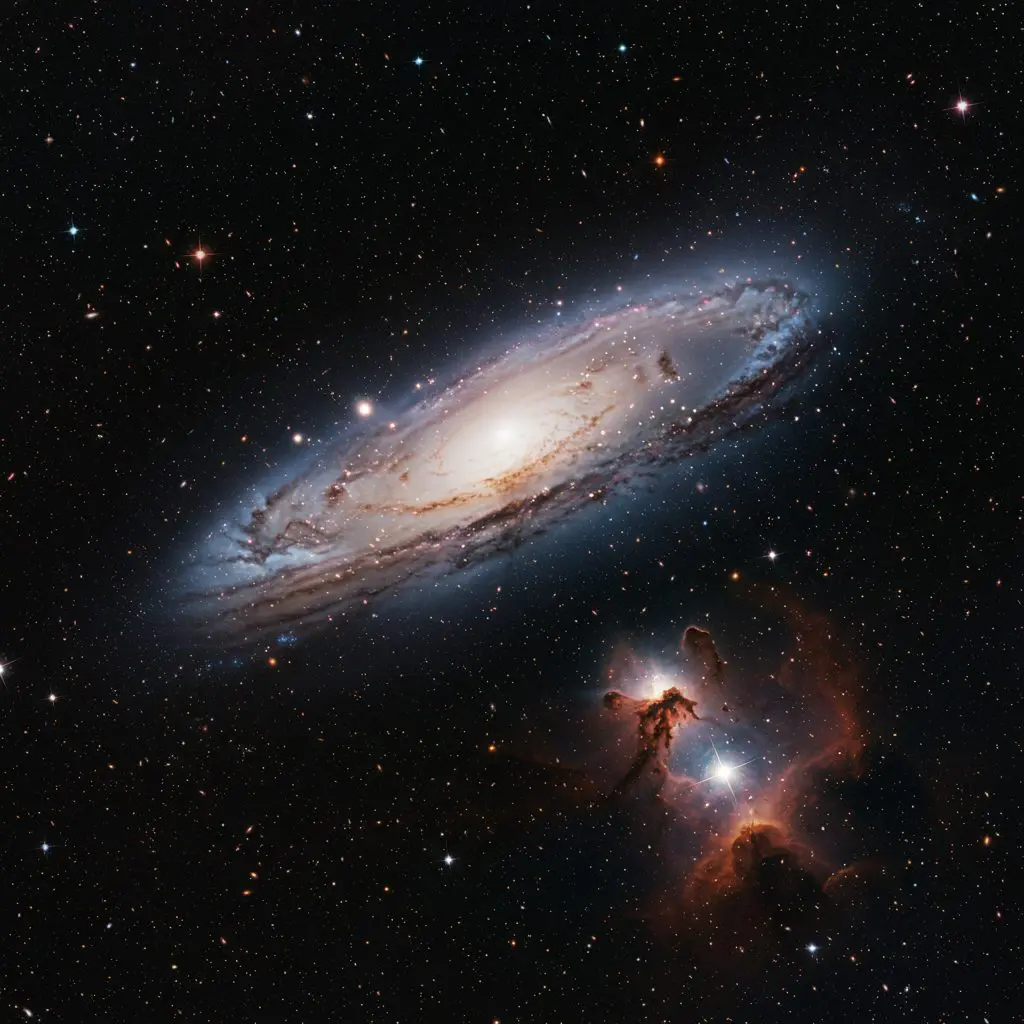
The U.S. National Science Foundation and Department of Energy’s jointly funded Vera C. Rubin Observatory released its first imagery today, demonstrating an unprecedented scale of cosmic detail captured in just over ten hours of test observations. The observatory’s 3.2-gigapixel camera, the largest of its kind, produced images of the Trifid and Lagoon nebulae from 678 individual exposures. Brookhaven National Laboratory contributed to the camera’s development, creating the largest charge-coupled device (CCD) array ever built, and is now preparing to analyse data from the ten-year Legacy Survey of Space and Time, which aims to map the visible universe and investigate phenomena including dark energy and near-Earth asteroids.
Observatory Unveils Initial Imagery
The NSF-DOE Vera C. Rubin Observatory has released initial imagery following an event in Washington, D.C., demonstrating cosmic phenomena captured at an unprecedented scale. These first images include the Trifid and Lagoon nebulae, constructed from 678 individual exposures collected over seven hours, and showcase a level of detail previously unattainable. The observatory’s 3.2-gigapixel digital camera, the largest of its kind, facilitated the capture of these nebulae with exceptional clarity, highlighting its capacity to detect faint and distant objects.
The development of the observatory’s primary instrument benefited from a key contribution by Brookhaven National Laboratory, which was responsible for creating the largest charge-coupled device (CCD) array ever built. CCDs, light-sensitive electronic sensors used in digital cameras, are critical to achieving the ambitious survey goals of the Rubin Observatory, given the array’s size and sensitivity. The ten-year Legacy Survey of Space and Time (LSST) observational programme, central to the Rubin Observatory’s mission, will generate a comprehensive map of the visible universe by tracking billions of celestial objects.
The data acquired through the LSST will be used to investigate a wide range of astrophysical phenomena, including the nature of dark energy and dark matter, and the formation and evolution of galaxies. Beyond these core areas, the observatory’s capabilities extend to potential advancements in fields such as materials science and environmental monitoring, demonstrating the broad impact of the Rubin Observatory. Physicists at Brookhaven are currently preparing for the analysis of the forthcoming data, developing both the algorithms and computational infrastructure necessary to process the immense volume of information expected from the survey.
Advanced Camera Technology
The observatory’s primary instrument is a 3.2-gigapixel digital camera, representing the largest of its kind ever constructed, and enabling it to survey the entire visible sky multiple times each night. Brookhaven National Laboratory played a key role in the development of this camera, specifically contributing to the creation of the largest charge-coupled device (CCD) array ever built. These CCDs are light-sensitive electronic sensors used to capture images in digital cameras, and the array’s size and sensitivity are critical to the observatory’s ambitious survey goals.
The ten-year Legacy Survey of Space and Time (LSST) observational programme, central to the Rubin Observatory’s mission, will create a comprehensive map of the visible universe by tracking the positions and movements of billions of celestial objects. This data will be used to investigate a wide range of astrophysical phenomena, including the nature of dark energy and dark matter, and the formation and evolution of galaxies. The observatory’s capabilities also offer opportunities for advancements in areas such as materials science and environmental monitoring, further expanding the potential impact of the Rubin Observatory.
Scientific Scope and Future Analysis
In just over ten hours of test observations, the observatory has revealed a level of detail previously unattainable, showcasing its potential to transform our understanding of the universe. The observatory’s primary instrument facilitated the capture of the Trifid and Lagoon nebulae, vast clouds of gas and dust where stars are born, with exceptional clarity, highlighting its capacity to detect faint and distant objects.
Physicists at Brookhaven are actively preparing for the analysis of the forthcoming data, developing algorithms and computational infrastructure to process the immense volume of information expected from the Legacy Survey of Space and Time (LSST). This ten-year observational programme, central to the Rubin Observatory’s mission, will create a comprehensive map of the visible universe, tracking the positions and movements of billions of celestial objects.
The data acquired through the LSST will be used to investigate a wide range of astrophysical phenomena, including the nature of dark energy and dark matter, and the formation and evolution of galaxies, offering opportunities for advancements in areas such as materials science and environmental monitoring.
External Link: Click Here For More
The immense scale of the LSST survey generates petabytes of raw data annually, presenting a monumental computational challenge. Successfully processing this data requires not only sophisticated algorithms but also a vast, dedicated computational infrastructure. Astronomers must develop highly optimized pipelines capable of real-time, cross-correlating multiple distinct datasets—spanning imaging, spectroscopy, and photometry—to isolate faint signals from cosmic noise.
At the heart of the technological capability is the physics of the charge-coupled device (CCD) itself. CCDs operate by converting incident photons into electrical charges proportional to the light’s energy. The increased pixel count and overall area of the largest arrays significantly boost the observatory’s quantum efficiency, allowing it to detect extremely low flux levels from objects hundreds of millions of light-years away, thereby maximizing the depth of the survey.
A core focus of the data analysis will be the detection of transient phenomena. Unlike traditional surveys that map stable objects, LSST is designed to detect ‘time domain’ variability—such as supernovae, merging neutron stars, or fast radio bursts. These transient events provide immediate clues about the extreme astrophysical processes and evolutionary endpoints of massive stars.
Furthermore, the wide field of view combined with high depth means the observatory is uniquely suited to studying gravitational lensing. By precisely measuring how the light from distant galaxies is distorted and magnified by intervening clusters of galaxies, researchers can map the distribution of invisible mass, providing critical constraints on models of dark matter.