Rapidly rotating Bose-Einstein condensates self-organise into stable droplet arrays, a phenomenon underpinned by dynamically stable single droplets acting as fundamental units. Theoretical work, guided by a theorem concerning localised states, confirms these arrays represent stationary solutions to the Gross-Pitaevskii equation, forming via phase-engineered initial condensates.
The behaviour of matter at extremely low temperatures continues to reveal unexpected phenomena, with recent experiments demonstrating the self-organisation of rotating Bose-Einstein condensates, a state of matter formed when bosons are cooled to near absolute zero, into stable droplet arrays. These droplets, sustained by a delicate balance of attractive and repulsive interactions, offer a novel platform for exploring many-body physics and potentially manipulating quantum systems. Researchers from the State Key Laboratory of Information Photonics and Optical Communications at Beijing University of Posts and Telecommunications, alongside colleagues from the Quantum Science Center of Guangdong-Hong Kong-Macao Greater Bay Area, investigate the formation and stability of these quantum droplets in a study detailed in their article, ‘Quantum droplets in rapidly rotating two-dimensional Bose-Einstein condensates’. Zhen Cao, Siying Li, Zhendong Li, Xinyi Liu, Zhigang Wu, and Mingyuan Sun present a theoretical framework, grounded in the Gross-Pitaevskii equation – a central equation in the study of Bose-Einstein condensation – to explain the observed droplet behaviour and propose methods for their controlled generation through initial condensate phase engineering.
Researchers have established a definitive link between rapidly rotating Bose-Einstein condensates (BECs) and the spontaneous formation of stable, self-organised droplet arrays, revealing a new method for creating and controlling quantum matter. These condensates, when subjected to rapid rotation and brought close to the lowest Landau level, exhibit a tendency to arrange themselves into persistent, spatially ordered structures. The Landau level represents the quantised energy states that arise when a charged particle, such as an atom within the BEC, is subjected to a strong magnetic field, restricting its motion to specific orbits.
Theoretical work rigorously demonstrates the existence of localised states, crucial for droplet formation, within two-dimensional interacting systems under a magnetic field. These states are derived from solutions to the Gross-Pitaevskii equation, a nonlinear partial differential equation that accurately models the quantum mechanical behaviour of bosons – particles with integer spin. The equation, solved here in a rotating reference frame to account for the condensate’s spin, predicts the conditions under which these localised states, and therefore the droplets, become stable. Confirmation of the dynamic stability of individual droplets establishes them as fundamental components for constructing more complex quantum systems.
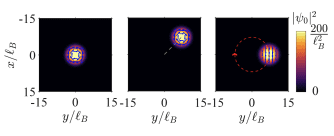
Experiments show that droplet arrays form dynamically from carefully engineered initial condensate phases, offering a practical route to generate and manipulate these arrays with precision. By controlling the initial conditions of the condensate, researchers can tailor the characteristics of the resulting droplet array, opening possibilities for advanced quantum simulations and information processing. This ability to manipulate the initial phase represents a powerful tool for investigating complex quantum phenomena and controlling the emergent behaviour of the system.
This research extends beyond mere observation of droplet formation, elucidating the mechanisms governing their stability and dynamic behaviour, and providing a comprehensive understanding of the droplet state in rapidly rotating BECs. By integrating theoretical proofs with numerical simulations, scientists have established a robust framework for predicting and controlling these quantum systems, potentially advancing quantum technology and broadening the scope of applications for these unique quantum systems. The combination of theoretical and experimental results provides a strong foundation for future investigations into the behaviour of quantum matter under extreme conditions.
👉 More information
🗞 Quantum droplets in rapidly rotating two-dimensional Bose-Einstein condensates
🧠 DOI: https://doi.org/10.48550/arXiv.2506.17081