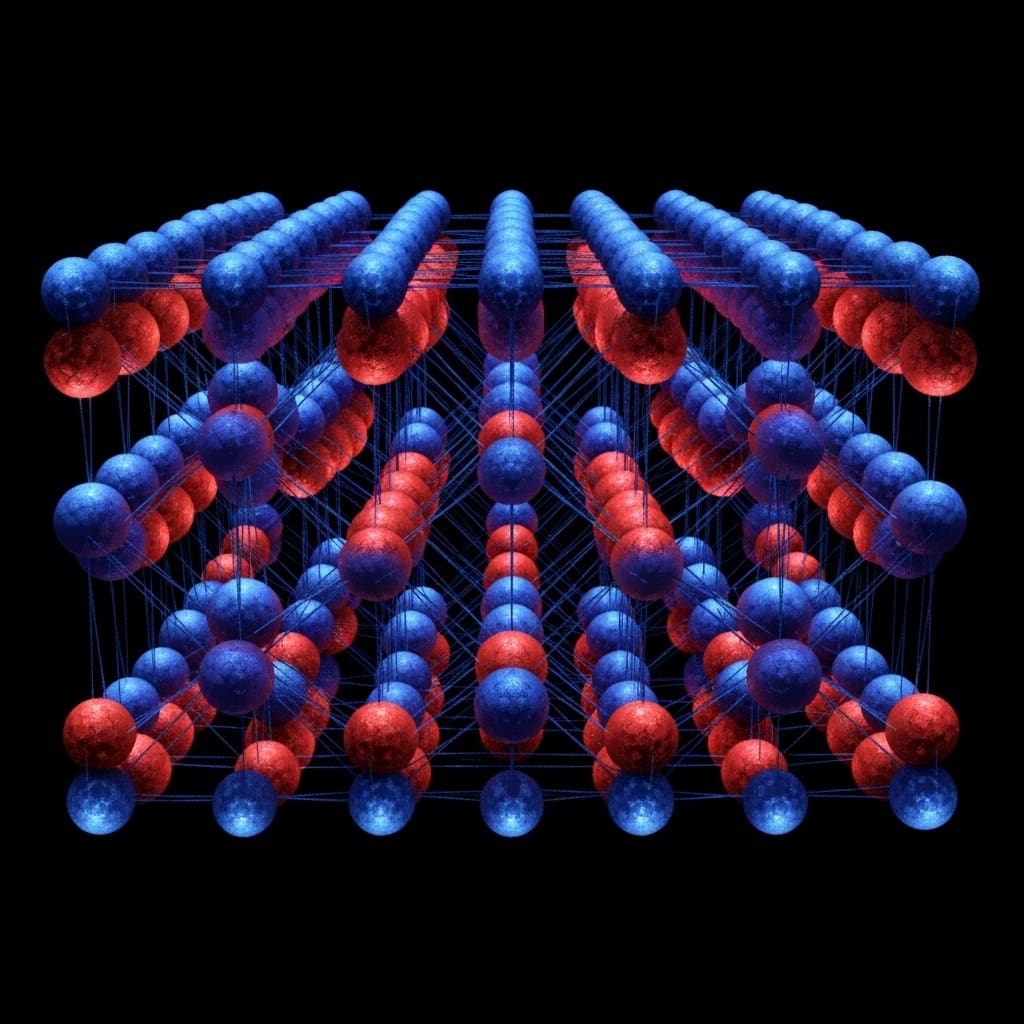
Researchers investigating the complex behaviour of magnetic materials have uncovered surprising similarities in the properties of two distinct pyrochlore magnets. Imre Hagymási from the Institute for Solid State Physics and Optics, Wigner Research Centre for Physics, Budapest, along with colleagues, detail in their recent work a robust half-magnetization plateau observed in both spin-1 and spin-3/2 pyrochlore Heisenberg antiferromagnets. This collaborative study, utilising large-scale density-matrix renormalization group calculations, reveals that the same underlying 16-site magnetic state governs the plateau phase in both systems, a finding that challenges predictions from simpler effective models. The work provides crucial nonperturbative insight into field-induced phases within these materials and offers valuable guidance for the design and understanding of future spin-1 and spin-3/2 magnetic compounds.
Magnetic materials now have a clearer pathway towards predictable behaviour at high fields. Calculations reveal that two distinct magnetic systems unexpectedly settle into the same stable arrangement. This discovery challenges existing theories and offers a new understanding of complex magnetic ordering in these materials. Scientists are employing advanced computational techniques to unravel the complex behaviour of frustrated quantum magnets.
These materials, where competing interactions prevent simple magnetic ordering, present a fertile ground for discovering novel quantum phenomena. Recent work focuses on pyrochlore Heisenberg antiferromagnets, characterised by a three-dimensional lattice of corner-sharing tetrahedra, and their response to external magnetic fields. Understanding these systems is challenging due to the extensive degeneracy of their ground states, even in classical models, and the emergence of unusual correlations like those observed in spin-ice materials.
Researchers have performed large-scale simulations revealing details of the magnetisation process in both spin-1 and spin-3/2 pyrochlore antiferromagnets. Predicting the behaviour of these quantum systems requires going beyond classical descriptions. A key question concerns the stability of half-magnetisation plateaus, where the material exhibits a constant magnetisation value over a range of applied magnetic fields.
These plateaus are often linked to specific ordered states, with one prominent theoretical model predicting a particular arrangement known as the “R” state. However, this prediction relies on a perturbative approach, which may break down when quantum fluctuations become dominant. To address this, scientists have turned to the density-matrix renormalisation group (DMRG), a numerical method capable of handling strongly correlated quantum systems.
Accurately simulating three-dimensional systems with DMRG requires substantial computational resources. Simulations were conducted with bond dimensions reaching 20,000, allowing for the investigation of clusters containing up to 128 sites. Both the spin-1 and spin-3/2 models exhibited a strong half-magnetisation plateau, indicating a stable state at intermediate magnetic fields.
Surprisingly, the simulations revealed that the favoured state on the largest clusters, those with 64 sites, is not the “R” state predicted by the perturbative analysis. Instead, both spin systems consistently selected a different ordered state, dubbed the “S” state, characterised by a 16-site magnetic unit cell. This finding demonstrates that the perturbative mechanism fails to accurately describe the Heisenberg limit, where quantum fluctuations are strong.
By establishing the nonperturbative selection of the half-plateau state, these results offer predictive guidance for experiments on real materials like NaCaNi2F7 and Cr-based spinels, which exhibit similar magnetic behaviour. The work provides a detailed characterisation of field-induced phases in pyrochlore magnets, opening avenues for designing materials with tailored magnetic properties.
Numerical simulations model magnetic ground states via optimised DMRG convergence
Large-scale density-matrix renormalization group (DMRG) calculations underpinned this work, a numerical technique employed to determine the ground states of strongly correlated quantum systems. These calculations were performed with bond dimensions reaching up to 20,000, allowing for accurate representation of quantum entanglement within the system. Explicit SU and U spin symmetries were incorporated into the DMRG to improve the efficiency and precision of the simulations.
Although DMRG is typically applied to one-dimensional systems, its successful adaptation to two- and three-dimensional frustrated magnets involved mapping the pyrochlore lattice onto a one-dimensional “snake path” for computation. Assessing the reliability of results from DMRG requires careful convergence testing. Researchers extrapolated variational energies to the error-free limit using the two-site variance as a convergence measure.
For each potential ordering pattern, independent simulations were initiated from several symmetry-related starting states, retaining only the lowest-energy extrapolation to ensure the most stable solution was identified. Periodic clusters of up to 128 sites were considered, providing a systematic way to examine finite-size effects and approach the thermodynamic limit.
Comparing competing low-energy states demanded a consistent approach. The magnetization curves were determined following a protocol established in previous work, allowing for direct comparison of results. For the cubic 32-site cluster, full magnetization curves were obtained for both spin-1 and spin-3/2 systems. Focusing on the internal ordering of the half-magnetization plateaus, the spin structure factor was computed at a bond dimension of 10,000, revealing line-like features indicative of dimensional reduction and broken rotational symmetry.
Examining cuts in the [hhl] and [hl0] planes of the spin structure factor revealed how the form of symmetry breaking depended on the cluster geometry. Additional simulation details and information regarding the periodic clusters are provided in the supplementary materials, ensuring transparency and reproducibility of the research.
Magnetization profiles and ground state selection within the half-magnetization plateau
At a bond dimension of 12,000, calculations reveal on-site magnetization values of approximately 0.88 and -0.64 for the majority and minority spins, respectively, when examining the spin-1 model. Correspondingly, the spin-3/2 model exhibits values of around 1.36 and -1.09 under identical conditions. These measurements, obtained for the “S” state on a 64-site cubic cluster, define the magnetic moment distribution within the half-magnetization plateau.
In particular, the “R” state displays in effect the same magnetization values for both spin configurations. Despite similarities in overall magnetization, simulations consistently selected the same 16-site state, a quadrupled unit cell, as the ground state for both spin-1 and spin-3/2 models across the largest 64-site cubic cluster investigated. Once calculations reached this cluster size, the “S” state became the preferred configuration, diverging from predictions based on effective dimer models.
By employing density-matrix renormalization group calculations with bond dimensions up to 20,000, the research definitively demonstrates a breakdown of perturbative mechanisms at the Heisenberg point. The study’s methodology involved examining periodic clusters containing up to 128 sites, allowing for a detailed characterisation of the field-induced phases.
Extrapolations using the two-site variance as a convergence measure ensured reliable energy comparisons between competing states. Independent runs were initiated from several symmetry-related starting states, retaining only the lowest-energy extrapolations to guarantee accuracy. Also, analysis of the half-magnetization plateau showed a clear preference for the “S” state, contrasting with the “R” state favoured by previous perturbative analyses.
At the Heisenberg limit, both spin-1 and spin-3/2 systems consistently favoured this distinct ordered plateau state, indicating a nonperturbative selection mechanism. Beyond simply identifying the preferred state, the work provides a detailed characterisation of the magnetic order within the plateau, establishing a foundation for understanding field-induced phases in pyrochlore magnets.
Density-matrix renormalization reveals unexpected magnetic order in pyrochlore antiferromagnets
Scientists studying complex magnetic materials have long struggled to predict how these systems will behave under strong external fields. For decades, theoretical models relied on simplifying assumptions, often leading to predictions that failed to match experimental observations. Detailed computational work using a technique called density-matrix renormalization offers a clearer picture of magnetism in a specific class of materials, pyrochlore antiferromagnets.
These materials, containing arrangements of magnetic atoms, exhibit unusual properties, including the potential for ‘half-magnetization plateaus’ where the material’s magnetism saturates at half its maximum value. Pinpointing the exact arrangement of magnetic moments within these plateaus proved remarkably difficult. Earlier approaches, based on approximating the interactions between atoms, consistently favoured one particular state, dubbed the ‘R’ state.
However, these new calculations demonstrate that this prediction is incorrect. Simulations consistently reveal a different, ‘S’ state as the favoured configuration, even when extending calculations to larger, more realistic system sizes. This discrepancy highlights the limitations of simplified models when dealing with strongly interacting quantum systems.
Interpreting these results requires careful consideration of computational constraints. While the simulations provide strong evidence for the ‘S’ state, achieving complete convergence in these complex calculations remains a challenge. Larger systems are modelled, the computational demands increase rapidly, limiting the ability to fully eliminate finite-size effects.
The observed symmetry lowering from cubic to orthorhombic in the favoured state raises questions about the role of subtle structural distortions and their impact on magnetic behaviour. This work represents a step forward in understanding the behaviour of quantum magnets. By providing a non-perturbative characterisation of these phases, researchers can better guide the design of new materials with tailored magnetic properties.
Future efforts might focus on exploring the effects of introducing imperfections or disorder into the pyrochlore lattice, or on extending these calculations to even more complex magnetic structures. In the end, a deeper understanding of these materials could unlock new technologies in data storage and spintronics.
👉 More information
🗞 A Tale of Two Plateaus: Competing Orders in Spin-1 and Spin-\tfrac{3}{2}\tfrac{3}{2} Pyrochlore Magnets
🧠 ArXiv: https://arxiv.org/abs/2602.16661