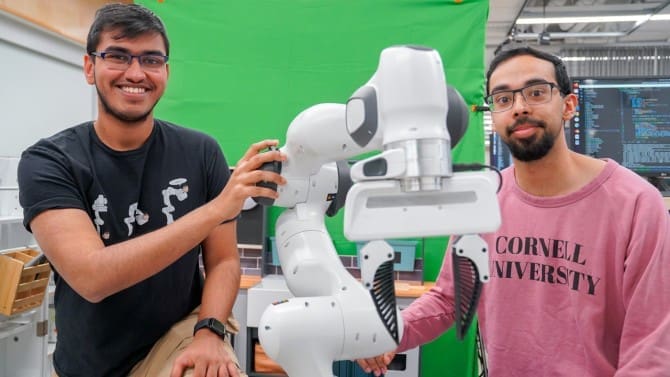
Cornell University researchers have developed a robotic framework called RHyME (Retrieval for Hybrid Imitation under Mismatched Execution), enabling robots to learn tasks by observing single how-to videos. This innovation addresses the challenge of teaching robots with extensive data and precise instructions by allowing them to adapt from human demonstrations, significantly reducing training time and resources. RHyME requires only 30 minutes of robot data and has demonstrated over a 50% increase in task success compared to previous methods. Kushal Kedia, a doctoral student, will present this research at the IEEE International Conference on Robotics and Automation in Atlanta, highlighting its potential to advance robotics efficiency and adaptability.
The RHyME (Retrieval for Hybrid Imitation under Mismatched Execution) framework represents a significant advancement in robot imitation learning. Developed by researchers at Cornell University, this system enables robots to learn tasks by observing a single how-to video, marking a departure from traditional methods that require extensive step-by-step instructions and large amounts of data.
Historically, robots have struggled with adaptability, often halting operations when faced with unexpected disruptions such as losing a tool or encountering an unforeseen obstacle. RHyME addresses these limitations by allowing robots to draw upon their memory banks of video demonstrations to perform tasks they have only observed once. This capability significantly reduces the time and resources needed for training, making robotic systems more efficient and practical.
The framework works by translating human actions into robot-compatible movements, effectively bridging the gap between fluid human motion and precise robotic execution. By leveraging existing video data, RHyME enables robots to perform multi-step tasks with a marked increase in success rates compared to previous methods. For instance, robots trained using RHyME achieved over 50% higher task success rates in lab settings, while requiring only 30 minutes of robot training data.
The scalability of RHyME contributes to its potential in advancing robotic systems capable of performing diverse tasks with greater autonomy. By addressing challenges such as human-robot motion mismatches and reducing training complexity, RHyME represents a significant step toward developing more efficient and adaptable robotic learning systems.
The translation of human actions into robot-compatible movements remains a critical challenge in robotics. Human demonstrations often involve motions that differ significantly from those required by robots due to differences in anatomy or task requirements. This mismatch can lead to suboptimal performance if not properly addressed during the learning process.
Additionally, traditional robotic learning methods often require hours of flawless video demonstrations to achieve reliable performance. This extensive training requirement can be a barrier to practical implementation, particularly in dynamic environments where conditions may change frequently.
RHyME addresses these challenges by employing advanced algorithms that retrieve and adapt relevant portions of existing demonstration data. The framework breaks down human demonstrations into modular components, which are then recombined to suit the specific requirements of the task at hand. This approach allows robots to learn efficiently from a limited amount of training data while maintaining flexibility in adapting to new situations.
The RHyME framework significantly enhances the feasibility of implementing robots in domestic settings by minimizing the need for extensive training data. This innovation allows robots to learn tasks efficiently from a single video demonstration, translating human actions into precise robotic movements. Such capability is particularly advantageous for home use, where tasks like cleaning and cooking require adaptability without the necessity for flawless demonstrations.
In practical terms, RHyME enables robots to assist with everyday chores, offering support in areas such as meal preparation or household maintenance. This adaptability makes it easier to integrate robots into daily life, as they can perform a variety of tasks without requiring professional setups or extensive training sessions.
The implications of RHyME extend to improving accessibility for individuals who may benefit from robotic assistance at home, such as the elderly. By reducing the complexity of setup and operation, these robots can seamlessly integrate into domestic environments, providing essential support with minimal intervention. This advancement underscores the potential for robots to become integral tools in enhancing quality of life through practical, efficient home automation.
More information
External Link: Click Here For More