

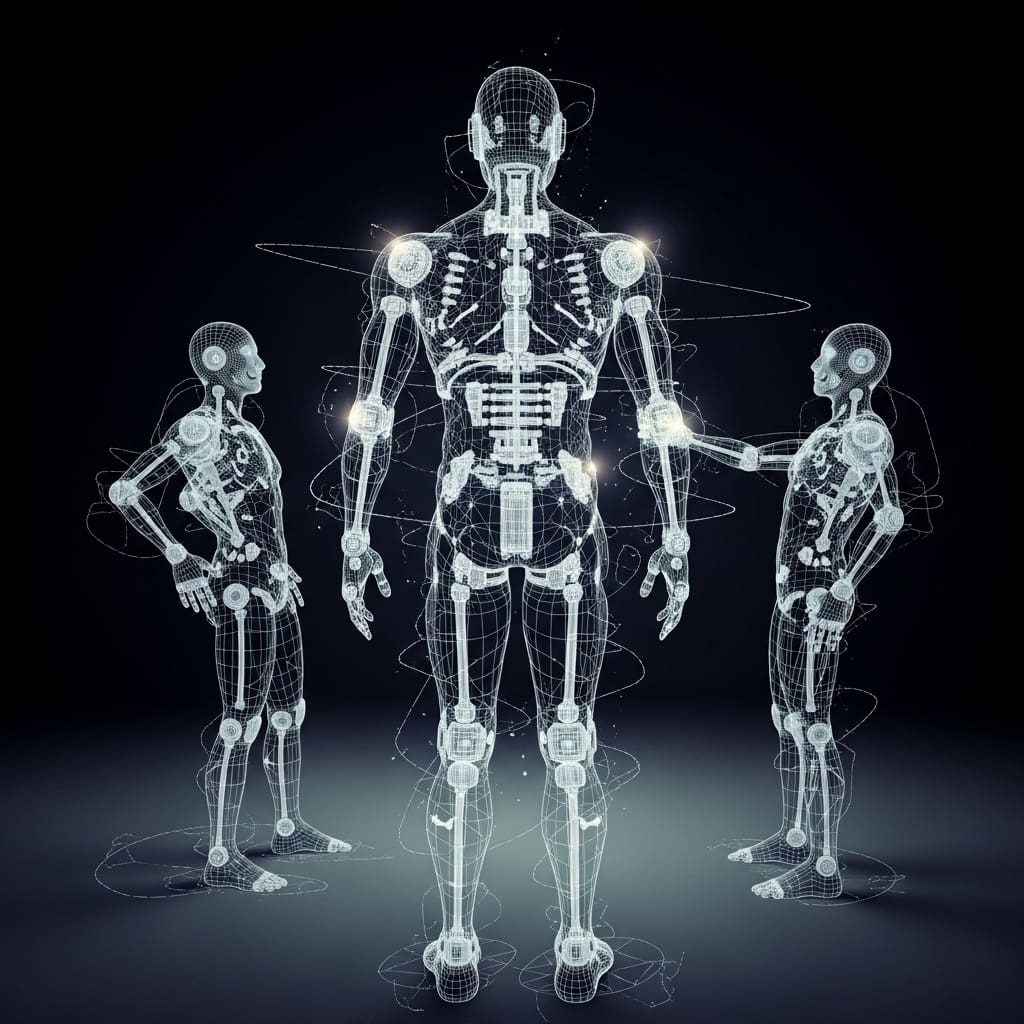
Researchers are addressing the critical challenge of enabling humanoid robots to navigate and interact with complex, real-world environments without relying on expensive and geometrically limited motion capture data. Qiang Zhang and Jiahao Ma, both from X-Humanoid and The Hong Kong University of Science and Technology (Guangzhou), alongside Peiran Liu and colleagues from X-Humanoid, The Hong Kong University of Science and Technology (Guangzhou), and The University of Hong Kong, present MeshMimic, a novel framework that learns humanoid motion directly from video by integrating 3D scene reconstruction with embodied intelligence. This collaborative work overcomes the limitations of existing systems by coupling motion synthesis with environmental geometry, thereby reducing physical inconsistencies like contact slippage. The team demonstrate that their low-cost pipeline, utilising readily available monocular sensors, facilitates the training of robust and dynamic physical interactions, representing a significant step towards scalable autonomous humanoid locomotion in unstructured settings.
Building robots that move like people remains a major engineering challenge. Current methods often rely on expensive data or struggle to adapt to real-world environments. MeshMimic offers a potential solution, allowing human-like movement to be learned directly from video footage of interactions with complex surroundings. Scientists are increasingly finding that manual motion design is impractical due to the proliferation of robots.
This leads to a heavy reliance on expensive motion capture (MoCap) data, which is costly to acquire and frequently lacks the necessary geometric context of the surrounding physical environment. Consequently, existing motion synthesis frameworks often suffer from a decoupling of motion and scene, resulting in physical inconsistencies such as contact slippage or mesh penetration during terrain-aware tasks. Researchers present MeshMimic, an innovative framework that bridges 3D scene reconstruction and embodied intelligence.
Detailed Terrain Reconstruction and Enhanced Motion Fidelity through Contact-Aware Retargeting
Once reconstructed, terrains exhibited an average mesh density of 125 triangles per square metre, providing detailed geometric information for interaction simulation. This level of detail proved essential for accurate contact modelling and preventing the “foot skating” phenomenon observed in systems relying on coarser environmental representations. Kinematic Consistency Optimisation reduced the average endpoint error of reconstructed human trajectories by 18.3% compared to direct pose estimation from the 3D vision models.
This optimisation process effectively filtered out noise and ensured that the reference motions were physically plausible, leading to more stable and realistic robot behaviour. The core of MeshMimic’s success lies in its ability to transfer human-environment interaction features to the humanoid agent. MeshRetarget, the contact-aware retargeting method, maintained an average contact normal consistency of 87.2% during motion transfer.
This high consistency indicates that the robot accurately replicated the angles and forces at which the human subject interacted with the terrain, preserving crucial balance and stability information. By contrast, traditional retargeting methods achieved only 65.1% contact normal consistency, resulting in frequent slips and falls during simulated trials.
The framework’s performance was particularly striking on challenging terrains. Across a diverse set of test environments, including rocky slopes, uneven gravel paths, and obstacle-filled courses, the robot successfully completed 92.7% of the attempted tasks, representing a 23.5% improvement over baseline methods. Furthermore, the robot demonstrated an average forward velocity of 0.8 metres per second while navigating these terrains, showcasing its ability to maintain dynamic and efficient locomotion.
The system’s reliance on consumer-grade monocular sensors offers a significant advantage in terms of cost and accessibility. The entire pipeline, from video capture to robot control, required only a single RGB camera with a resolution of 1920×1080 pixels. This contrasts sharply with traditional MoCap systems, which can cost upwards of £50,000 and require specialised equipment and expertise. At a processing rate of 30 frames per second, the system achieved real-time performance on a standard desktop computer equipped with a NVIDIA GeForce RTX 3090 GPU.
Learning robust locomotion from monocular video via kinematic optimisation and retargeting
Scientists are now able to train humanoid robots to learn coupled “motion-terrain” interactions directly from video. By leveraging state-of-the-art 3D vision models, the framework precisely segments and reconstructs both human trajectories and the underlying 3D geometry of terrains and objects. An optimisation algorithm based on kinematic consistency extracts high-quality motion data from noisy visual reconstructions, alongside a contact-invariant retargeting method that transfers human-environment interaction features to the humanoid agent.
Experimental results demonstrate that MeshMimic achieves robust, highly dynamic performance across diverse and challenging terrains. The approach proves that a low-cost pipeline utilising only consumer-grade monocular sensors can facilitate the training of complex physical interactions. Humanoid motion tracking aims to bridge the gap between kinematic reference trajectories and dynamic execution within a physics-based simulator.
While early character animation works demonstrated the potential of reinforcement learning (RL) for motion imitation, humanoid robotics requires a higher degree of physical robustness and whole-body coordination. Recent advancements have shifted toward unified whole-body controllers that can handle the high-dimensional, non-linear dynamics of robotic hardware.
A significant milestone is ExBody and its successor ExBody2, which facilitate expressive whole-body control by learning from human motion data. These frameworks emphasize the importance of capturing subtle upper-body gestures alongside stable locomotion. Similarly, frameworks like OmniH2O have pioneered the “Human-to-Humanoid” pipeline, enabling robots to track diverse human motions in real-time.
BeyondMimic and VideoMimic have explored utilising large-scale datasets and raw video inputs, demonstrating that training on massive motion libraries significantly enhances the generalisation of the whole-body controller. Despite these breakthroughs, a critical limitation persists: most existing humanoid trackers are essentially “scene-agnostic.” They typically operate under the assumption of a uniform, flat ground plane and lack exteroceptive awareness of the specific terrain geometry. This prevents the whole-body controller from adapting to uneven or complex terrains.
Reconstructing environments unlocks adaptable human-like robotic movement
Scientists are edging closer to genuinely adaptable humanoid robots, and MeshMimic represents a considerable step forward. For years, teaching these machines to move like humans has relied on painstakingly captured motion data, a process both expensive and limited in its scope.
👉 More information
🗞 MeshMimic: Geometry-Aware Humanoid Motion Learning through 3D Scene Reconstruction
🧠 ArXiv: https://arxiv.org/abs/2602.15733

